
Web Meeting
This tutorial is more for fun and to check how much I can integrate Amari Callbox to my daily life working environment. This test is not much of technical details of cellular protocol. It was more to show a case where Amarisoft callbox is integrated with internet environment and you can get access to the callbox in more natural distance (i.e, not right in front of the box). You may take this as a kind of your personal atto deployment(smaller than femto). This setup demonstrate a case that would not easily been done by other lab test equipment highlighted as below
- Wider Coverage : Even though the coverage is not as wide as in real deployment, Amarisoft callbox would provide much wider coverage than other lab test equipment. Usually you may lose connection from other lab test equipment if you move the DUT just a meter away from the equipment antenna. This test is done by the default hardware without using any external amplifier.
- Multiple UE connection : Most of lab test equipment is designed for single UE test (i.e, it can establish the connection with only one UE). But Amarisoft callbox support multiple UEs (several hundreds of UEs) as in live deployment.
Table of Contents
Introduction
The Amarisoft Callbox represents a versatile and powerful software-defined radio (SDR) platform designed for 4G/5G cellular network research, development, and testing. Leveraging a high degree of configurability, the Callbox provides a fully functional cellular network-in-a-box, integrating core network, radio access network, and radio interface functionalities within a compact and portable system. Architecturally, the Callbox emulates both eNodeB/gNodeB and EPC/5GC components, enabling end-to-end connectivity and facilitating robust test environments for various wireless scenarios. It supports multiple simultaneous User Equipments (UEs), higher-layer protocol emulation, and real-time traffic generation, all managed through a flexible software interface accessible over standard IP networks. In the broader telecommunications ecosystem, the Amarisoft Callbox accelerates prototyping, interoperability testing, and feature validation, bridging the gap between conceptual research and deployment-ready solutions. Its capability to operate in standalone or connected modes, handle wide bandwidths, and provide rich telemetry makes it a preferred tool for engineers seeking practical and scalable approaches to network experimentation. By integrating with existing internet environments and supporting remote access, the Callbox offers unique opportunities to simulate real-world deployments, extend coverage beyond traditional lab setups, and experiment with new cellular use cases in a controlled, reproducible manner.
-
Context and Technology Overview
- Amarisoft Callbox: A software-based cellular network emulator supporting 4G LTE and 5G NR protocols, designed to facilitate R&D, feature testing, and network validation.
- Architectural Highlights: Integrates core, radio access, and radio interface layers within a unified platform; supports multiple UEs and real-time network management.
- Integration Capabilities: Enables remote access and internet integration, extending network reach and usability beyond the immediate physical vicinity.
-
Relevance and Importance of This Tutorial
- Demonstrates practical use of Amarisoft Callbox in a non-traditional, remotely accessible setup.
- Highlights unique advantages such as wider coverage and support for multiple UEs, surpassing typical lab test equipment limitations.
- Provides insights into deploying a personal atto-cell environment for experimentation and daily workflow integration.
-
Learning Outcomes
- Understand how to integrate Amarisoft Callbox with internet-connected environments for enhanced accessibility and flexibility.
- Gain practical knowledge of configuring and managing the Callbox to support multiple UEs and wider coverage scenarios.
- Acquire skills applicable to both lab-based and field-testing contexts, leveraging advanced SDR capabilities.
-
Prerequisite Knowledge and Skills
- Familiarity with cellular network concepts (4G/5G architecture, UE, RAN, Core Network).
- Basic understanding of SDR platforms and network emulation principles.
- Experience with IP networking and remote system access is beneficial for maximizing tutorial value.
Summary of the Tutorial
This tutorial outlines test procedures for verifying internet connectivity and web meeting participation using cellular-connected UEs and an Amarisoft Callbox system. The summary below details each step, organized as per the stages in the original content.
-
Test Setup
- Use the SIM card supplied with the system unless reconfiguration is required.
- Physically separate the Callbox and DUTs by a wall (~3m apart) to simulate realistic wireless conditions.
- Provide internet access to the Callbox using one of several methods; in this tutorial, Case 4 is used.
- If using Case 2 or 3 for internet, enable WiFi via command line on the Callbox's Linux OS using nmcli commands:
-
# nmcli dev status
# nmcli radio wifi
# nmcli device wifi rescan
# nmcli dev wifi list
# nmcli dev wifi connect network-ssid password "network-password"
-
-
Configuration
- Ensure the configuration assigns at least one IP to each UE via an internet APN. Acceptable configurations include LTE attach, SA, or NSA modes.
-
Pre-Connection Check-Up
- Verify all necessary network interfaces (including tun0, tun1, tun2, tun3) are up on the Callbox.
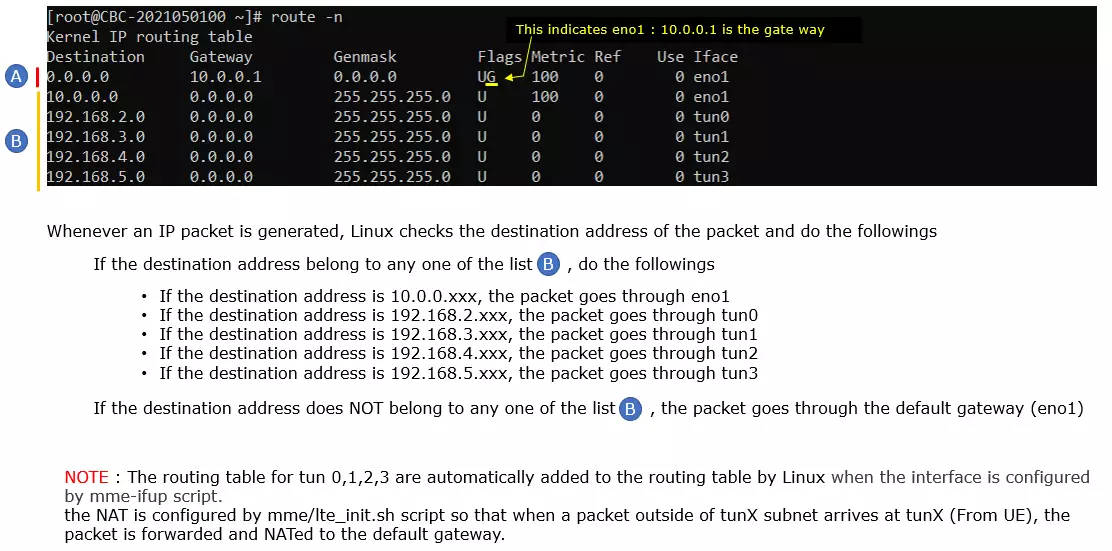
- Check the routing table to confirm proper configuration and presence of tunnel interfaces.
- Test internet connectivity from the Callbox by:
- Pinging an external IP (e.g., 8.8.8.8) to check for basic internet access.
- Pinging a URL to verify DNS resolution is functional.
- Optionally, resolve a URL to its IP and ping both the domain and its IP address to check consistency.
-
Initial Attach and Verification Before Internet Connection
- Turn off WiFi on UEs to ensure internet access occurs only via cellular network.
- Perform initial attach procedure to connect each UE to the Callbox.
- Confirm that each UE is successfully attached and assigned an IP address.
-
Web Meeting Participation Test
- Set up a web meeting session (e.g., Zoom).
- Join the session with:
- Two UEs connected via the Amarisoft Callbox's cellular network
- One laptop connected over WiFi
The procedures in this tutorial emphasize stepwise verification of network connectivity and demonstrate the use of the Callbox system for realistic wireless and internet-access scenarios, culminating in successful participation in a web meeting from multiple devices.
Test Setup
Test setup for this tutorial is as shown below.
- SIM Card used in this tutorial is the one delivered with the system as it is.
- If you want to change the configuration, The tutorial Configuration Guide would help
Following shows the location of the Callbox and the DUTs. Callbox and DUTs are in different rooms separated by a wall at a distance of about 3 m. (NOTE : Usually other test equipment does not provide stable connectivity in this kind of situation)

The wireless connectivity among Callbox and all the DUTs used in this tutorial is as shown below.

There are several many ways to provide internet access to your CallBox. Followings are some of them I can think of. In this tutorial, I used the Case 4.
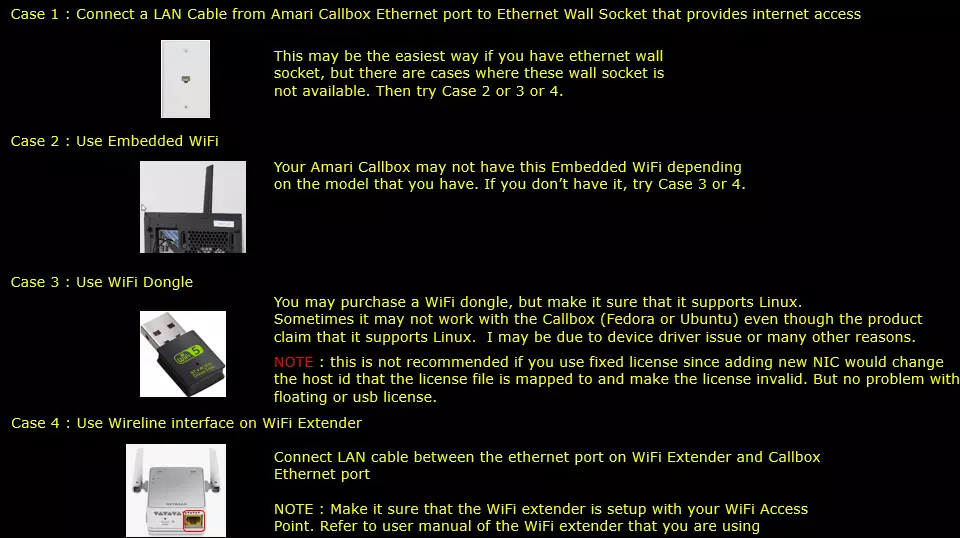
If you decided to use Case 2 and Case 3, following tips would be helpful.
Since Amari Callbox is running command line mode of Linux (Fedora or Ubuntu) NOT on GUI , it is not straightforward to enable / connect WiFi.
Followings are some of the command line command you would need to get WiFi connectivity. You may search these commands on internet for the detailed usage.
# nmcli dev status
# nmcli radio wifi
# nmcli device wifi rescan
# nmcli dev wifi list
# nmcli dev wifi connect network-ssid password "network-password"
Configuration
You can use any configuration that will assign at least one IP to UE with internet apn. For example, you can use LTE attach configuration or SA or NSA configuration.
Check Up before trying UE connection
Before you trying internet connection with UE, you need to check several basic things shown in this section and make it sure everything works as shown here, otherwise Internet connection from UE may not work.
Make it sure that the network interface with internet connectivity is up and tun0,1,2,3 are up.
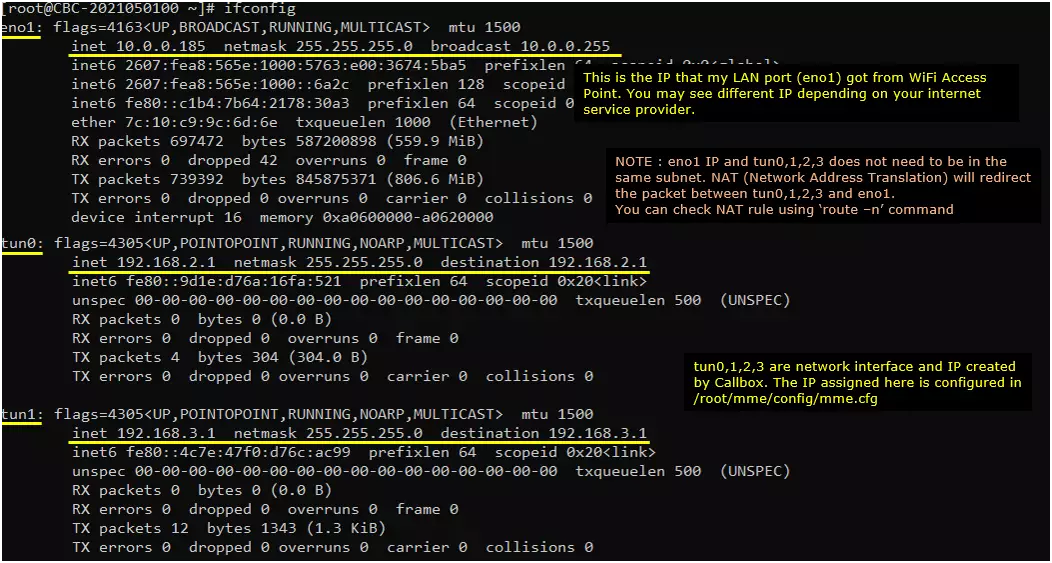
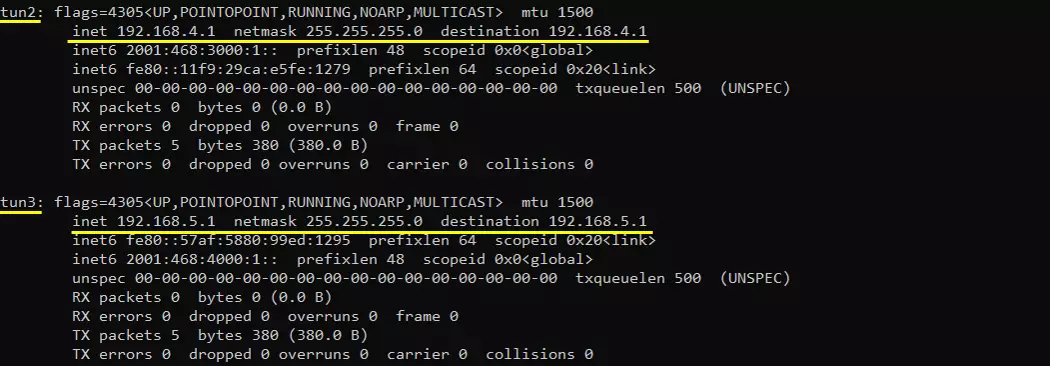
Check up the routing table on CallBox PC. It would usually be as follows. (NOTE : The gateway Iface name may be different on your system depending on your system configuration. But you should see tun0, tun1, tun2, tun3 as shown below)
Make it sure that the call box can reach a server over the internet. I am checking the connectivity as follows
Try ping to 8.8.8.8. This is google DNS and this is configured as DNS by default in mme.cfg. If ping goes through, it mean that your callbox got access to external network (internet)

Try ping to a url to check the DNS is working

[Optional] you may find the IP address to a specific url and try ping to the server with both in direct IP and url

Initial Attach and Check up before Internet Connection
The purpose of this test is to get UE connected to internet via cellular network (not WiFi). To prevent the UE from getting access to internet via WiFi, it would be safe to turn off WiFi.
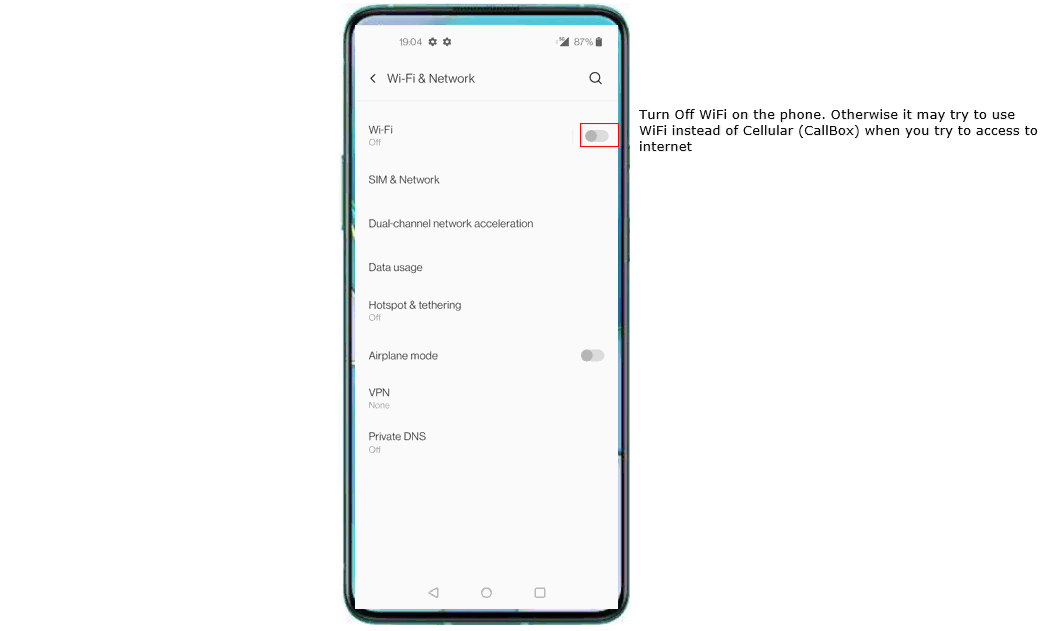
Do the initial attach and confirm that UE is connected to Callbox. Confirm that both UE gets attached.

Confirm that both UEs are assigned with an IP.

Join the meeting from all the DUT
I setup a Web Meeting session (e.g, a Zoom session) and got three devices joining the meeting. I got 2 UEs joining the meeting over Cellular Network on Amarisoft Callbox and got a laptop joining the session over WiFi.
