
LTE Measurement Report
This tutorial shows how to test Measurement Report in LTE. You can configure the measurement report configuration either by meas_config_desc parameter or asn file. This tutorial shows you the both ways.
Measurement on UE side happens both in Idle and Connected mode described as below. This tutorial is for the measurement in Connected mode only.
- Idle Mode Measurement : This happens mainly before cell selection (e.g, on Power on or during Out Of Coverage) and after RrcConnectionRelease for neighbour cell monitoring or cell reselection. The most important measurement items in this case are RSRP and RSRQ. The measurement done in this situation is used only for internal decision making and does not get reported to network.
- Connected Mode Measurement : This happens in various situation and the detailed lower layer measurement is up to modem implmentation (i.e, varies dependings on modem) but the measurement should happen when the measurement report is configured in RRC message (e.g, RrcConnectionReconfiguration). This RRC based measurement is usually performed by various triggers. The list of these triggers has gotten longer as LTE evolves. Some of the typical trigger is illustrated as below.
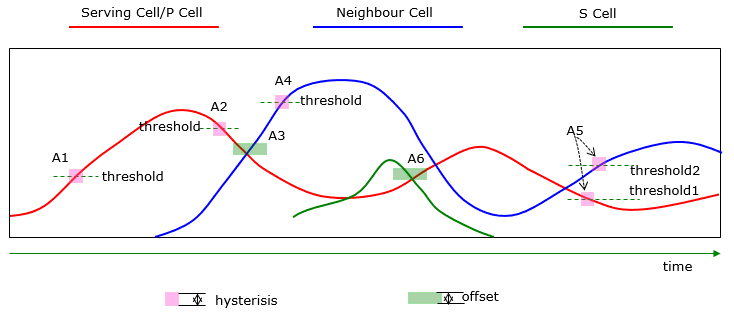
Image Source : Sharetechnote
Table of Contents
- LTE Measurement Report
- Introduction
- Summary of the Tutorial
- Test Setup
- Key Configuration Parameters
- Test 1 : LTE to LTE, IntraFrequency with meas_config_desc
- Test 2 : LTE to LTE, InterFrequency with meas_config_desc
- Test 3 : LTE to LTE, IntraFrequency Periodic Report with meas_config (ASN.1 file)
- Test 4 : LTE to LTE, IntraFrequency Event A3 with meas_config (ASN.1 file)
- Test 5 : LTE to LTE, InterFrequency CGI Report with meas_config (ASN.1 file)
- RRC / NAS Signaling
Introduction
Long Term Evolution (LTE) is a key wireless communication standard that enables high-speed data transmission for mobile devices and forms the backbone of modern cellular networks. A critical component of LTE's robust performance and mobility management is the measurement reporting mechanism, which allows User Equipment (UE) to evaluate and communicate radio conditions to the network. Measurement reports are central to functions such as handover, cell reselection, and interference management, ensuring seamless connectivity and optimal resource allocation. Measurement configuration and reporting in LTE are orchestrated primarily via Radio Resource Control (RRC) signaling in the Connected mode, where the network dynamically instructs UEs to monitor and report specific radio parameters—such as Reference Signal Received Power (RSRP) and Reference Signal Received Quality (RSRQ)—based on various triggers or events. These configurations can be managed through parameterized descriptions (meas_config_desc) or ASN.1-based files, depending on system requirements and test scenarios. Understanding and testing the measurement reporting process is essential for validating UE behavior, optimizing network performance, and ensuring compliance with 3GPP specifications. This tutorial provides comprehensive guidance on configuring and testing LTE measurement reports in Connected mode, emphasizing both practical setup and the underlying architectural context within the LTE ecosystem.
-
Context and Background
- Measurement reporting in LTE is integral to network-controlled mobility, interference detection, and dynamic resource management.
- UEs perform measurements in both Idle and Connected modes, but only Connected mode measurements are reported to the network for operational decision-making.
- Measurement reports are configured and triggered via RRC signaling, which instructs the UE on when and what to measure.
- Key measurement metrics include RSRP and RSRQ, which provide insights into signal strength and quality from serving and neighboring cells.
-
Relevance and Importance of the Tutorial
- Accurate measurement reporting is crucial for ensuring reliable handovers, maintaining service quality, and optimizing network throughput.
- This tutorial addresses both the configuration of measurement reporting (using meas_config_desc parameters or ASN.1 files) and the validation of the reporting process in a controlled test environment.
- It empowers engineers, testers, and researchers to understand and validate UE measurement behavior, contributing to network robustness and compliance.
-
Learning Outcomes
- Comprehend the architectural role of measurement reporting within the LTE protocol stack.
- Gain hands-on experience in configuring measurement reports using different approaches (parameter-based and ASN.1-based).
- Understand the typical triggers and scenarios for measurement reporting in Connected mode.
- Be able to analyze, troubleshoot, and validate the measurement reporting process for varied test cases.
-
Prerequisite Knowledge and Skills
- Familiarity with LTE network architecture and protocol layers (especially RRC and PHY).
- Basic understanding of radio measurements (RSRP, RSRQ) and their significance.
- Experience with network testing tools, UE configuration, and interpreting protocol signaling flows.
- Knowledge of ASN.1 encoding and configuration files is beneficial for advanced configuration scenarios.
Summary of the Tutorial
This tutorial provides detailed step-by-step procedures for configuring and verifying various LTE intra- and inter-frequency measurement scenarios using Amarisoft tools. Each test demonstrates specific use cases, configuration steps, and log analysis for measurement reporting, with focus on both configuration file tweaks and practical execution. The procedures preserve original formatting, indentation, and content structure as provided in the source.
-
Test 1: LTE to LTE, IntraFrequency with meas_config_desc
- Modify enb-2cell-meas-intra.cfg based on enb-2cell-ho.cfg and use mme-ims.cfg as is.
- Configure both eNB cells, adding each as a neighbor in the other's ncell_list.
- Set measurement criteria in meas_config_desc parameter; only relevant events are applied to the RRC message.
- Start LTE service, verify cell configuration using cell phy and cell commands.
- Adjust cell power using cell gain (recommended) or tx_gain.
- Power on UE and let it attach to the cell.
- Check cell gain value as needed with the cell command.
- Log analysis involves verifying the configuration of measurement objects and ensuring the UE provides measResultNeighCells in its report when the trigger condition is met.
-
Test 2: LTE to LTE, InterFrequency with meas_config_desc
- Modify enb-2cell-meas-inter.cfg based on enb-2cell-ho.cfg and use mme-ims.cfg unchanged.
- Configure neighbor cells in each other's ncell_list as in Test 1.
- Set measurement criteria with meas_config_desc.
- Start LTE service, verify cell configuration, and adjust cell power using cell gain or tx_gain.
- Power on UE, let it attach, and adjust cell power to trigger measurement report.
- Log analysis steps:
- Verify measurement object and report configuration during attach.
- Check measurement reports; if measurement gap is not enabled, only serving cell measurements appear.
- When serving and target cell power conditions are met, measurement gap is enabled and neighbor cell results appear in the report.
-
Test 3: LTE to LTE, IntraFrequency Periodic Report with meas_config (ASN.1 file)
- Modify enb-2cell-meas-intra-asn-periodic.cfg and use mme-ims.cfg as is.
- Remove ncell_list to avoid conflicts between ASN configuration and automatic callbox setup.
- Set meas_config parameter to reference the intended ASN.1 file (meas_config_periodic.asn).
- Start LTE service, check cell configuration, adjust power (cell gain), attach UE, and adjust power to trigger periodic measurement reports.
- Log analysis:
- Verify configuration during attach.
- UE sends reports with only serving cell when the trigger condition isn't met.
- When the power condition is right, UE sends reports with both serving and neighbor cells (measResultNeighCells).
-
Test 4: LTE to LTE, IntraFrequency Event A3 with meas_config (ASN.1 file)
- Modify enb-2cell-meas-intra-asn-a3.cfg and use mme-ims.cfg.
- Remove ncell_list to prevent collision with ASN configuration.
- Reference ASN.1 file (meas_config_a3.asn) for Event A3 measurement configuration.
- Start LTE service, check configuration, adjust power, attach UE, and adjust cell power to trigger Event A3 report.
- Log analysis:
- Verify measurement configuration during attach.
- Upon trigger, UE sends measurement report including neighbor cell results.
-
Test 5: LTE to LTE, InterFrequency CGI Report with meas_config (ASN.1 file)
- Modify enb-2cell-meas-inter-asn-cgi.cfg and use mme-ims.cfg.
- Remove ncell_list to avoid ASN/automatic config collision.
- Reference ASN.1 file (meas_config_L_L_inter_cgi.asn) for CGI reporting configuration.
- Start LTE service, verify basic cell configuration, adjust cell power, attach UE.
- Log analysis:
- Verify measurement report configuration during attach.
- Check that the UE sends measResultNeighCells with cgi-Info.
General Notes for All Tests:
- Always check and verify cell and neighbor cell configuration using the appropriate commands and configuration files.
- Adjust cell power carefully to ensure trigger conditions for measurement reports are met, using cell gain rather than tx_gain to avoid unexpected behavior.
- For ASN.1-based configurations, ensure the referenced ASN.1 files match your test requirements and use the ASN1 Editor GUI if needed.
- Log analysis is critical to confirm the correct setup of measurement objects, report configurations, and that the UE responds with the expected measurement results under the correct conditions.
Test Setup
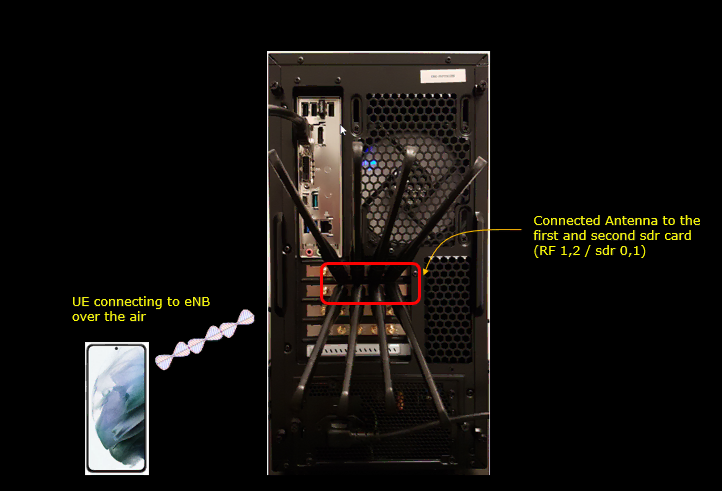
Test setup for this tutorial is as shown below.
- SIM Card used in this tutorial is the one delivered with the system as it is.
- If you want to change the configuration, The tutorial Configuration Guide would help
Key Configuration Parameters
Followings are important configuration parameters for this tutorial. You may click on the items for the descriptions from Amarisoft documents.
- ncell_list : In this link, you would get the descriptions for all the items listed below
- rat
- cell_id
- meas_config
- meas_config_desc : In this link, you would get the descriptions for all the items listed below
- a1_report_type
- a1_rsrp
- a1_hysteresis
- a1_time_to_trigger
- a2_report_type
- a2_hysteresis
- a2_time_to_trigger
- a3_report_type
- a3_offset
- a3_hysteresis
- a3_time_to_trigger
- rsrp_filter_coeff
- nr_b1_report_type
- nr_b1_rsrp
- nr_b1_hysteresis
- nr_b1_time_to_trigger
- nr_rsrp_filter_coeff
- meas_gap_config
Test 1 : LTE to LTE, IntraFrequency with meas_config_desc
This test shows how to configure Intra frequency measurement for an LTE cell to measure another LTE cell and verify it.
Configuration
I used the enb-2cell-meas-intra.cfg which is copied and modified from enb-2cell-ho.cfg.

I also used mme-ims.cfg as it is.

Configure enb-2cell-meas-intra.cfg as below.
This example sets the basic LTE cell configuration for an intra-frequency measurement test. The configuration uses two cells, and both cells are configured as FDD cells with 5 MHz downlink bandwidth.
N_CELL is set to 2. This means the eNB will run two LTE cells. This value should not be changed because it is used by config.cfg. In this tutorial, these two cells are used to create a serving cell and a neighbor cell for RRC measurement.
TDD is set to 0. This means the cell operates in FDD mode. In this mode, downlink and uplink use separate frequency bands.
N_RB_DL is set to 25. This means the LTE downlink bandwidth is 5 MHz. The comment shows the possible values, such as 6 for 1.4 MHz, 15 for 3 MHz, 25 for 5 MHz, 50 for 10 MHz, 75 for 15 MHz, and 100 for 20 MHz.
N_ANTENNA_DL is set to 1. This means the downlink transmission uses one antenna port. For this measurement tutorial, single antenna operation is enough because the main focus is not MIMO performance but RRC measurement and reporting behavior.
N_ANTENNA_UL is also set to 1. This means the uplink side also uses one antenna.
CHANNEL_SIM is set to 0. This means the channel simulator is disabled. With this setting, the test starts from a simple and stable radio condition. This makes it easier to observe the basic RRC measurement configuration and measurement report behavior.
N_ENB is set to 0. The comment says this value is used for ng-eNB. Since this tutorial is focused on LTE eNB measurement, this value remains 0.

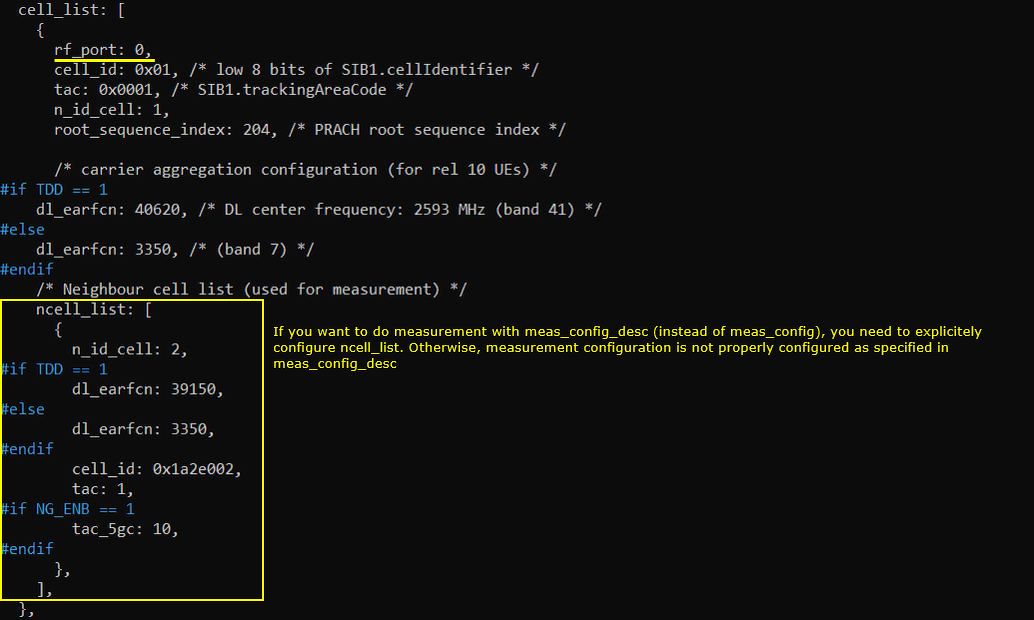
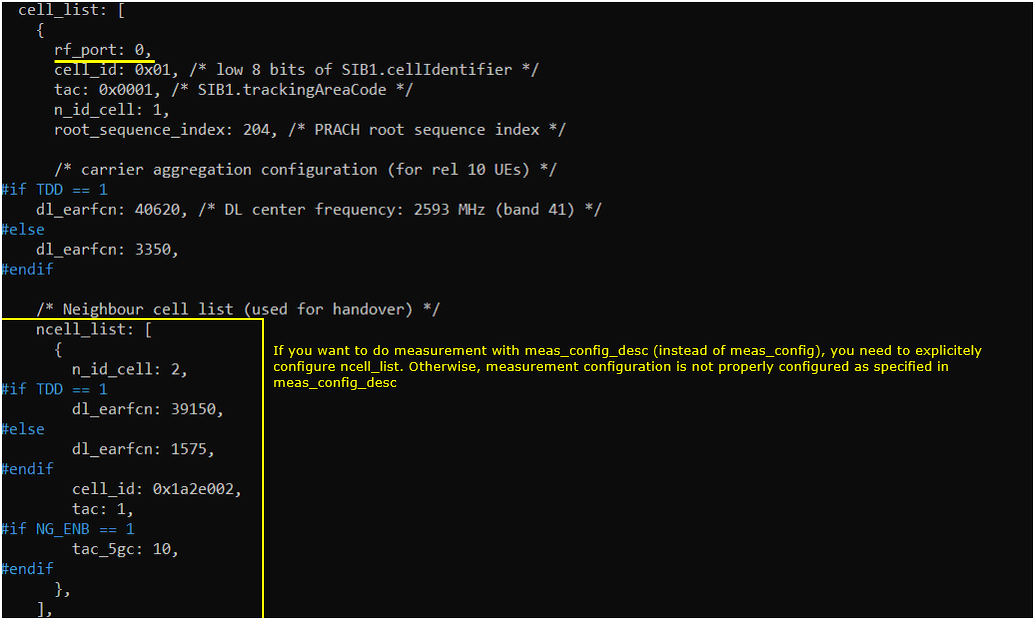
Add the second cell, which is the measurement target cell, into the neighbour cell list of the first cell, which is the camping cell.
In this example, the first cell is configured as the serving cell where the UE camps. The second cell is added under ncell_list so that the first cell knows this cell as a neighbour cell for measurement. This is important because RRC measurement configuration usually does not work only by defining two cells. The serving cell should also have proper neighbour cell information so that the eNB can generate a valid measurement configuration for the UE.
The neighbour cell entry uses n_id_cell set to 2. This identifies the physical cell ID of the neighbour cell. In this test, this is the second LTE cell and it becomes the target cell that the UE will measure.
For FDD operation, dl_earfcn is set to 3350. This is the same downlink EARFCN as the serving cell, so this configuration is for intra-frequency measurement. The UE measures another cell on the same LTE carrier frequency.
The neighbour cell has cell_id set to 0x1a2e002 and tac set to 1. These values identify the neighbour cell at the system information level. The cell_id is used as the E-UTRAN cell identity, and tac is the tracking area code.
The note in the example is important. If you want to do measurement using meas_config_desc instead of meas_config, you need to explicitly configure ncell_list. Otherwise, the measurement configuration may not be generated properly according to the meas_config_desc setting.
So the key point of this step is simple. The first cell is the camping cell. The second cell is the measurement target cell. To make the UE measure the second cell, the second cell should be declared as a neighbour cell of the first cell.
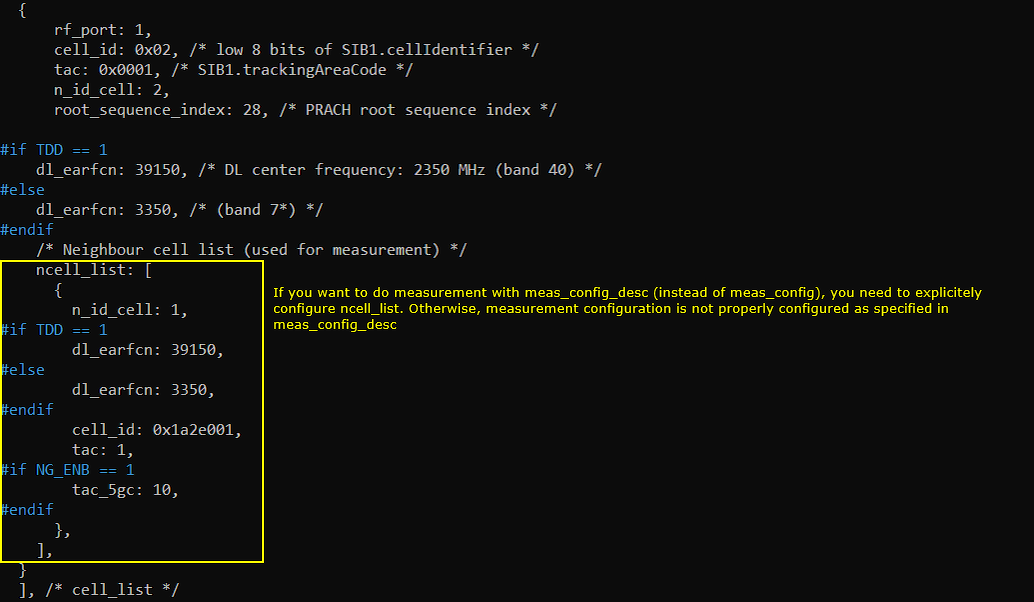
Add the first cell, which is the measurement target cell, into the neighbour cell list of the second cell, which is the camping cell.
In this example, the second cell is configured with rf_port set to 1, cell_id set to 0x02, tac set to 0x0001, and n_id_cell set to 2. This means this cell is the second LTE cell in the test configuration. When the UE camps on this cell, the first cell should be configured as its neighbour cell so that the UE can measure it.
The neighbour cell entry is added under ncell_list. In this entry, n_id_cell is set to 1. This identifies the physical cell ID of the first LTE cell. So, from the point of view of the second cell, cell 1 becomes the neighbour measurement target.
For FDD operation, dl_earfcn is set to 3350. This is the same downlink EARFCN as the second cell. So this is still an intra-frequency measurement case. The UE does not need to retune to another frequency. It measures another cell on the same carrier frequency.
The neighbour cell_id is set to 0x1a2e001, and tac is set to 1. These values identify the first cell as an E-UTRAN cell. They should match the identity information configured for the first cell.
This configuration is the reverse direction of the previous step. In the previous step, the second cell was added as a neighbour of the first cell. In this step, the first cell is added as a neighbour of the second cell.
This is useful when the UE may camp on either cell. If the UE camps on cell 1, it can measure cell 2. If the UE camps on cell 2, it can measure cell 1. Therefore, the measurement setup becomes bidirectional between the two LTE cells..
Configure the measurement criteria using the meas_config_desc parameter.
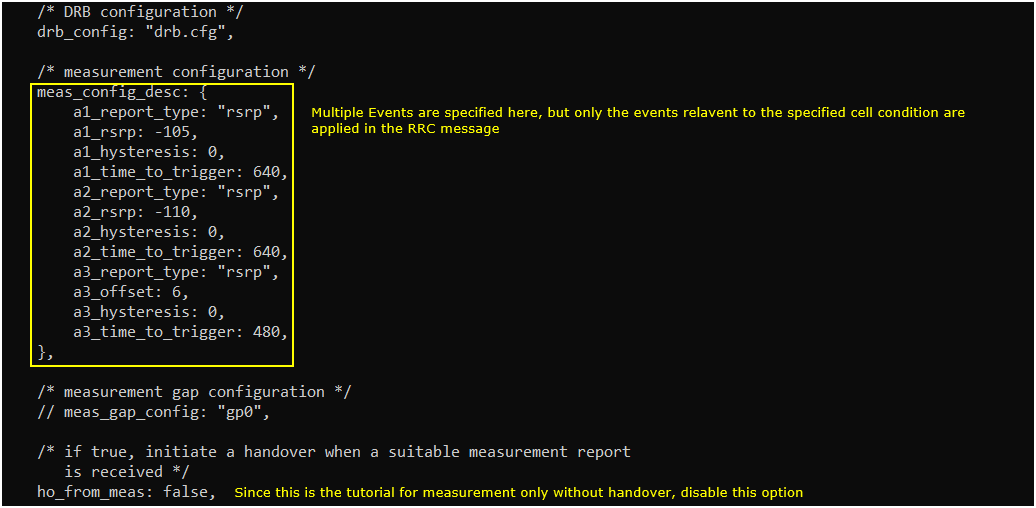
In this example, the measurement configuration is defined under meas_config_desc. This parameter provides a simplified way to describe measurement reporting criteria. Based on this description, Amarisoft generates the actual RRC Measurement Configuration that is sent to the UE.
Several measurement events are configured in the same section. The example includes A1, A2, and A3 related parameters. However, this does not mean all of them are always sent to the UE in the final RRC message. Amarisoft applies only the measurement events that are relevant to the current cell condition and neighbour cell configuration.
a1_report_type is set to rsrp. This means Event A1 uses RSRP as the measurement quantity. Event A1 is triggered when the serving cell becomes better than a configured threshold.
a1_rsrp is set to -105. This is the RSRP threshold used for Event A1. If the serving cell RSRP becomes better than this value, the UE can trigger an A1 measurement report.
a1_hysteresis is set to 0. This means no additional hysteresis margin is applied to the A1 trigger condition.
a1_time_to_trigger is set to 640. This means the A1 condition must remain true for 640 ms before the UE sends the measurement report. This prevents short and unstable radio fluctuations from immediately triggering a report.
a2_report_type is also set to rsrp. This means Event A2 also uses RSRP as the measurement quantity. Event A2 is triggered when the serving cell becomes worse than a configured threshold.
a2_rsrp is set to -110. This is the RSRP threshold for Event A2. If the serving cell RSRP becomes worse than this value and stays there long enough, the UE can report that the serving cell quality has degraded.
a2_hysteresis is set to 0, and a2_time_to_trigger is set to 640. So, like A1, there is no hysteresis margin, and the trigger condition must be maintained for 640 ms.
a3_report_type is set to rsrp. This means Event A3 compares the serving cell and neighbour cell using RSRP.
a3_offset is set to 6. This means the neighbour cell must be better than the serving cell by the configured offset before Event A3 can be triggered. This is commonly used for mobility-related measurement because it detects when a neighbour cell becomes sufficiently better than the current serving cell.
a3_hysteresis is set to 0, and a3_time_to_trigger is set to 480. So the A3 condition must remain true for 480 ms before the UE sends the measurement report.
The measurement gap configuration is commented out in this example. Since this tutorial uses intra-frequency measurement, the UE can usually measure the neighbour cell without measurement gaps. Measurement gaps are more important for inter-frequency or inter-RAT measurement, where the UE may need time to tune away from the serving frequency.
ho_from_meas is set to false. This is important for this tutorial. It means the eNB does not initiate handover even if a suitable measurement report is received. Therefore, this test focuses only on RRC measurement configuration and measurement report behavior, not on the handover procedure.
So the main point of this step is that meas_config_desc defines the possible measurement event criteria. Amarisoft then selects and applies the relevant criteria when generating the actual RRC measurement configuration for the UE.
Perform the test
Perform the test by starting the LTE service and checking the basic cell configuration with the cell phy and cell commands.
In this example, the LTE service is already running and the eNB shows two LTE cells. The PLMN is 00101 and the eNB ID is 0x1a2e0. This confirms that the test setup is using the intended two-cell LTE configuration.
The cell phy command shows the physical-layer configuration of both cells. Cell 0x001 and Cell 0x002 are both LTE cells on band 7. Both cells use 5 MHz bandwidth, which corresponds to 25 resource blocks. Both cells use the same downlink ARFCN, 3350, and the same uplink ARFCN, 21350. This is important because this tutorial is for intra-frequency measurement. The UE measures a neighbour cell on the same LTE carrier frequency.
The PCI values are different. Cell 0x001 uses PCI 1, and Cell 0x002 uses PCI 2. This allows the UE to distinguish the two cells even though they use the same frequency. This is the key condition for intra-frequency neighbour cell measurement.
The cell command shows the higher-level LTE cell configuration. Cell 0x001 has TAC 0x0001, dl_earfcn 3350, PCI 1, and PRACH sequence index 204. Cell 0x002 also has TAC 0x0001 and dl_earfcn 3350, but it uses PCI 2 and PRACH sequence index 28.
This confirms that the two cells are configured as separate LTE cells under the same PLMN and same frequency. Any LTE cell configuration is acceptable for this test, as long as the cells are properly created and can be used for measurement. The important point is that the UE can camp on one cell and measure the other cell as an intra-frequency neighbour.


Adjust cell power using 'cell gain' command. (
In this example, the purpose is to make the UE camp on cell 1 first. To do this, cell 1 is configured with higher power than cell 2.
The command cell_gain 1 -10 sets the downlink gain of cell 1 to -10 dB. The command cell_gain 2 -20 sets the downlink gain of cell 2 to -20 dB. Since cell 1 has 10 dB higher gain than cell 2, the UE is more likely to detect cell 1 as the stronger cell and camp on it.
After applying the command, the cell command is used again to verify the result. In the output, cell 0x001 shows dl_gain -10.0, and cell 0x002 shows dl_gain -20.0. This confirms that the cell power difference has been applied correctly.
For this test, it is better to use cell_gain rather than tx_gain. Both commands can change the transmitted signal level, but tx_gain may also affect the reference power information broadcast in SIB. If the SIB reference power changes, the UE may interpret the cell power differently from what you expect. This can make the measurement behavior harder to understand.
In this example, tx_gain is kept at the default value. The tx_gain command shows TX0 gain as 89.8 dB and TX1 gain as 89.8 dB. Nothing is changed at the RF transmit gain level.
The important point is that the relative power between the two cells should be controlled clearly. Here, cell 1 is made stronger than cell 2 so that the UE camps on cell 1. Later, by changing the cell gain values again, you can create the measurement condition where the neighbour cell becomes stronger and triggers the configured RRC measurement event.


Power on the UE and let the UE attach to the cell.
In this example, the trace command is used after the UE is powered on. The purpose is to confirm that the UE is connected to the intended serving cell before starting the measurement test.
The PRACH line shows cell=01. This means the UE performs random access on cell 1. Since cell 1 was configured with higher gain than cell 2 in the previous step, this is the expected result. The UE detects cell 1 as the stronger cell and starts access from that cell.
In the trace output, the UE_ID is 1 and the Cell column shows 001. This confirms that the UE is attached to cell 0x001. The RNTI is 003d, which is the temporary radio identifier assigned to this UE by the eNB.
The downlink measurement values show that the UE is receiving the signal from the serving cell. The snr value is around 14 to 15 dB in the shown lines, and the puc value is also displayed. These values indicate that the UE has an active radio connection with the eNB.
The uplink side also shows active transmission information, such as mcs, rxko, rxok, bitrate, phr, pl, and timing advance. This means the UE is not just detecting the cell, but has established an active LTE connection.
The important point in this step is to verify the initial camping condition. Before testing RRC measurement reporting, the UE should be attached to cell 1. Once this is confirmed, you can change the relative cell power later and observe whether the UE sends a measurement report when the neighbour cell becomes better according to the configured event condition.

You can check the current cell gain value using the cell command whenever you need.
In this example, the cell command is used again after changing the cell power. This is a quick way to confirm whether the intended gain values are actually applied to each LTE cell.
The output shows that cell 0x001 has dl_gain set to -16.0, and cell 0x002 has dl_gain set to -10.0. This means cell 2 is now transmitted with higher downlink power than cell 1. Compared with the previous setting, the power relationship has been reversed.
This kind of power adjustment is used to create the condition for triggering a measurement report. The UE initially camps on cell 1 because cell 1 was stronger. Then, by reducing the gain of cell 1 and increasing the relative strength of cell 2, the neighbour cell can become better than the serving cell.
If Event A3 is used, the UE checks whether the neighbour cell becomes better than the serving cell by the configured offset. In this tutorial, the A3 offset was configured as 6. So the gain difference should be adjusted enough to make cell 2 appear sufficiently better than cell 1 from the UE point of view.
The proper gain values may be different depending on the UE, antenna connection, cable loss, RF environment, and test setup. So the exact values shown here should be understood as one working example, not as fixed values that always work in every environment.
The important point is to monitor the current dl_gain values and adjust them step by step until the UE sends the expected RRC measurement report.

Log Analysis
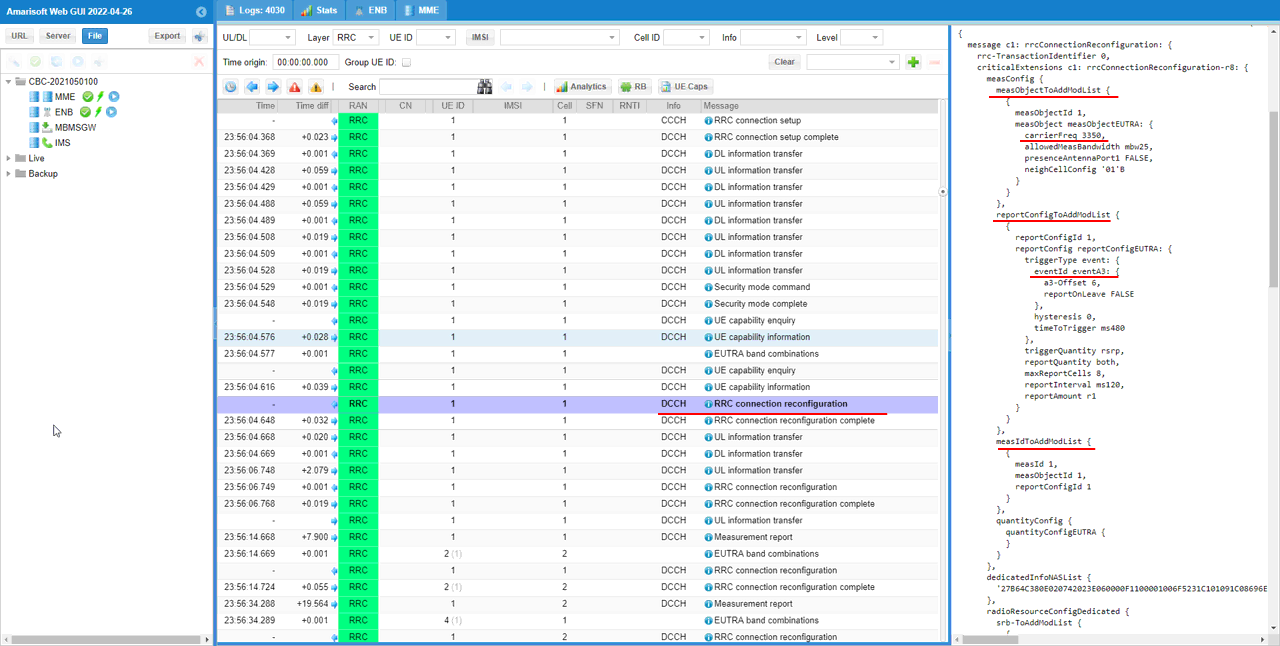
During the initial attach, the Callbox sends the RRC Connection Reconfiguration message to the UE. This message includes the measurement configuration that the UE should use after attach.
In this example, the important part is measConfig inside rrcConnectionReconfiguration. This is where the eNB tells the UE what to measure, how to evaluate the measurement condition, and when to send a Measurement Report.
The measObjectToAddModList section defines the measurement object. In this example, measObjectId is 1 and the measurement object is measObjectEUTRA. The carrierFreq is 3350, which matches the LTE downlink EARFCN used by both cells in this test. This means the measurement is configured for the same LTE frequency as the serving cell, so it is an intra-frequency measurement. The allowedMeasBandwidth is mbw25, which matches the 5 MHz LTE bandwidth used in the cell configuration. The presenceAntennaPort1 is FALSE, and neighCellConfig is set to 01.
The reportConfigToAddModList section defines the event condition for measurement reporting. In this example, reportConfigId is 1 and the report type is reportConfigEUTRA. The triggerType is event, and the configured event is eventA3. This means the UE will send a Measurement Report when the neighbour cell becomes better than the serving cell by the configured A3 condition.
The a3-Offset is set to 6. This is the key trigger parameter for Event A3. It means the neighbour cell should become sufficiently better than the serving cell before the UE reports it. In the earlier configuration, this came from a3_offset in meas_config_desc.
The hysteresis is set to 0. This means no additional margin is added to the event condition. The timeToTrigger is set to ms480. This means the A3 condition must remain true for 480 ms before the UE sends the Measurement Report. This prevents a short temporary power change from immediately triggering the report.
The triggerQuantity is rsrp. This means the A3 comparison is based on RSRP. The reportQuantity is both, so the UE can include both RSRP and RSRQ related measurement result information in the report. The maxReportCells is 8, reportInterval is ms120, and reportAmount is r1. This means the UE reports at most 8 cells, uses a 120 ms reporting interval if repeated reporting is needed, and sends one report for this event.
The measIdToAddModList section connects the measurement object and the report configuration together. In this example, measId is 1, measObjectId is 1, and reportConfigId is 1. This mapping is very important. The measurement object only tells the UE what frequency and cells to measure. The report configuration only tells the UE what event condition to apply. The measId connects these two pieces, so the UE knows to apply reportConfigId 1 to measObjectId 1.
So the main confirmation point in this log is that the RRC Connection Reconfiguration contains all three required parts: measObjectToAddModList, reportConfigToAddModList, and measIdToAddModList. In this example, they are configured for intra-frequency LTE Event A3 measurement on EARFCN 3350. This confirms that the measurement configuration generated from meas_config_desc has been delivered to the UE as intended.
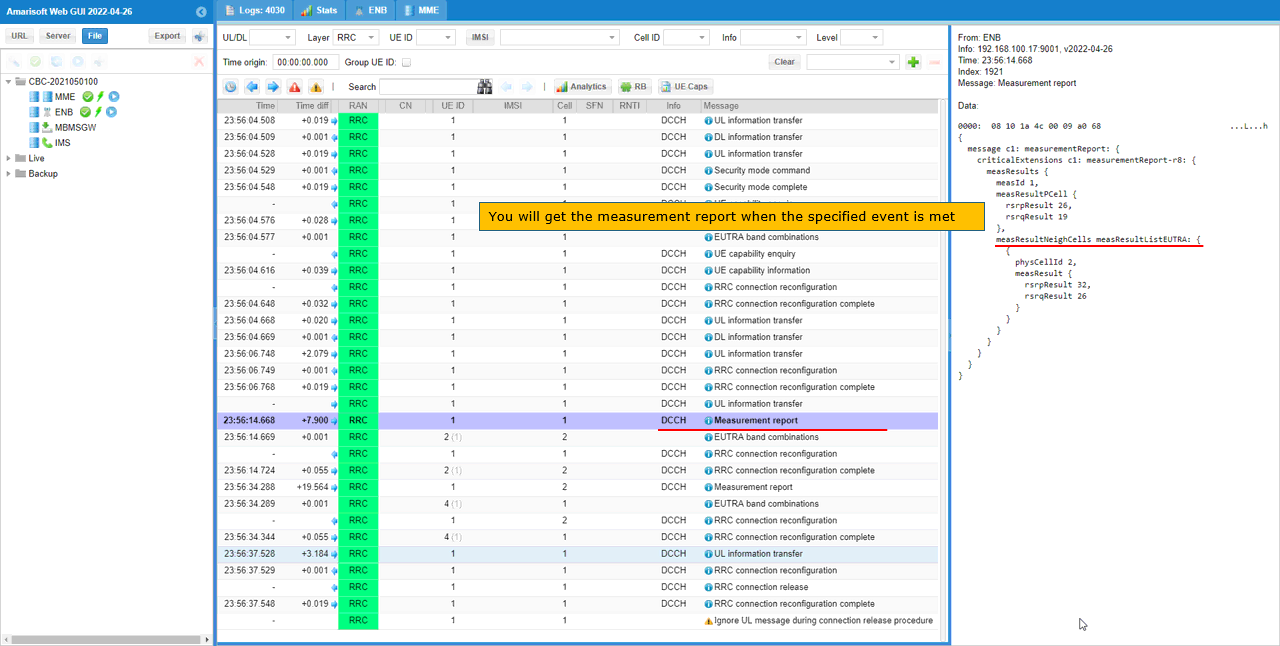
Once the cell power condition meets the configured measurement event, the UE sends a Measurement Report to the eNB.
In this example, the Measurement Report appears after the neighbour cell becomes good enough to satisfy the configured event condition. Since the earlier RRC Connection Reconfiguration configured Event A3, this report indicates that the UE has detected the neighbour cell as better than the serving cell according to the A3 rule.
The selected log entry is Measurement report. On the right side, the decoded RRC message shows message c1: measurementReport. This confirms that the UE is sending an RRC Measurement Report on DCCH.
Inside measurementReport, measResults is included. The measId is 1. This is important because measId 1 was configured earlier in measIdToAddModList. It links the measurement object and report configuration together. So this report is related to the measurement object and A3 report configuration that were sent to the UE during initial attach.
The measResultPCell section shows the serving cell measurement result. In this example, rsrpResult is 26 and rsrqResult is 19. These are not direct dBm or dB values. They are encoded LTE RRC measurement result indexes. They represent the UE measurement result for the current serving cell.
The most important part is measResultNeighCells. In this example, it contains measResultListEUTRA, which means the UE is reporting an LTE neighbour cell measurement result.
Inside measResultListEUTRA, physCellId is 2. This indicates that the reported neighbour cell is PCI 2, which corresponds to the second LTE cell in this test. This confirms that the UE measured the intended target cell.
The neighbour measurement result shows rsrpResult 32 and rsrqResult 26. These values indicate that the UE measured the neighbour cell and included its result in the report. Since this report was triggered by Event A3, the neighbour cell measurement became sufficiently better than the serving cell measurement for the required time-to-trigger period.
So the key confirmation point in this log is the presence of measResultNeighCells in the Measurement Report. Without this item, you may only know the UE sent a report, but you cannot clearly confirm which neighbour cell was measured and reported. In this example, measResultNeighCells shows PCI 2, so the report is correctly generated for the second cell, which is the intended measurement target cell.
Test 2 : LTE to LTE, InterFrequency with meas_config_desc
This test shows how to configure inter frequency measurement for an LTE cell to measure another LTE cell and verify it.
Configuration
I used the enb-2cell-meas-inter.cfg which is copied and modified from enb-2cell-ho.cfg.

I also used mme-ims.cfg as it is.
Configure enb-2cell-meas-inter.cfg as below.
This example sets the basic two-cell LTE configuration for the inter-frequency measurement test. One cell is used as the serving cell, and the other cell is used as the measurement target cell.
N_CELL is set to 2, so the eNB runs two LTE cells. TDD is set to 0, so both cells operate in FDD mode. N_RB_DL is set to 25, which means 5 MHz LTE bandwidth.
N_ANTENNA_DL and N_ANTENNA_UL are both set to 1. This keeps the test simple with single antenna operation.
CHANNEL_SIM is set to 0, so the channel simulator is disabled. This makes it easier to control the measurement condition using cell gain and frequency settings.
N_ENB is set to 0, so the configuration is used as a normal LTE eNB configuration.
The key point is that this test still uses two LTE cells, but the two cells will be configured on different DL EARFCNs. So the UE camps on one LTE cell and measures another LTE cell on a different LTE frequency.
Add the second cell, which is the measurement target cell, into the neighbour cell list of the first cell, which is the camping cell.
In this example, cell 1 is configured as the serving cell. It uses n_id_cell 1 and dl_earfcn 3350 for FDD operation. This is the cell where the UE is expected to camp first.
The second cell is added under ncell_list. This neighbour entry uses n_id_cell 2, so it points to the second LTE cell. The important difference from the intra-frequency test is dl_earfcn. For FDD operation, the neighbour cell dl_earfcn is set to 1575. This is different from the serving cell EARFCN 3350, so the target cell becomes an inter-frequency LTE neighbour.
The neighbour cell_id is set to 0x1a2e002, and tac is set to 1. These values identify the target LTE cell at the system information level.
The note in the example is important. When meas_config_desc is used, ncell_list should be configured explicitly. Otherwise, Amarisoft may not generate the intended measurement configuration from meas_config_desc.
So the key point is that cell 1 has cell 2 in its neighbour list, but cell 2 is configured on a different DL EARFCN. This makes the test an LTE-to-LTE inter-frequency measurement case.
Add the first cell, which is the measurement target cell, into the neighbour cell list of the second cell, which is the camping cell.
In this example, cell 2 is configured with rf_port 1, cell_id 0x02, tac 0x0001, and n_id_cell 2. This means this is the second LTE cell. For FDD operation, this cell uses dl_earfcn 1575, so it is on a different LTE frequency from cell 1.
The first cell is added under ncell_list as the neighbour cell. In this neighbour entry, n_id_cell is set to 1. This points to the first LTE cell as the measurement target from the point of view of cell 2.
For FDD operation, the neighbour dl_earfcn is set to 3350. This is different from the serving cell EARFCN 1575. So if the UE camps on cell 2, it can measure cell 1 as an inter-frequency LTE neighbour.
The neighbour cell_id is set to 0x1a2e001, and tac is set to 1. These values identify the first LTE cell at the system information level.
This configuration is the reverse direction of the previous step. In the previous step, cell 2 was added as a neighbour of cell 1. In this step, cell 1 is added as a neighbour of cell 2. This makes the neighbour relation bidirectional, so the UE can perform inter-frequency measurement no matter which of the two LTE cells it camps on.
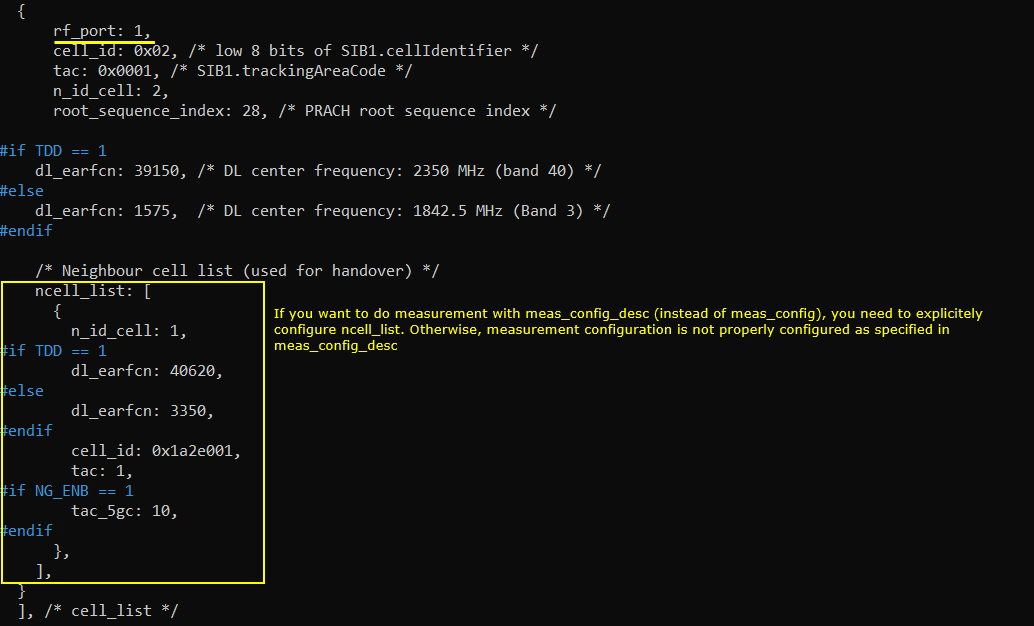
Configure the measurement criteria using the meas_config_desc parameter.
In this example, the same meas_config_desc structure is used for the inter-frequency test. Several event conditions are defined, including A1, A2, and A3. However, Amarisoft applies only the event configuration that matches the current cell and neighbour cell condition when it generates the actual RRC measurement configuration.
a1_report_type is set to rsrp, and a1_rsrp is set to -105. This means Event A1 is based on serving-cell RSRP. A1 is used when the serving cell becomes better than the configured threshold.
a2_report_type is also set to rsrp, and a2_rsrp is set to -110. This means Event A2 is triggered when the serving cell becomes worse than the configured threshold.
a3_report_type is set to rsrp, and a3_offset is set to 6. This means Event A3 is based on RSRP comparison between the serving cell and the neighbour cell. The neighbour cell should become better than the serving cell by the configured offset before the UE sends a Measurement Report.
The time-to-trigger values are also configured. A1 and A2 use 640 ms, while A3 uses 480 ms. This means the event condition must stay true for the specified time before the report is triggered.
The meas_gap_config line is commented out in this example. For inter-frequency measurement, a measurement gap may be needed depending on UE capability and test condition. If the UE cannot measure the other LTE frequency while staying connected to the serving cell, you may need to enable a measurement gap such as gp0.
ho_from_meas is set to false. This keeps the test focused only on measurement reporting. Even if the UE sends a valid Measurement Report, the eNB does not start handover from this report.
The main point is that meas_config_desc defines the measurement event criteria in a simple way. Amarisoft then converts the relevant part into the RRC Measurement Configuration sent to the UE.
Perform the test
Perform the test by starting the LTE service and checking the basic cell configuration with the cell phy and cell commands.
In this example, the eNB is running two LTE cells under PLMN 00101 and eNB ID 0x1a2e0. This confirms that the two-cell LTE test setup is active.
The cell phy command shows the physical-layer configuration of both cells. Cell 0x001 and cell 0x002 are both LTE cells on band 7 with 5 MHz bandwidth. Cell 0x001 uses PCI 1, and cell 0x002 uses PCI 2. The different PCI values allow the UE to distinguish the two cells.
The cell command shows the higher-level cell configuration. Cell 0x001 has TAC 0x0001, dl_earfcn 3350, PCI 1, and PRACH sequence index 204. Cell 0x002 has TAC 0x0001, dl_earfcn 3350, PCI 2, and PRACH sequence index 28.
For an inter-frequency test, the important thing to verify here is that the serving cell and target cell are eventually configured with different DL EARFCNs. The screenshot shows both cells with dl_earfcn 3350, so this output looks like an intra-frequency cell status. In the inter-frequency test, you should confirm that one cell uses the serving EARFCN and the other cell uses the target EARFCN, such as 3350 and 1575, depending on your configuration.
The key point of this step is to make sure both LTE cells are running normally before attaching the UE. Once the cells are active and the EARFCN configuration is confirmed, you can attach the UE to the serving cell and then adjust the cell power to trigger the inter-frequency measurement report.
Adjust cell power using 'cell gain' command. (
In this example, cell 1 is made stronger than cell 2 so that the UE camps on cell 1 at the beginning of the test.
The command cell_gain 1 -10 sets the downlink gain of cell 1 to -10 dB. The command cell_gain 2 -20 sets the downlink gain of cell 2 to -20 dB. Since cell 1 has higher power than cell 2, the UE is expected to select cell 1 as the serving cell.
After applying the commands, the cell command is used to verify the current gain values. The output shows that cell 0x001 has dl_gain -10.0, and cell 0x002 has dl_gain -20.0. This confirms that the intended power condition is applied.
In this test, cell_gain is preferred over tx_gain. tx_gain can also change the transmitted power, but it may affect the reference power information in SIB. Then the UE may behave slightly differently from the expected measurement condition.
The tx_gain command is also checked, but it is kept at the default value. TX0 and TX1 both show 89.8 dB.
The main purpose of this step is to create a stable initial condition. The UE should first camp on cell 1. Later, the relative cell power can be changed so that the inter-frequency target cell becomes suitable for triggering the measurement report.
Power on the UE and let the UE attach to the cell.
In this example, the trace command is used to confirm the initial attach condition. The PRACH line shows cell=01, which means the UE starts random access on cell 1. This is the expected result because cell 1 was configured with higher cell gain than cell 2.
In the trace table, the UE_ID is 1 and the Cell column shows 001. This confirms that the UE is connected to cell 0x001. The RNTI is 003d, which is the temporary radio identifier assigned to the UE.
The downlink side shows active radio status with CQI, RI, MCS, retransmission count, bitrate, SNR, and PUCCH power information. The uplink side also shows active transmission status such as MCS, bitrate, PHR, path loss, and timing advance.
The important point is to confirm that the UE is attached to cell 1 before triggering the inter-frequency measurement condition. After this initial attach is confirmed, you can adjust the relative cell power so that the target cell becomes suitable for triggering the configured measurement report.
Adjust the cell power to trigger the measurement report.
In this example, the UE initially camps on cell 1. Then the cell gain is changed so that cell 2 becomes stronger than cell 1.
The command cell_gain 2 -10 sets the target cell power to -10 dB. Then cell_gain 1 -20, cell_gain 1 -30, and cell_gain 1 -40 are used step by step to reduce the serving cell power. This makes the serving cell weaker and makes the target cell relatively better.
After changing the gain values, the cell command is used to confirm the current status. The output shows that cell 0x001 has dl_gain -40.0, and cell 0x002 has dl_gain -10.0. This means cell 2 is now much stronger than cell 1.
This power condition is intended to trigger the configured measurement event. Since this is an inter-frequency test, cell 1 is on dl_earfcn 3350 and cell 2 is on dl_earfcn 1575. The UE is connected to cell 1, but it should measure cell 2 on the different LTE frequency.
The exact gain values may vary depending on the UE and test environment. In some cases, a smaller difference may be enough. In other cases, you may need to increase the power difference further.
The key point is to create a clear condition where the inter-frequency target cell becomes good enough to satisfy the configured measurement event. Once this condition is met and maintained for the required time-to-trigger, the UE should send the Measurement Report.

Log Analysis
During the initial attach, the Callbox sends the RRC Connection Reconfiguration message to the UE. This message includes the measurement configuration generated from meas_config_desc.
In this example, the important part is measConfig. The log shows measObjectToAddModList, reportConfigToAddModList, and later measIdToAddModList. These three parts should be checked together because they define what the UE should measure, what reporting condition should be used, and how the measurement object and report condition are linked.
In measObjectToAddModList, there are two EUTRA measurement objects. One measurement object is for carrierFreq 3350, and another measurement object is for carrierFreq 1575. This is the key difference from the intra-frequency test. Since the target LTE cell is on a different EARFCN, Amarisoft configures an additional EUTRA measurement object for the inter-frequency target.
The reportConfigToAddModList section shows multiple event configurations. In this example, Event A1, Event A2, and Event A3 are configured as specified in the configuration file. Event A1 uses a1-Threshold threshold-RSRP 35, Event A2 uses a2-Threshold threshold-RSRP 30, and Event A3 is also configured later in the same report configuration list.
This confirms that meas_config_desc has been converted into actual RRC measurement report configurations. The UE receives these event rules through RRC Connection Reconfiguration and evaluates them after attach.
The important point is that not only one event can appear in the RRC message. In this inter-frequency test, A1, A2, and A3 can be included depending on the configured cell and neighbour condition. The UE then uses the linked measId to decide which measurement object and which report configuration should be applied.
So the main confirmation point in this log is that the RRC Connection Reconfiguration includes measurement objects for both EARFCNs, 3350 and 1575, and includes the expected event configurations from meas_config_desc. This means the UE has received the proper RRC measurement configuration for LTE inter-frequency measurement.
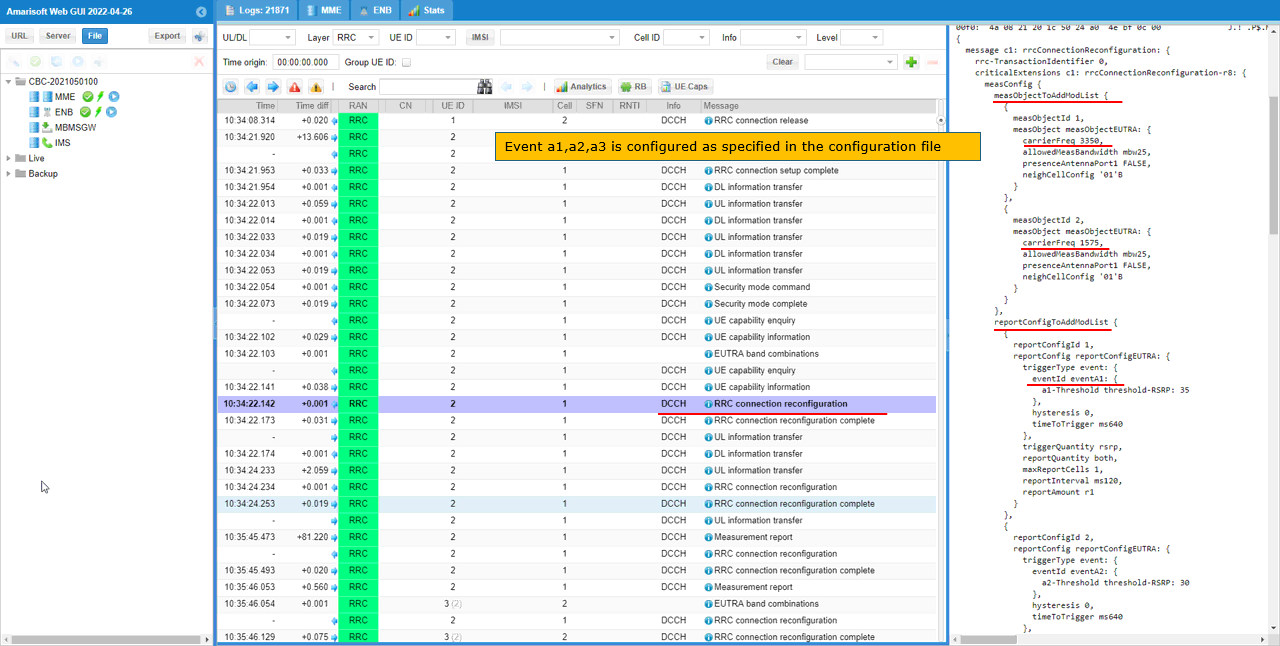
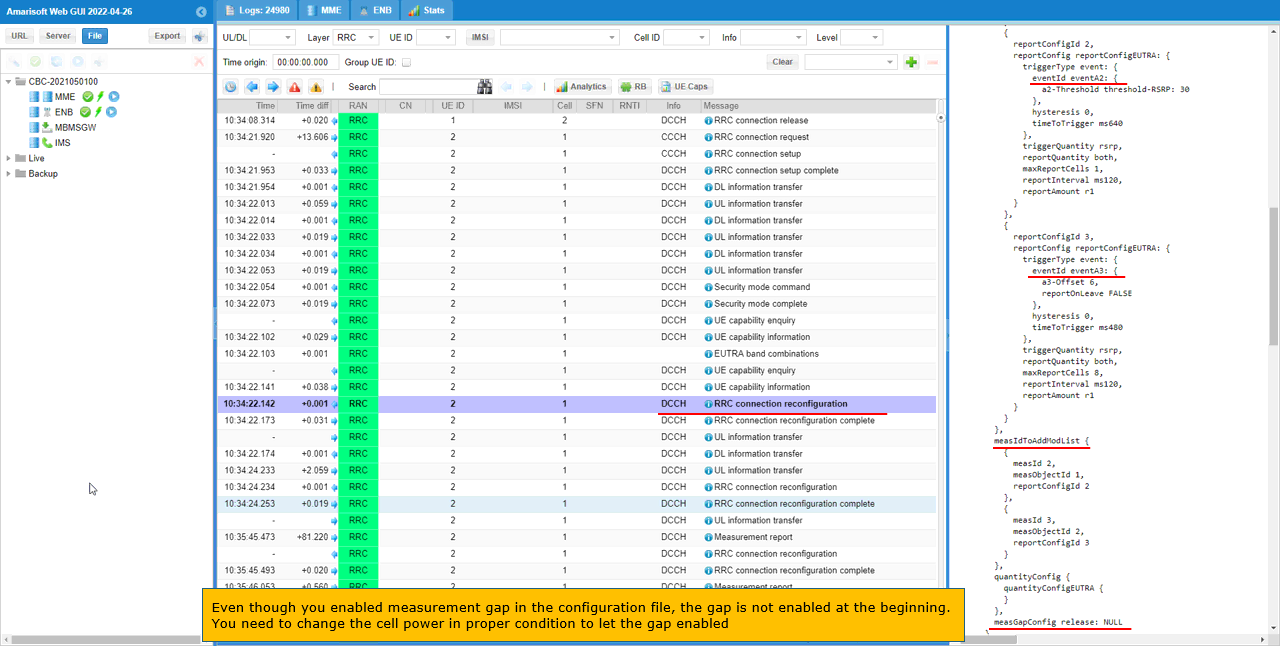
This part of the log shows the rest of the RRC measurement configuration for the inter-frequency test.
In this example, reportConfigId 2 is configured for Event A2. The trigger condition is eventA2, and a2-Threshold is threshold-RSRP 30. This means the UE can trigger this report when the serving cell becomes worse than the configured RSRP threshold. The hysteresis is 0, and timeToTrigger is ms640.
reportConfigId 3 is configured for Event A3. The trigger condition is eventA3, and a3-Offset is 6. This means the UE can trigger this report when the neighbour cell becomes better than the serving cell by the configured offset. The timeToTrigger is ms480, so the condition should stay valid for 480 ms before the UE sends the report.
The measIdToAddModList section shows how the measurement objects and report configurations are connected. In this example, measId 2 uses measObjectId 1 and reportConfigId 2. This connects the serving-frequency measurement object with the A2 report configuration. measId 3 uses measObjectId 2 and reportConfigId 3. This connects the inter-frequency target measurement object with the A3 report configuration.
This mapping is important. The measurement object only defines what frequency to measure. The report configuration only defines when to report. The measId connects these two together and tells the UE which event rule should be applied to which LTE frequency.
At the bottom, measGapConfig release NULL is shown. This means the measurement gap is not enabled at this point. Even though the measurement gap is configured in the configuration file, it may not be enabled immediately at the beginning. You need to create the proper cell power condition first. Then the eNB can update the measurement configuration and enable the gap when it becomes necessary.
So the key point in this example is that A1, A2, and A3 are configured as expected, but the measurement gap is still released at the initial stage. For inter-frequency measurement, always check not only measObjectToAddModList, reportConfigToAddModList, and measIdToAddModList, but also whether measGapConfig is actually enabled later in the test.
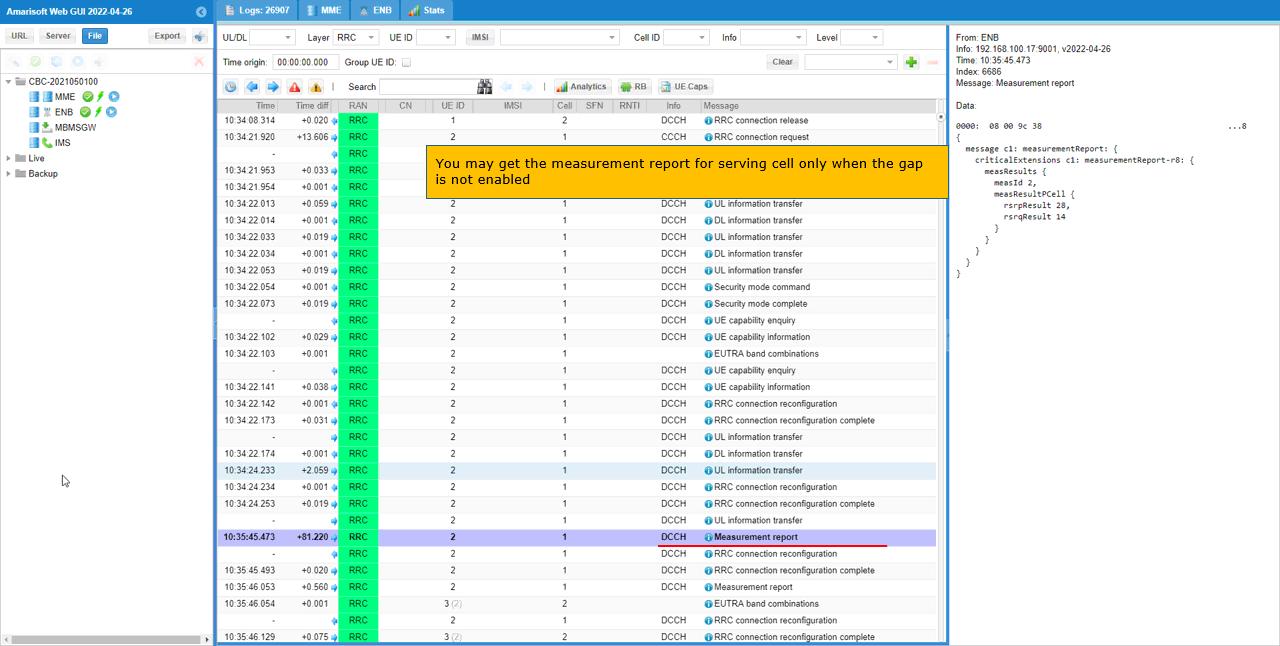
Once the cell power condition meets the configured measurement event, the UE sends a Measurement Report.
In this example, the Measurement Report is received after the serving cell power is reduced and the configured condition is met. However, the report contains only the serving cell measurement result.
The decoded message shows message c1: measurementReport. Inside measResults, measId is 2. This indicates that the report is associated with the measurement identity configured earlier for Event A2. Event A2 is a serving-cell quality event, so the report can be triggered when the serving cell becomes worse than the configured threshold.
The measResultPCell section is included, and it shows rsrpResult 14. This is the serving cell measurement result. However, there is no measResultNeighCells item in this report. This means the UE is not reporting the inter-frequency neighbour cell measurement in this message.
This can happen when the measurement gap is not enabled. For inter-frequency measurement, the UE may need a measurement gap to tune away from the serving frequency and measure the target LTE frequency. If the gap is not enabled, the UE may still report serving-cell related events such as A2, but it may not be able to report the neighbour cell result.
So the important point is to check the content of the Measurement Report carefully. Receiving a Measurement Report alone does not always mean that the inter-frequency target cell was measured. For this test, you should confirm whether measResultNeighCells is present. If it is missing, the report is likely only for the serving cell condition, not for the inter-frequency neighbour cell.
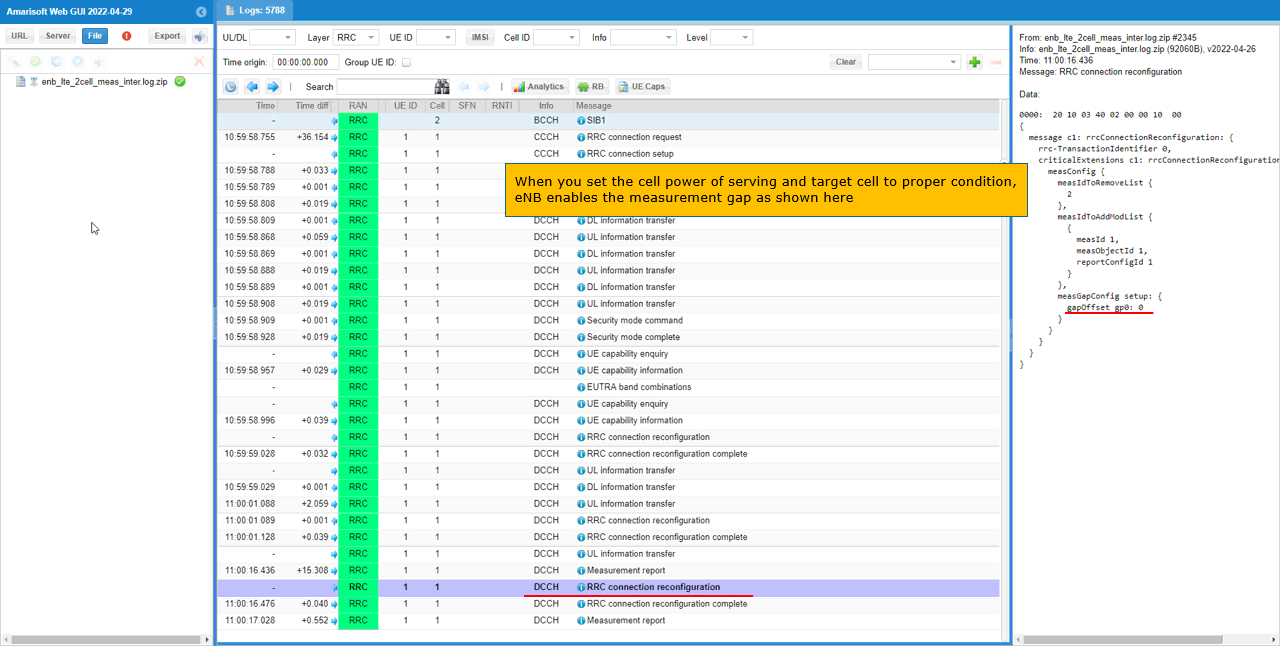
When you set the serving cell and target cell power to the proper condition, the eNB enables the measurement gap.
In this example, another RRC Connection Reconfiguration message is sent after the cell power condition changes. This message updates the UE measurement configuration.
The important part is measGapConfig. In the earlier log, measGapConfig was shown as release NULL, which means the measurement gap was not enabled yet. In this log, measGapConfig is shown as setup, and gapOffset is set to gp0 0. This means the eNB now enables the measurement gap for the UE.
This is important for inter-frequency measurement. Since the target LTE cell is on a different EARFCN, the UE may need a short time period to tune away from the serving frequency and measure the target frequency. The measurement gap gives the UE this time.
The log also shows measIdToRemoveList and measIdToAddModList. This means the eNB is modifying the active measurement configuration. In this example, measId 2 is removed, and measId 1 is added with measObjectId 1 and reportConfigId 1. So the eNB is not only enabling the gap, but also updating the measurement identity used by the UE.
The key point is that measurement gap activation may not happen immediately at initial attach. Even if the configuration file includes measurement gap related settings, the actual RRC message may first show measGapConfig as release. After the proper radio condition is created, the eNB sends another RRC Connection Reconfiguration and enables measGapConfig setup.
So, for inter-frequency measurement, you should check two things. First, check that the UE receives measurement objects and report configurations. Second, check that measGapConfig is actually set up when the inter-frequency measurement condition requires it.
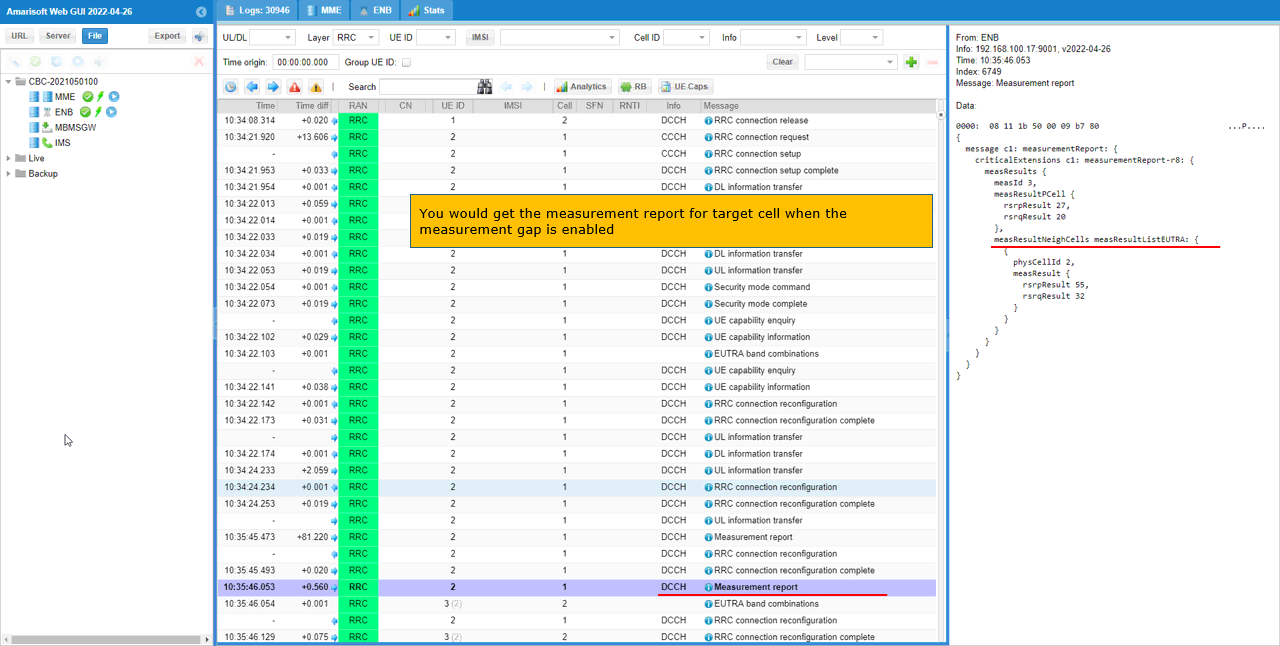
Once the cell power condition meets the configured inter-frequency measurement event, the UE sends the Measurement Report for the target cell.
In this example, the selected log entry is Measurement report. On the right side, the decoded RRC message shows measurementReport. This confirms that the UE sent an RRC Measurement Report to the eNB.
Inside measResults, measId is 3. This is important because measId 3 was configured earlier for the inter-frequency target measurement. It links the target EARFCN measurement object with the A3 report configuration.
The measResultPCell section shows the serving cell measurement result. In this example, the serving cell has rsrpResult 27 and rsrqResult 20. These values represent the encoded LTE RRC measurement result indexes for the current serving cell.
The most important part is measResultNeighCells. In this example, measResultNeighCells contains measResultListEUTRA. This means the UE successfully measured and reported an LTE neighbour cell.
Inside measResultListEUTRA, physCellId is 2. This identifies the reported neighbour cell as PCI 2, which is the target LTE cell in this test. The neighbour cell measurement result shows rsrpResult 55 and rsrqResult 32. This confirms that the UE measured the target cell and included it in the Measurement Report.
This is the expected result after the measurement gap is enabled. Without the measurement gap, the UE may only report the serving cell condition. After the gap is enabled, the UE can measure the inter-frequency target cell and include measResultNeighCells in the report.
So the key confirmation point is the presence of measResultNeighCells in the Measurement Report. In this example, it reports PCI 2, so the inter-frequency LTE target cell was measured and reported correctly.
Test 3 : LTE to LTE, IntraFrequency Periodic Report with meas_config (ASN.1 file)
This test shows how to configure Intra frequency measurement for an LTE cell to measure another LTE cell with ASN file and verify it.
Configuration
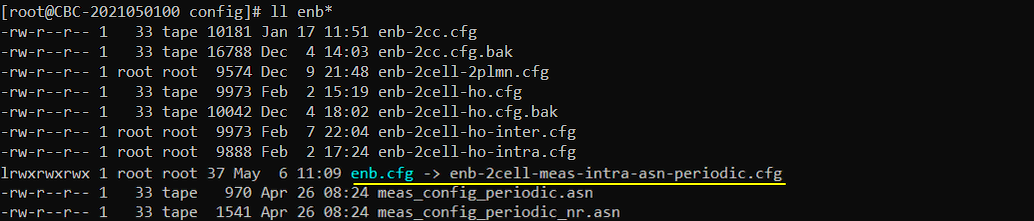
I used the enb-2cell-meas-intra-asn-periodic.cfg which is copied and modified from enb-2cell-ho.cfg.
I also used mme-ims.cfg as it is.
Configure enb-2cell-meas-intra-asn-periodic.cfg as below.
This example sets the basic two-cell LTE configuration for the intra-frequency periodic measurement test. One cell is used as the serving cell, and the other cell is used as the measurement target cell.
N_CELL is set to 2, so the eNB runs two LTE cells. TDD is set to 0, so the cells operate in FDD mode. N_RB_DL is set to 25, which means 5 MHz LTE bandwidth.
N_ANTENNA_DL and N_ANTENNA_UL are both set to 1. This keeps the test simple with single antenna operation.
CHANNEL_SIM is set to 0, so the channel simulator is disabled. This makes the radio condition easier to control using cell gain.
N_ENB is set to 0, so this is used as a normal LTE eNB configuration.
The key point is that this test still uses two LTE cells on the same LTE frequency. The difference from the previous tests is that the measurement configuration will be provided by meas_config using an ASN.1 file, and the UE will send periodic Measurement Reports instead of event-triggered reports.
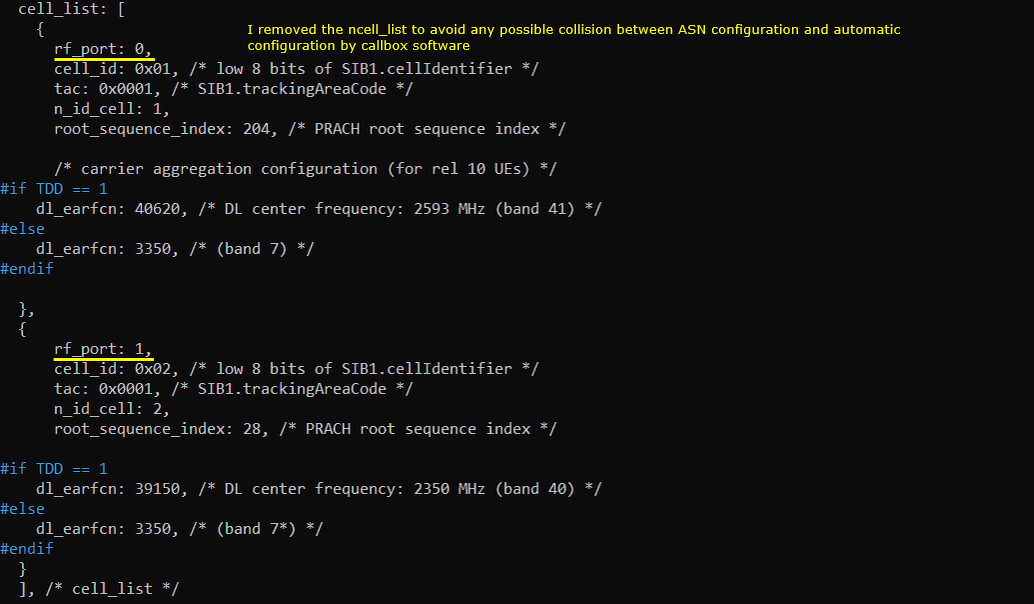
In this test, ncell_list is removed to avoid any possible collision between the ASN.1 measurement configuration and the automatic configuration generated by the Callbox software.
In the previous meas_config_desc-based tests, ncell_list was important because Amarisoft used it to generate the measurement configuration automatically. However, in this test, the measurement configuration is provided directly through the meas_config ASN.1 file. So the neighbour relation is already described by the ASN.1 measurement configuration, not by the automatic ncell_list handling.
The first cell is configured with rf_port 0, cell_id 0x01, tac 0x0001, and n_id_cell 1. For FDD operation, dl_earfcn is set to 3350.
The second cell is configured with rf_port 1, cell_id 0x02, tac 0x0001, and n_id_cell 2. For FDD operation, dl_earfcn is also set to 3350.
Since both cells use the same DL EARFCN, this is still an intra-frequency LTE measurement test. The UE camps on one LTE cell and measures the other LTE cell on the same carrier frequency.
The key point is that the cell configuration only defines the two LTE cells. The measurement behavior itself is controlled by the ASN.1 meas_config file. This makes the test more explicit and avoids unexpected overlap between manual ASN.1 measurement configuration and Amarisoft’s automatic neighbour-based measurement configuration.
Specify the ASN.1 file that configures the intended measurement condition using the meas_config parameter.
In this example, meas_config is set to meas_config_periodic.asn. This means the RRC measurement configuration is not automatically generated from meas_config_desc. Instead, Amarisoft reads the ASN.1 measurement configuration from this file and sends it to the UE through RRC Connection Reconfiguration.
This is useful when you want full control over the measurement configuration. For example, you can explicitly define the measurement object, report configuration, measurement ID, and periodic reporting behavior in the ASN.1 file.
The measurement gap configuration is commented out in this example. Since this is an intra-frequency measurement test, the UE can measure the target cell on the same LTE frequency without a measurement gap.
ho_from_meas is set to false. This keeps the test focused only on measurement reporting. Even if the UE sends Measurement Reports, the eNB does not start handover based on those reports.
The key point is that the measurement behavior in this test is controlled by meas_config_periodic.asn. So the next important step is to check the ASN.1 file and confirm that it defines the intended periodic measurement report configuration.

Following is the configuration in meas_config_periodic.asn which is provided by the default installation package. (
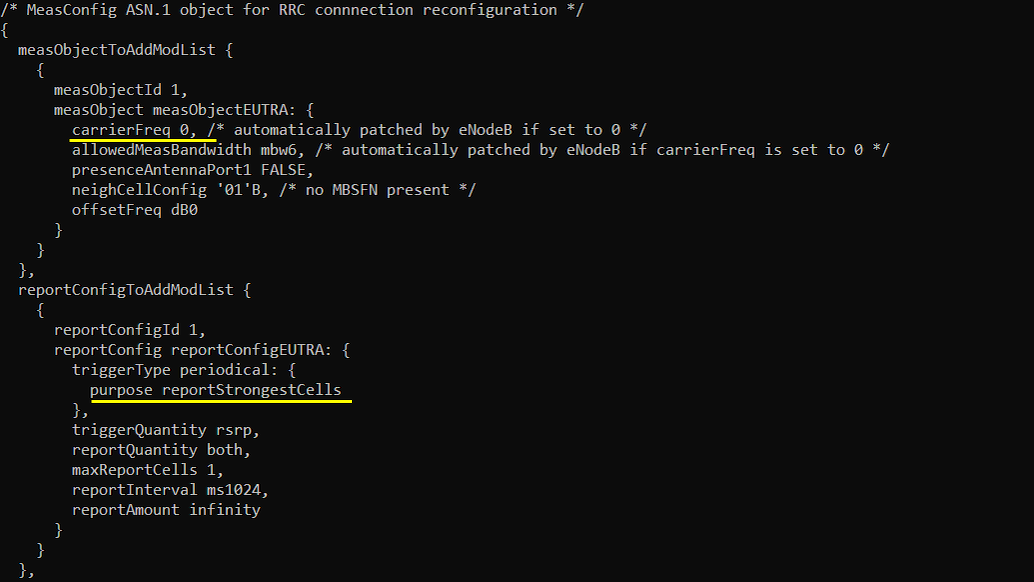
This ASN.1 file defines the MeasConfig object that will be included in the RRC Connection Reconfiguration message.
The measObjectToAddModList section defines what the UE should measure. In this example, measObjectId is set to 1 and the object type is measObjectEUTRA. The carrierFreq is set to 0. This means the eNodeB will automatically patch the carrier frequency when it sends the configuration to the UE. allowedMeasBandwidth is also set to mbw0, and it can also be patched automatically by the eNodeB when carrierFreq is set to 0.
The reportConfigToAddModList section defines how the UE should report the measurement result. In this example, reportConfigId is set to 1 and reportConfigEUTRA is used.
The triggerType is set to periodic. This is the main point of this test. The UE does not wait for an event such as A3. Instead, it sends Measurement Report messages periodically.
The purpose is set to reportStrongestCells. This means the UE reports the strongest detected cells for the configured measurement object.
triggerQuantity is set to rsrp, so the measurement trigger and evaluation are based on RSRP. reportQuantity is set to both, so the UE can report both RSRP and RSRQ.
maxReportCells is set to 1. This means the UE reports only one cell in the measurement result. reportInterval is set to ms1024, so the UE sends the report roughly every 1024 ms. reportAmount is set to infinity, so the UE continues periodic reporting until the configuration is changed or released.
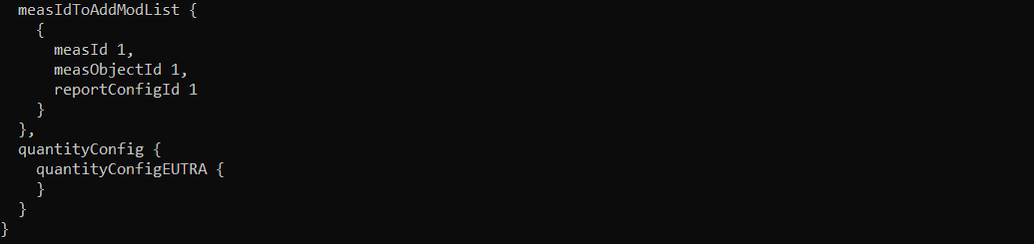
The measIdToAddModList section connects the measurement object and report configuration. In this example, measId 1 links measObjectId 1 with reportConfigId 1.
The key point is that this ASN.1 file directly defines a periodic LTE measurement configuration. When this file is loaded through meas_config, the UE should receive this configuration in RRC Connection Reconfiguration and then start sending periodic Measurement Reports.
Perform the test
Perform the test by starting the LTE service and checking the basic cell configuration with the cell phy and cell commands.
In this example, the eNB is running two LTE cells under PLMN 00101 and eNB ID 0x1a2e0.
The cell phy command shows that both cells are LTE cells on band 7 with 5 MHz bandwidth. Both cells use DL ARFCN 3350 and UL ARFCN 21350. This confirms that the two cells are configured on the same LTE frequency, which matches the purpose of this intra-frequency measurement test.
The PCI values are different. Cell 0x001 uses PCI 1, and cell 0x002 uses PCI 2. This allows the UE to distinguish the two cells even though they are on the same frequency.
The cell command shows the higher-level cell information. Cell 0x001 has TAC 0x0001, dl_earfcn 3350, PCI 1, and PRACH sequence index 204. Cell 0x002 has TAC 0x0001, dl_earfcn 3350, PCI 2, and PRACH sequence index 28.
The important point is to confirm that both LTE cells are running normally and are configured on the same DL EARFCN. Since the measurement configuration will be loaded from the ASN.1 meas_config file, this step is mainly to verify that the radio cell setup is ready before attaching the UE.
Adjust cell power using 'cell gain' command. (
In this example, cell 1 is made stronger than cell 2 so that the UE camps on cell 1 at the beginning of the test.
cell_gain 1 -10 sets the downlink gain of cell 1 to -10 dB. cell_gain 2 -20 sets the downlink gain of cell 2 to -20 dB. Since cell 1 has higher power than cell 2, the UE is expected to select cell 1 as the serving cell.
After applying the commands, the cell command is used to confirm the result. The output shows dl_gain -10.0 for cell 0x001 and dl_gain -20.0 for cell 0x002.
In this test, it is better to use cell_gain rather than tx_gain. tx_gain can also change the transmitted power, but it may change the reference power information in SIB. Then the UE may behave differently from what you expect.
The tx_gain command is checked only for confirmation. TX0 and TX1 remain at the default gain value, 89.8 dB.
The key point is to create a stable initial condition where the UE camps on cell 1. Since this is a periodic measurement test, the UE does not need a special event condition to send reports. Once the ASN.1 measurement configuration is applied, the UE should periodically report the measured cell according to the configured report interval.
Power on the UE and let the UE attach to the cell.
In this example, the trace command is used to confirm that the UE attaches to the intended serving cell. The PRACH line shows cell=01, which means the UE starts random access on cell 1. This is expected because cell 1 was configured with higher gain than cell 2.
In the trace output, UE_ID is 1 and the Cell column shows 001. This confirms that the UE is connected to cell 0x001. The RNTI is 003d, which is the temporary radio identifier assigned to the UE.
The downlink and uplink status values are also shown, such as CQI, RI, MCS, SNR, bitrate, PHR, path loss, and timing advance. These values indicate that the UE has completed access and has an active LTE radio connection.
The key point is to confirm the initial serving cell before checking periodic measurement reporting. Once the UE is attached to cell 1, the ASN.1 measurement configuration can be delivered through RRC Connection Reconfiguration, and the UE should start sending periodic Measurement Reports according to the configured report interval.
Adjust the cell power to trigger the periodic measurement report.
In this example, the UE initially camps on cell 1. Then the relative cell power is changed so that cell 2 becomes stronger than cell 1.
cell_gain 2 -10 sets the downlink gain of cell 2 to -10 dB. cell_gain 1 -20 reduces the downlink gain of cell 1 to -20 dB. After applying these commands, the cell command is used to confirm the current gain values.
The output shows that cell 0x001 has dl_gain -20.0, and cell 0x002 has dl_gain -10.0. So cell 2 is now stronger than cell 1.
Since this test uses periodic reporting, the UE does not need to wait for an event condition such as A3. However, changing the cell power is still useful because it makes the target cell more visible as one of the strongest measured cells.
In the ASN.1 configuration, the reporting purpose is reportStrongestCells and maxReportCells is set to 1. So the UE reports the strongest measured cell periodically. By making cell 2 stronger, the periodic Measurement Report is expected to include cell 2 as the reported neighbour cell.
The exact gain values may vary depending on the UE and test environment. The important point is to create a clear power condition where the target cell is stronger than the serving cell, so that the periodic report can show the intended measurement target.

Log Analysis
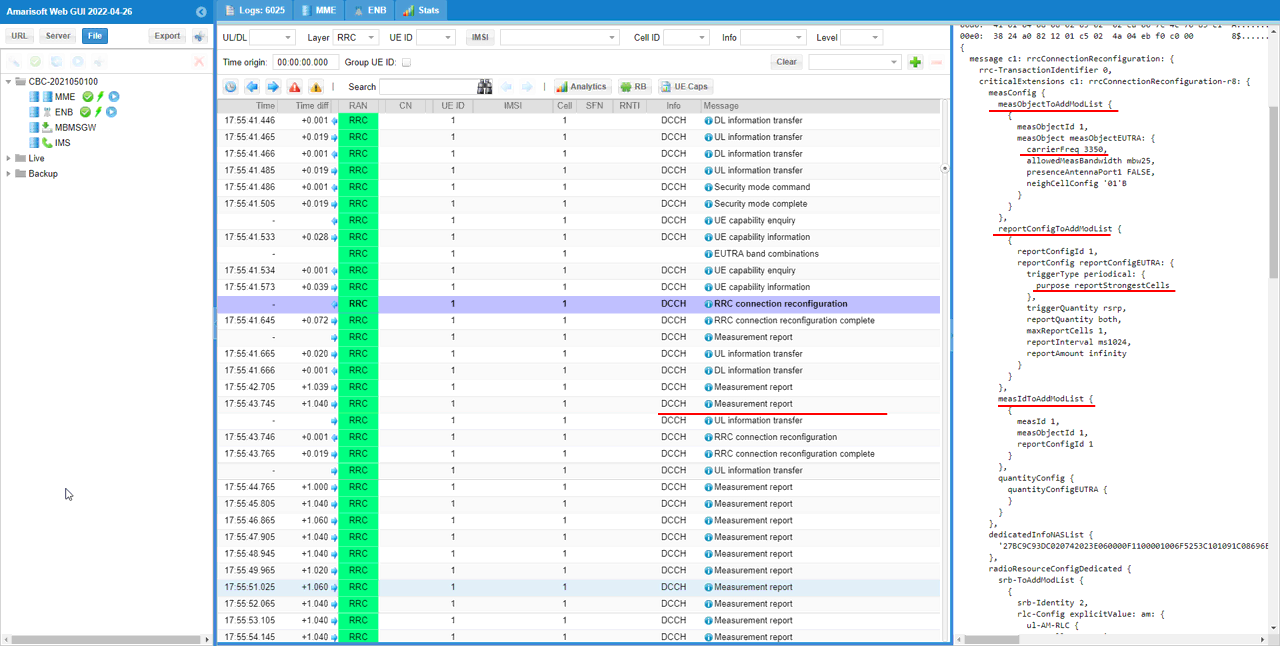
During the initial attach, the Callbox sends the RRC Connection Reconfiguration message to the UE. This message includes the measurement configuration loaded from the ASN.1 meas_config file.
In this example, the important part is measConfig. It contains measObjectToAddModList, reportConfigToAddModList, and measIdToAddModList. These three parts define what the UE should measure, how the UE should report it, and how the measurement object and report configuration are connected.
In measObjectToAddModList, measObjectId is set to 1 and measObjectEUTRA is used. The carrierFreq is shown as 3350, and allowedMeasBandwidth is shown as mbw25. In the ASN.1 file, these values were set to automatic values, but the eNB patched them with the actual serving LTE frequency and bandwidth before sending the RRC message to the UE.
The reportConfigToAddModList section shows reportConfigId 1. The reportConfig is reportConfigEUTRA, and triggerType is periodic. This confirms that the UE is configured for periodic measurement reporting, not event-triggered reporting.
The purpose is reportStrongestCells. This means the UE reports the strongest measured cell for this measurement object. The triggerQuantity is rsrp, and reportQuantity is both. So the measurement is based on RSRP, but the report can include both RSRP and RSRQ.
The maxReportCells value is 1. This means the UE reports only one strongest cell. The reportInterval is ms1024, so the UE sends the Measurement Report roughly every 1024 ms. The reportAmount is infinity, so the periodic reporting continues until the measurement configuration is changed or released.
The measIdToAddModList section connects the measurement object and report configuration. In this example, measId 1 links measObjectId 1 with reportConfigId 1. This tells the UE to apply the periodic reporting rule to the LTE measurement object on EARFCN 3350.
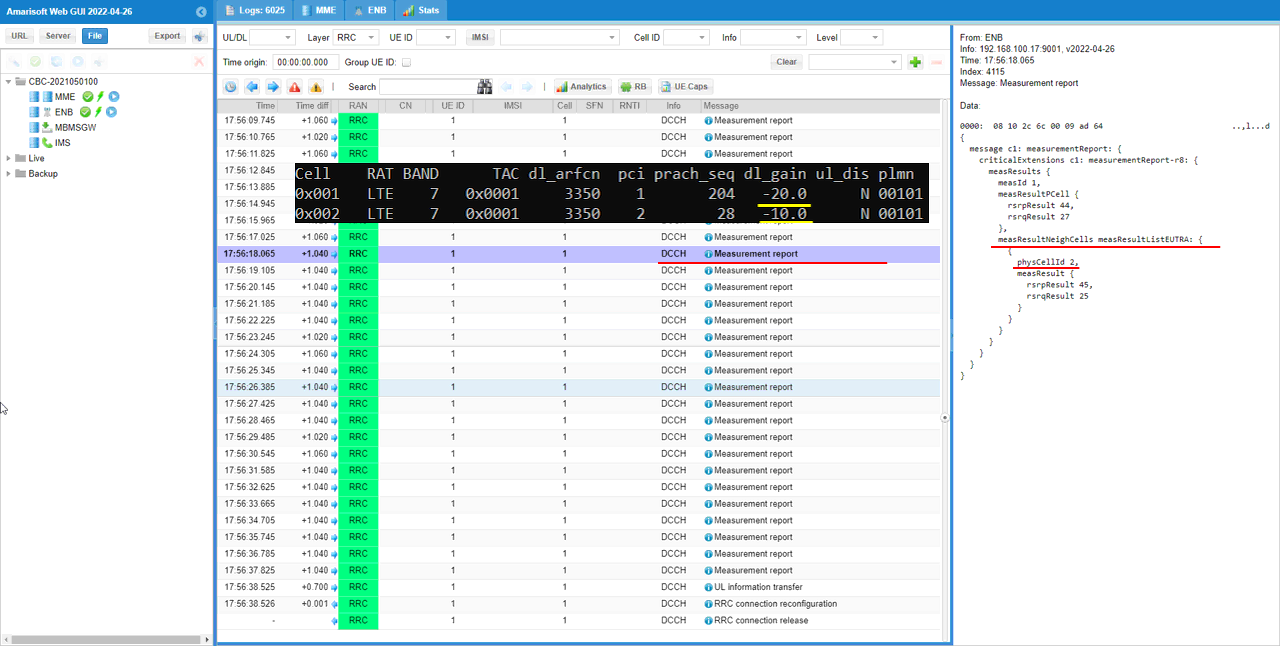
The log list also shows repeated Measurement report messages after the RRC Connection Reconfiguration. This is the expected behavior for periodic reporting. Unlike A3 or other event-based reporting, the UE does not wait for a specific trigger condition. Once the configuration is applied, it sends reports periodically according to the configured report interval.
So the main confirmation point in this log is that the RRC Connection Reconfiguration contains the periodic report configuration from the ASN.1 file, and the UE starts sending repeated Measurement Report messages afterward.
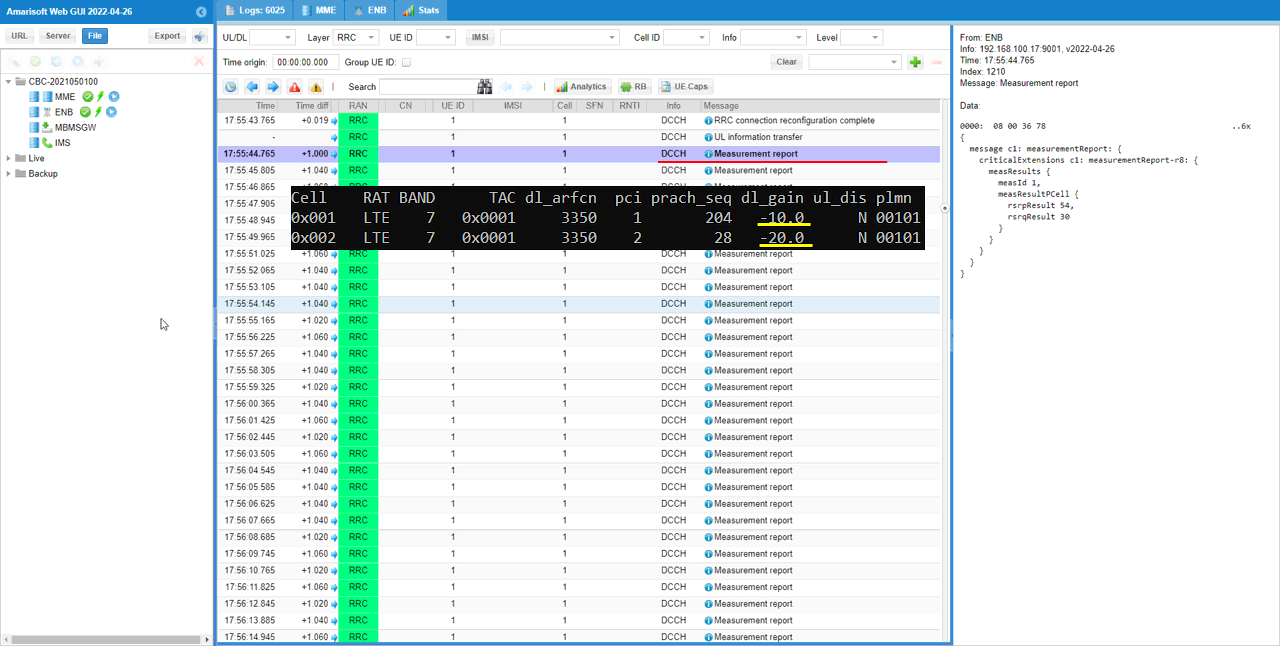
When the cell power is not in the state that makes the neighbour cell strong enough, the UE may send the periodic Measurement Report with serving cell information only.
In this example, cell 1 is still stronger than cell 2. The cell command output shows that cell 0x001 has dl_gain -10.0, while cell 0x002 has dl_gain -20.0. So the UE still sees the serving cell as the stronger cell.
The decoded Measurement Report shows measId 1. This matches the periodic measurement configuration that was sent earlier by RRC Connection Reconfiguration.
Inside measResults, only measResultPCell is included. It shows rsrpResult 54 and rsrqResult 30 for the serving cell. However, measResultNeighCells is not included in this report.
This is expected in this condition. The ASN.1 configuration uses periodic reporting with purpose set to reportStrongestCells and maxReportCells set to 1. If the serving cell is still the strongest detected cell, the UE may report only the serving cell result.
So, even though the UE is sending periodic Measurement Reports, this does not always mean that the neighbour cell is included. To verify the target cell measurement, you should check whether measResultNeighCells appears in the report. If it is missing, adjust the cell gain so that the target cell becomes stronger or more clearly detectable by the UE.
When the cell power is in the right condition, the UE sends the periodic Measurement Report with both serving cell and target cell measurement results.
In this example, the cell command output shows that cell 0x001 has dl_gain -20.0, and cell 0x002 has dl_gain -10.0. This means the target cell, cell 2, is now stronger than the serving cell. This makes cell 2 visible as the strongest neighbour cell for the UE.
The decoded Measurement Report shows measId 1. This matches the periodic measurement configuration sent earlier by RRC Connection Reconfiguration.
Inside measResults, measResultPCell is included first. It shows the serving cell measurement result with rsrpResult 44 and rsrqResult 27. These values represent the UE measurement result for the current serving cell.
The important part is measResultNeighCells. In this example, measResultNeighCells contains measResultListEUTRA. This confirms that the UE is reporting an LTE neighbour cell in addition to the serving cell.
Inside the neighbour cell result, physCellId is 2. This means the reported neighbour cell is PCI 2, which is the intended target cell in this test. The neighbour cell measurement result shows rsrpResult 45 and rsrqResult 25.
So the key confirmation point is the presence of measResultNeighCells in the Measurement Report. Since this report includes physCellId 2, it confirms that the UE measured the target LTE cell and included it in the periodic report.
Test 4 : LTE to LTE, IntraFrequency Event A3 with meas_config (ASN.1 file)
This test shows how to configure Intra frequency measurement for Event A3 for an LTE cell to measure another LTE cell with ASN file and verify it.
Configuration
I used the enb-2cell-meas-intra-asn-a3.cfg which is copied and modified from enb-2cell-ho.cfg.
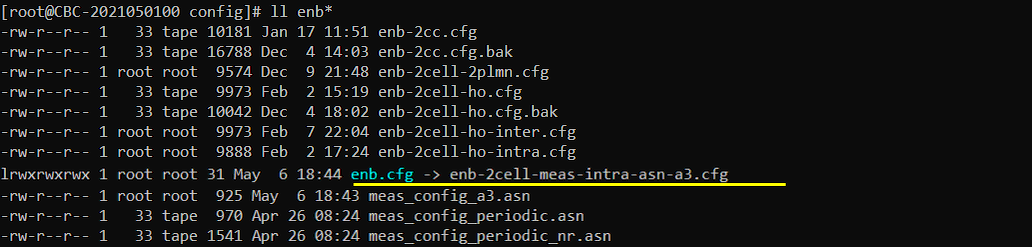
I also used mme-ims.cfg as it is.
Configure enb-2cell-meas-intra-asn-a3.cfg as below.
This example sets the basic two-cell LTE configuration for the intra-frequency Event A3 measurement test. One cell is used as the serving cell, and the other cell is used as the measurement target cell.
N_CELL is set to 2, so the eNB runs two LTE cells. TDD is set to 0, so the cells operate in FDD mode. N_RB_DL is set to 25, which means 5 MHz LTE bandwidth.
N_ANTENNA_DL and N_ANTENNA_UL are both set to 1. This keeps the RF setup simple with single antenna operation.
CHANNEL_SIM is set to 0, so the channel simulator is disabled. This makes it easier to control the measurement condition by changing the cell gain.
N_ENB is set to 0, so this is used as a normal LTE eNB configuration.
The key point is that this test uses two LTE cells on the same LTE frequency. The measurement configuration will be provided by meas_config using an ASN.1 file, and the UE will send a Measurement Report only when the Event A3 condition is satisfied.
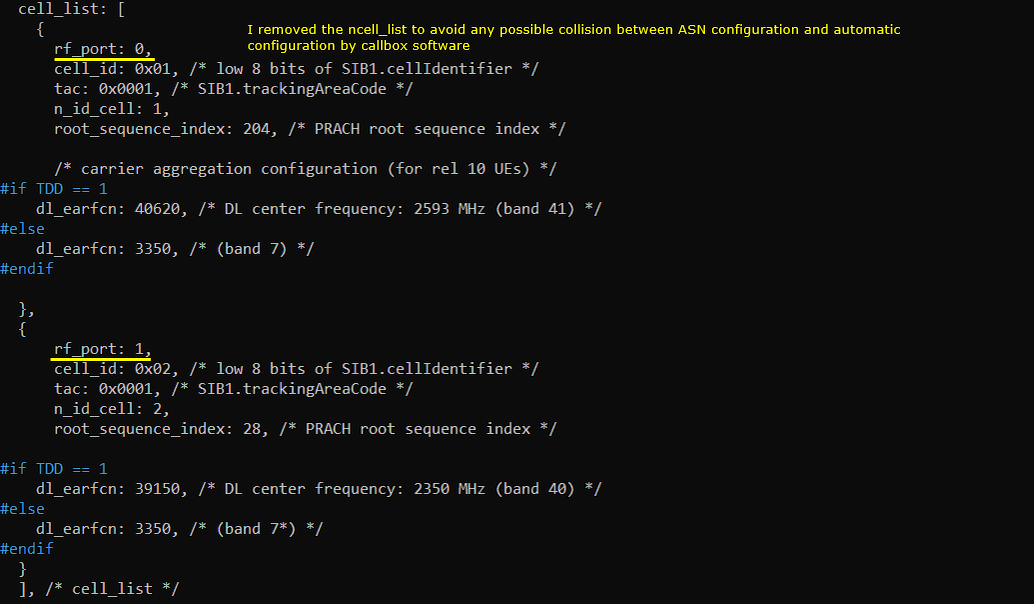
In this test, ncell_list is removed to avoid any possible collision between the ASN.1 measurement configuration and the automatic configuration generated by the Callbox software.
In the previous meas_config_desc-based tests, ncell_list was used so that Amarisoft could automatically generate the neighbour-cell based measurement configuration. In this test, the measurement configuration is provided directly by the ASN.1 meas_config file. So it is better to remove ncell_list and let the ASN.1 file control the measurement behavior explicitly.
The first cell is configured with rf_port 0, cell_id 0x01, tac 0x0001, and n_id_cell 1. For FDD operation, dl_earfcn is set to 3350.
The second cell is configured with rf_port 1, cell_id 0x02, tac 0x0001, and n_id_cell 2. For FDD operation, dl_earfcn is also set to 3350.
Since both cells use the same DL EARFCN, this is an intra-frequency LTE measurement test. The UE camps on one LTE cell and measures the other LTE cell on the same LTE carrier frequency.
The key point is that the cell configuration only defines the two LTE cells. The Event A3 measurement rule itself will be defined in the ASN.1 meas_config file. This avoids unexpected overlap between automatic neighbour-cell configuration and the manually defined ASN.1 measurement configuration.
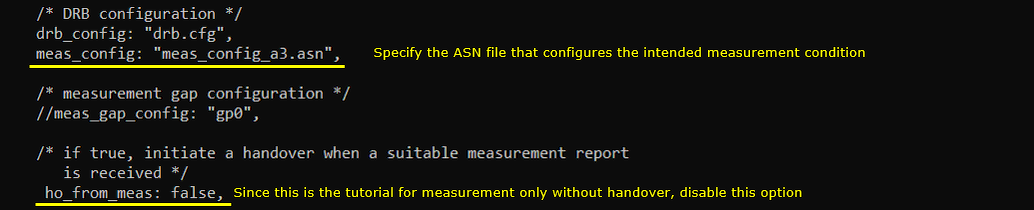
Specify the ASN.1 file that configures the intended Event A3 measurement condition using the meas_config parameter.
In this example, meas_config is set to meas_config_a3.asn. This means the measurement configuration is loaded directly from the ASN.1 file, instead of being generated automatically from meas_config_desc.
This is useful when you want to define the exact RRC measurement configuration by yourself. In this test, the ASN.1 file defines an intra-frequency LTE Event A3 measurement rule. The UE will use this configuration to compare the serving cell and neighbour cell.
The measurement gap configuration is commented out. Since this is an intra-frequency test, the UE can measure the neighbour cell on the same LTE frequency without using a measurement gap.
ho_from_meas is set to false. This disables handover from the measurement report. So even if the UE sends an Event A3 Measurement Report, the eNB does not start handover. This keeps the test focused only on measurement reporting.
The key point is that meas_config_a3.asn controls the measurement behavior. The cell configuration only creates the two LTE cells, while the ASN.1 file defines when the UE should send the Measurement Report.
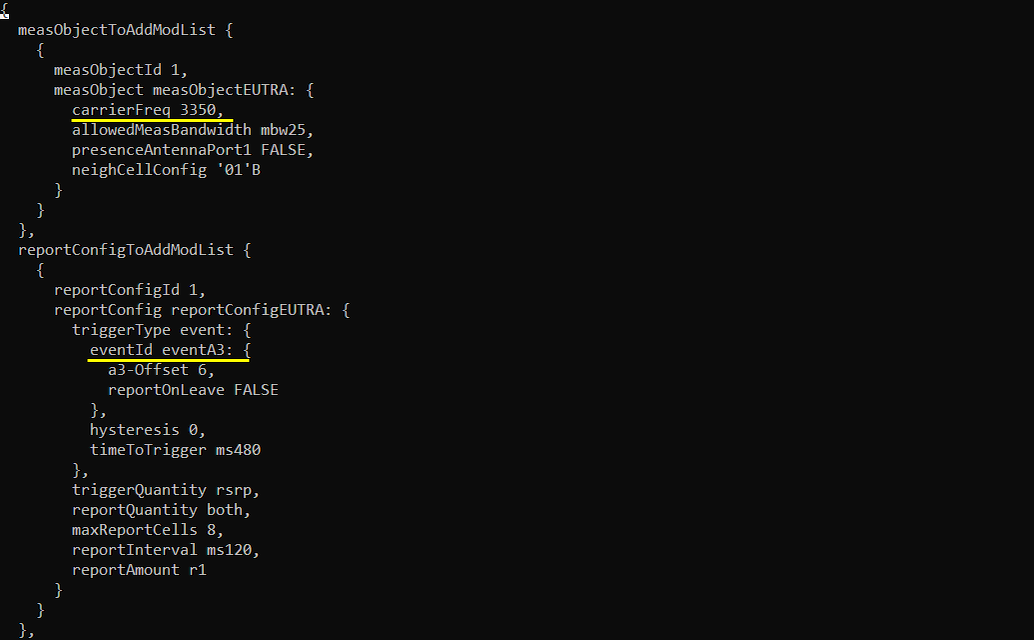
Following is the configuration in meas_config_a3.asn (
This ASN.1 file defines the MeasConfig object for intra-frequency Event A3 measurement.
In measObjectToAddModList, measObjectId is set to 1 and measObjectEUTRA is used. The carrierFreq is set to 3350 and allowedMeasBandwidth is set to mbw25. This means the UE measures LTE cells on DL EARFCN 3350 with 5 MHz measurement bandwidth.
In reportConfigToAddModList, reportConfigId is set to 1. The triggerType is event, and the eventId is eventA3. This means the UE sends a Measurement Report when the neighbour cell becomes better than the serving cell by the configured A3 condition.
a3-Offset is set to 6. This is the main A3 trigger offset. The neighbour cell should become better than the serving cell by this offset before the event can be triggered.
reportOnLeave is set to FALSE. This means the UE does not send a separate report when the A3 condition is no longer satisfied.
hysteresis is set to 0, so no additional hysteresis margin is applied. timeToTrigger is set to ms480, so the A3 condition must remain true for 480 ms before the UE sends the Measurement Report.
triggerQuantity is set to rsrp. This means the A3 comparison is based on RSRP. reportQuantity is set to both, so the UE can report both RSRP and RSRQ.
maxReportCells is set to 8, so the UE can include up to 8 neighbour cells in the report. reportInterval is set to ms120, and reportAmount is set to r1. This means the UE sends one Measurement Report when the event is triggered.
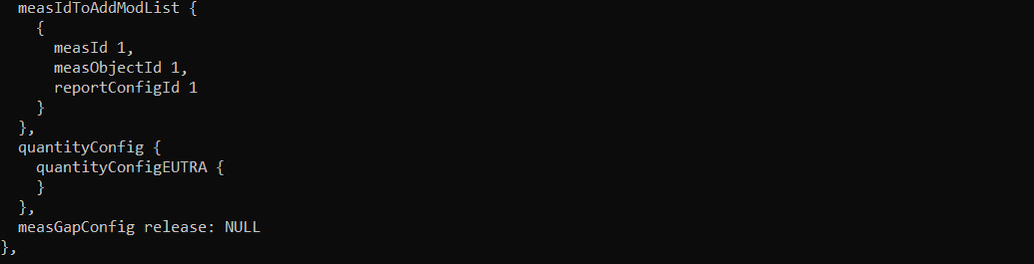
In measIdToAddModList, measId 1 links measObjectId 1 with reportConfigId 1. This tells the UE to apply the Event A3 reporting rule to the LTE measurement object on EARFCN 3350.
measGapConfig is set to release NULL. This is expected because this is an intra-frequency measurement test. The UE can measure the target LTE cell on the same frequency without a measurement gap.
The key point is that this ASN.1 file directly defines an LTE intra-frequency Event A3 measurement configuration. Once this configuration is sent to the UE, the UE should monitor the neighbour cell and send a Measurement Report when the A3 condition is satisfied.
Perform the test
Perform the test by starting the LTE service and checking the basic cell configuration with the cell phy and cell commands.
In this example, the eNB is running two LTE cells under PLMN 00101 and eNB ID 0x1a2e0.
The cell phy command shows that both cells are LTE cells on band 7 with 5 MHz bandwidth. Both cells use DL ARFCN 3350 and UL ARFCN 21350. This confirms that the two cells are configured on the same LTE frequency, which matches the intra-frequency Event A3 test scenario.
The two cells use different PCI values. Cell 0x001 uses PCI 1, and cell 0x002 uses PCI 2. This allows the UE to distinguish the serving cell and the target cell even though both cells are on the same EARFCN.
The cell command shows the higher-level cell configuration. Cell 0x001 has TAC 0x0001, dl_earfcn 3350, PCI 1, and PRACH sequence index 204. Cell 0x002 has TAC 0x0001, dl_earfcn 3350, PCI 2, and PRACH sequence index 28.
The important point is to confirm that both LTE cells are running normally on the same DL EARFCN before attaching the UE. Since the Event A3 measurement configuration is loaded from the ASN.1 meas_config file, this step is mainly to verify that the radio cell setup is ready for the measurement test.
Adjust cell power using 'cell gain' command. (
In this example, cell 1 is made stronger than cell 2 so that the UE camps on cell 1 at the beginning of the test.
cell_gain 1 -10 sets the downlink gain of cell 1 to -10 dB. cell_gain 2 -20 sets the downlink gain of cell 2 to -20 dB. Since cell 1 has higher power than cell 2, the UE is expected to select cell 1 as the serving cell.
After applying the commands, the cell command is used to confirm the result. The output shows dl_gain -10.0 for cell 0x001 and dl_gain -20.0 for cell 0x002.
In this test, it is better to use cell_gain rather than tx_gain. tx_gain can also change the transmitted power, but it may affect the reference power information in SIB. If that happens, the UE may interpret the cell power condition differently from what you expect.
The tx_gain command is checked only for confirmation. TX0 and TX1 remain at the default gain value, 89.8 dB.
The key point is to create a stable initial condition where the UE camps on cell 1. After the UE attaches, you can change the relative cell power so that cell 2 becomes better than cell 1 and triggers the Event A3 Measurement Report.
Power on the UE and let the UE attach to the cell.
In this example, the trace command is used to confirm that the UE attaches to the intended serving cell before testing Event A3.
The PRACH line shows cell=01. This means the UE starts random access on cell 1. This is expected because cell 1 was configured with higher cell gain than cell 2.
In the trace output, UE_ID is 1 and the Cell column shows 001. This confirms that the UE is connected to cell 0x001. The RNTI is 003d, which is the temporary radio identifier assigned to the UE.
The downlink and uplink status values are also shown, such as CQI, RI, MCS, SNR, bitrate, PHR, path loss, and timing advance. These values indicate that the UE has completed access and has an active LTE radio connection.
The key point is to confirm the initial serving cell. The UE should first camp on cell 1. After this is confirmed, you can change the relative cell power so that cell 2 becomes better than cell 1 and triggers the Event A3 Measurement Report.
Adjust the cell power to trigger the Event A3 Measurement Report.
In this example, the UE initially camps on cell 1. Then the relative cell power is changed so that cell 2 becomes stronger than cell 1.
cell_gain 2 -10 sets the downlink gain of cell 2 to -10 dB. This makes the target cell stronger. Then cell_gain 1 -20 and cell_gain 1 -30 reduce the downlink gain of cell 1 step by step. This makes the serving cell weaker.
After applying the commands, the cell command is used to confirm the current gain values. The output shows that cell 0x001 has dl_gain -30.0, and cell 0x002 has dl_gain -10.0.
This creates a clear condition where the neighbour cell becomes better than the serving cell. Since this test uses Event A3, the UE should send a Measurement Report when the neighbour cell becomes better than the serving cell by the configured A3 offset and the condition stays valid for the configured timeToTrigger.
The exact gain values may be different depending on the UE and RF environment. The important point is to adjust the relative power until cell 2 becomes strong enough to satisfy the Event A3 condition.

Log Analysis
During the initial attach, the Callbox sends the RRC Connection Reconfiguration message to the UE. This message includes the Event A3 measurement configuration loaded from the ASN.1 meas_config file.
In this example, the important part is measConfig. It contains measObjectToAddModList, reportConfigToAddModList, and measIdToAddModList. These three sections define what the UE should measure, what condition should trigger the report, and how the measurement object and report configuration are connected.
In measObjectToAddModList, measObjectId is set to 1 and measObjectEUTRA is used. The carrierFreq is 3350, and allowedMeasBandwidth is mbw25. This means the UE measures LTE cells on DL EARFCN 3350 with 5 MHz measurement bandwidth. Since both cells are configured on the same EARFCN, this is an intra-frequency measurement object.
In reportConfigToAddModList, reportConfigId is set to 1. The reportConfig is reportConfigEUTRA, and triggerType is event. The eventId is eventA3. This confirms that the UE is configured for Event A3 reporting, not periodic reporting.
The a3-Offset is set to 6. This means the UE sends a Measurement Report when the neighbour cell becomes better than the serving cell by the configured A3 offset. reportOnLeave is FALSE, so the UE does not send another report when the A3 condition is no longer satisfied.
The hysteresis is 0, and timeToTrigger is ms480. This means the A3 condition must remain valid for 480 ms before the UE sends the report. This avoids triggering a report from a very short power fluctuation.
The triggerQuantity is rsrp, so the A3 comparison is based on RSRP. reportQuantity is both, so the UE can include both RSRP and RSRQ in the Measurement Report. maxReportCells is 8, reportInterval is ms120, and reportAmount is r1. So the UE can report up to 8 neighbour cells, but it sends only one report when the event is triggered.
In measIdToAddModList, measId 1 links measObjectId 1 with reportConfigId 1. This mapping tells the UE to apply the Event A3 rule to the LTE measurement object on EARFCN 3350.
At the bottom, measGapConfig is release NULL. This is expected because this is an intra-frequency measurement test. The UE can measure the neighbour cell on the same LTE frequency without a measurement gap.
The key confirmation point is that the RRC Connection Reconfiguration contains the expected ASN.1-based Event A3 measurement configuration. Once the UE receives this configuration, it monitors the neighbour cell and sends a Measurement Report only when the A3 condition is satisfied.
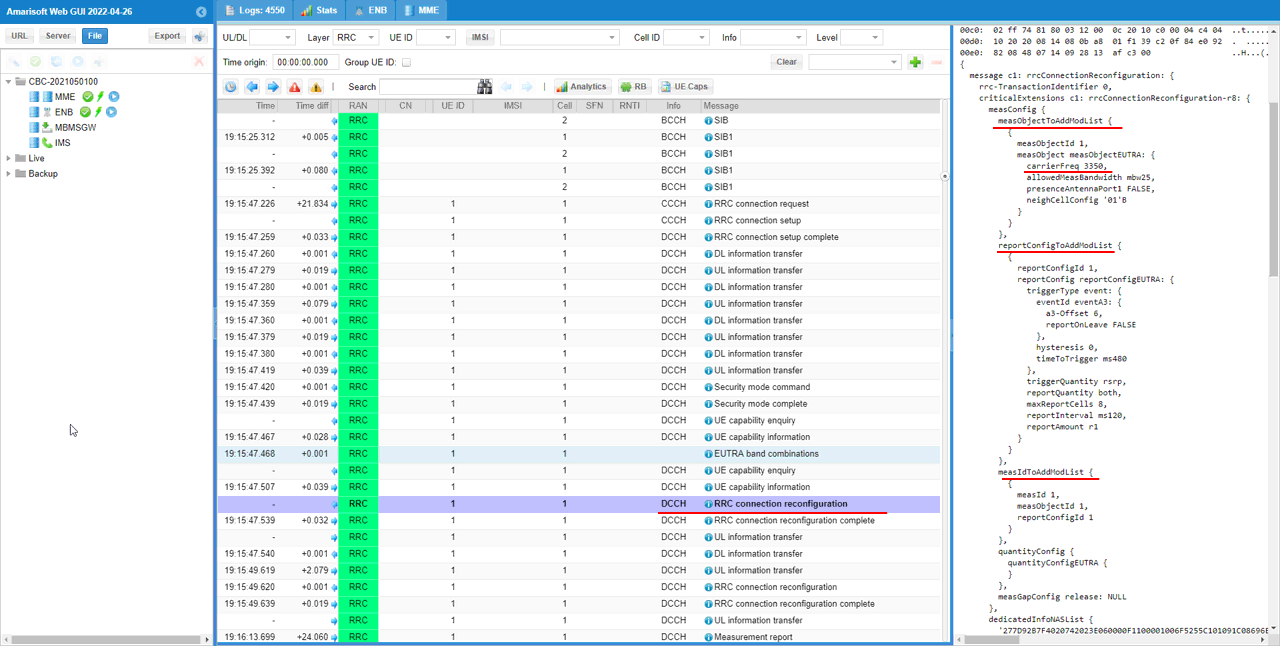
Once the cell power condition is met for triggering the Event A3 report, the UE sends the Measurement Report.
In this example, the selected log entry is Measurement report. The decoded RRC message shows message c1: measurementReport, which means the UE sent an RRC Measurement Report to the eNB.
Inside measResults, measId is 1. This matches the measurement identity configured earlier in the ASN.1 file. It links measObjectId 1 with reportConfigId 1, so this report is associated with the intra-frequency Event A3 configuration.
The measResultPCell section shows the serving cell measurement result. In this example, rsrpResult is 39 and rsrqResult is 22. These values are encoded LTE RRC measurement result indexes for the serving cell.
The important part is measResultNeighCells. In this example, measResultNeighCells contains measResultListEUTRA, which means the UE is reporting an LTE neighbour cell measurement result.
Inside measResultListEUTRA, physCellId is 2. This confirms that the reported neighbour cell is PCI 2, which is the target LTE cell in this test. The neighbour cell measurement result shows rsrpResult 50 and rsrqResult 32.
This is the expected result for Event A3. Cell 2 became better than the serving cell by the configured A3 offset, and the condition remained valid for the configured timeToTrigger. Then the UE sent the Measurement Report.
The key confirmation point is the presence of measResultNeighCells in the Measurement Report. This confirms not only that the UE sent a report, but also that the intended neighbour cell was measured and reported.
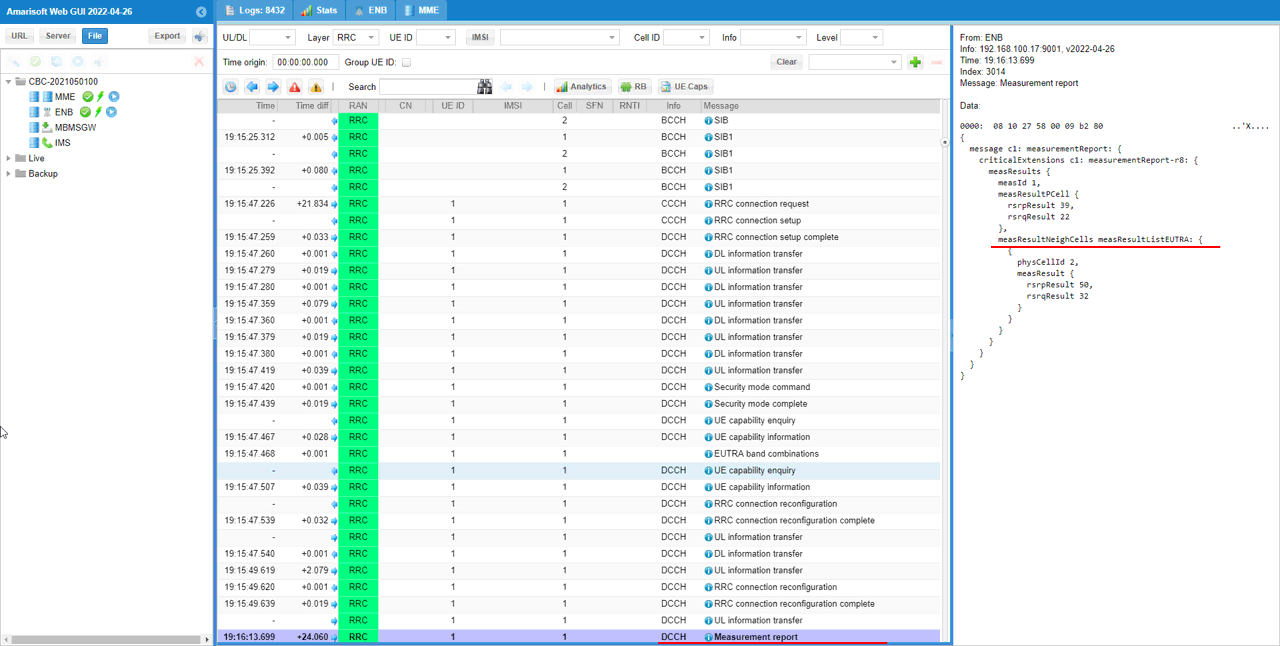
Test 5 : LTE to LTE, InterFrequency CGI Report with meas_config (ASN.1 file)
This test shows how to configure Intra frequency measurement for CGI Report for an LTE cell to measure another LTE cell with ASN file and verify it.
Configuration
I used the enb-2cell-meas-inter-asn-cgi.cfg which is copied and modified from enb-2cell-ho.cfg.
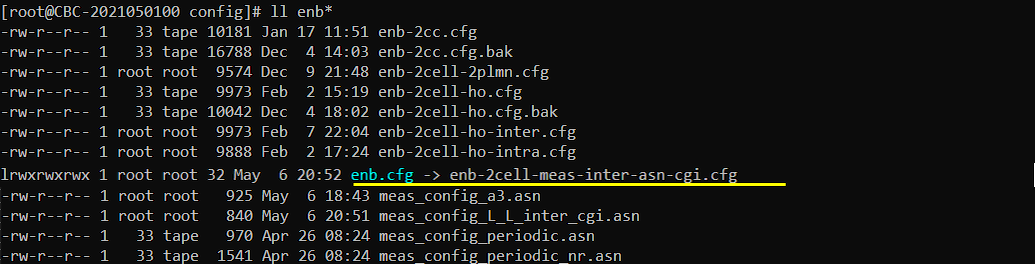
I also used mme-ims.cfg as it is.
Configure enb-2cell-meas-inter-asn-cgi.cfg as below.
This example sets the basic two-cell LTE configuration for the inter-frequency CGI report test. One cell is used as the serving cell, and the other cell is used as the CGI measurement target cell.
N_CELL is set to 2, so the eNB runs two LTE cells. TDD is set to 0, so the cells operate in FDD mode. N_RB_DL is set to 25, which means 5 MHz LTE bandwidth.
N_ANTENNA_DL and N_ANTENNA_UL are both set to 1. This keeps the RF setup simple with single antenna operation.
CHANNEL_SIM is set to 0, so the channel simulator is disabled. This makes it easier to control the measurement condition by changing the cell gain.
N_ENB is set to 0, so this is used as a normal LTE eNB configuration.
The key point is that this test uses two LTE cells on different LTE frequencies. The measurement configuration will be provided by meas_config using an ASN.1 file, and the UE will be requested to perform CGI reporting for the target LTE cell.
In this test, ncell_list is removed to avoid any possible collision between the ASN.1 measurement configuration and the automatic configuration generated by the Callbox software.
In the previous meas_config_desc-based tests, ncell_list was used to help Amarisoft generate the measurement configuration automatically. In this test, the measurement configuration is provided directly by the ASN.1 meas_config file. So it is better to remove ncell_list and let the ASN.1 file control the CGI reporting behavior explicitly.
The first cell is configured with rf_port 0, cell_id 0x01, tac 0x0001, and n_id_cell 1. For FDD operation, dl_earfcn is set to 3350. This is the serving cell where the UE is expected to camp first.
The second cell is configured with rf_port 1, cell_id 0x02, tac 0x0001, and n_id_cell 2. For FDD operation, dl_earfcn is set to 1575. This is the target LTE cell for the CGI report.
Since the two cells use different DL EARFCNs, this is an inter-frequency LTE measurement test. The UE camps on cell 1 on EARFCN 3350 and measures cell 2 on EARFCN 1575.
The key point is that the cell configuration only defines the two LTE cells and their frequencies. The CGI measurement rule itself will be defined in the ASN.1 meas_config file. This avoids unexpected overlap between automatic neighbour-cell configuration and the manually defined ASN.1 CGI measurement configuration.
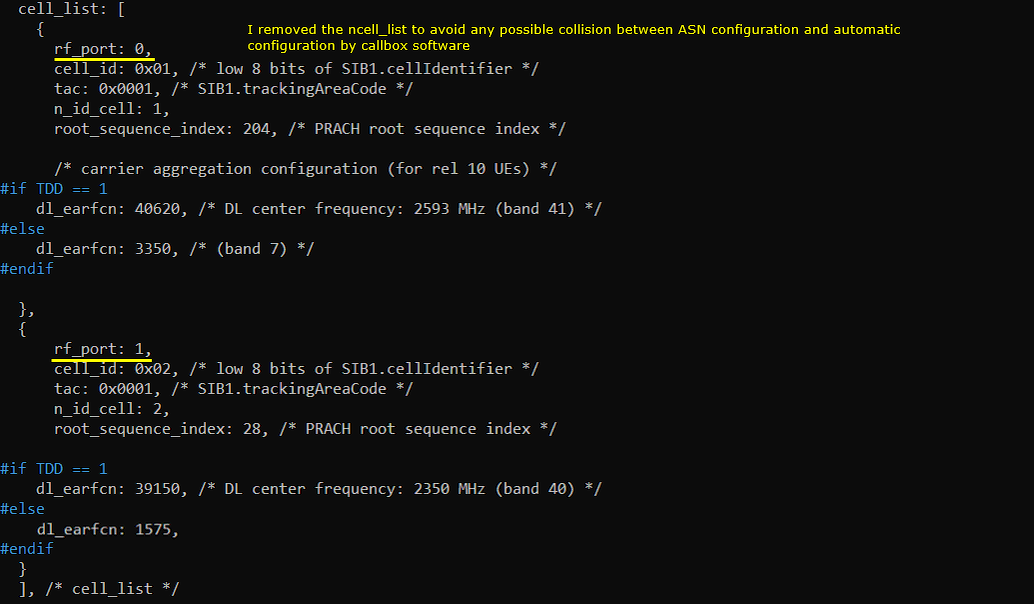
Specify the ASN.1 file that configures the intended CGI measurement condition using the meas_config parameter.
In this example, meas_config is set to meas_config_L_L_inter_cgi.asn. This means the measurement configuration is loaded directly from the ASN.1 file, instead of being generated from meas_config_desc.
The measurement gap configuration is enabled with meas_gap_config set to gp0. This is important because this is an inter-frequency CGI test. The UE camps on one LTE frequency, but it needs to measure and read system information from another LTE frequency. The measurement gap gives the UE time to tune away from the serving frequency and read the target cell information.
ho_from_meas is set to false. This disables handover based on the measurement report. Since this tutorial is focused only on CGI reporting, the eNB should not initiate handover even if a suitable measurement report is received.
The key point is that meas_config_L_L_inter_cgi.asn defines the CGI reporting behavior, while meas_gap_config gp0 provides the required gap for inter-frequency measurement. This allows the UE to measure the target LTE cell and report its cell identity information.
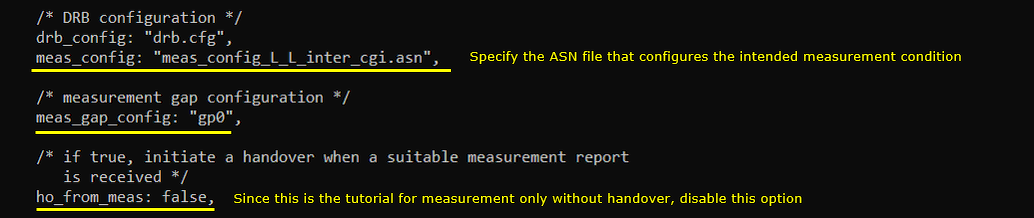
Following is the configuration in meas_config_L_L_inter_cgi.asn . (
This ASN.1 file defines the MeasConfig object for LTE inter-frequency CGI reporting.
In measObjectToAddModList, measObjectId is set to 1 and measObjectEUTRA is used. The carrierFreq is set to 1575. This is the DL EARFCN of the target LTE cell. The serving cell uses EARFCN 3350, so this configuration tells the UE to measure another LTE cell on a different frequency.
allowedMeasBandwidth is set to mbw25. This means the target LTE measurement bandwidth is 5 MHz. presenceAntennaPort1 is FALSE, and neighCellConfig is set to 01.
The important CGI-specific parameter is cellForWhichToReportCGI. It is set to 2. This means the UE should report CGI information for the cell whose physical cell ID is 2. In this test, PCI 2 is the target LTE cell on EARFCN 1575.
In reportConfigToAddModList, reportConfigId is set to 1 and reportConfigEUTRA is used. The triggerType is periodic, and the purpose is reportCGI. This is the key point of this test. The UE is not only asked to report radio measurement values. It is asked to read and report the CGI information of the specified target cell.
triggerQuantity is set to rsrp, and reportQuantity is set to both. maxReportCells is set to 2. reportInterval is set to ms2048, so the UE can report every 2048 ms. reportAmount is set to r16, so the UE may send up to 16 reports unless the configuration is changed or released.
In measIdToAddModList, measId 1 links measObjectId 1 with reportConfigId 1. This tells the UE to apply the CGI reporting rule to the LTE measurement object on EARFCN 1575.
At the bottom, measGapConfig is shown as release NULL in the ASN.1 file. However, the actual measurement gap can be set up or released automatically by the Callbox depending on the cell power condition and measurement configuration. Since this is an inter-frequency CGI test, you should check the actual RRC Connection Reconfiguration log later and confirm whether measGapConfig is enabled when needed.
The key point is that this ASN.1 file requests CGI reporting for PCI 2 on EARFCN 1575. The UE should use the measurement gap to measure the target frequency, read the required system information from the target cell, and then send a Measurement Report containing the CGI-related result.
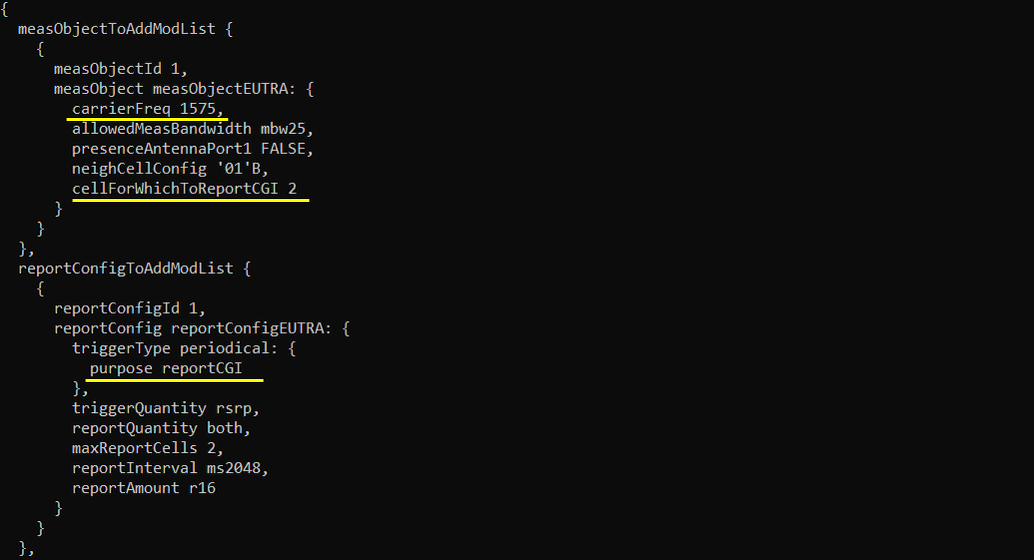
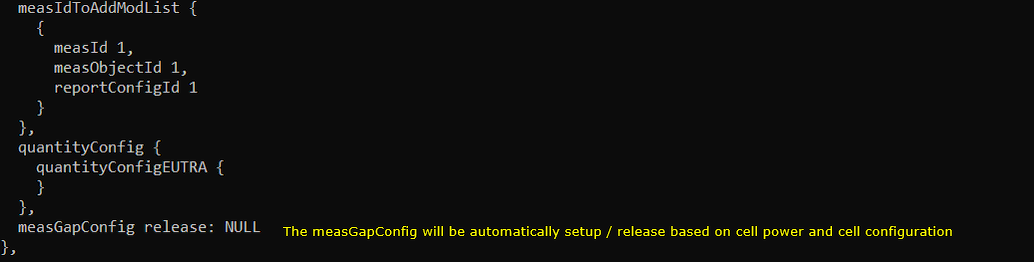
Perform the test
Perform the test by starting the LTE service and checking the basic cell configuration with the cell phy and cell commands.
In this example, the eNB is running two LTE cells under PLMN 00101 and eNB ID 0x1a2e0.
The cell phy command shows that both cells are LTE cells on band 7 with 5 MHz bandwidth. Cell 0x001 uses PCI 1, and cell 0x002 uses PCI 2. This confirms that the two LTE cells are active and can be distinguished by the UE.
The cell command shows the higher-level cell configuration. Cell 0x001 has TAC 0x0001, dl_earfcn 3350, PCI 1, and PRACH sequence index 204. Cell 0x002 has TAC 0x0001, dl_earfcn 3350, PCI 2, and PRACH sequence index 28.
For this CGI inter-frequency test, you should also verify the target cell frequency carefully. The ASN.1 file configured the CGI target measurement object with carrierFreq 1575, and the previous cell configuration also intended cell 2 to use dl_earfcn 1575. However, this output shows both cells with dl_earfcn 3350. If you are really running the inter-frequency CGI test, cell 2 should appear on the target EARFCN, such as 1575.
So the main purpose of this step is to confirm that both LTE cells are running normally. But before continuing with CGI reporting, make sure the serving cell and target cell frequency match the intended test scenario. For inter-frequency CGI reporting, the UE should camp on cell 1 and then measure/read CGI information from cell 2 on the different LTE frequency.
Adjust cell power using 'cell gain' command. (
In this example, cell 1 is made stronger than cell 2 so that the UE camps on cell 1 at the beginning of the test.
cell_gain 1 -10 sets the downlink gain of cell 1 to -10 dB. cell_gain 2 -20 sets the downlink gain of cell 2 to -20 dB. Since cell 1 has higher power than cell 2, the UE is expected to select cell 1 as the serving cell.
After applying the commands, the cell command is used to confirm the result. The output shows dl_gain -10.0 for cell 0x001 and dl_gain -20.0 for cell 0x002.
In this CGI inter-frequency test, it is better to use cell_gain rather than tx_gain. tx_gain can also change the transmitted power, but it may affect the reference power information broadcast in SIB. If that value changes, the UE may evaluate the cell condition differently from what you expect.
The tx_gain command is checked only for confirmation. TX0 and TX1 remain at the default gain value, 89.8 dB.
The key point is to create a stable initial condition where the UE camps on cell 1. After the UE attaches, the CGI measurement configuration can be applied, and the UE can use the measurement gap to measure the target cell and read its cell identity information.
Power on UE and let UE attach to the cell
In this example, the trace command is used to confirm that the UE camps on the intended serving cell before checking the CGI report behavior.
The PRACH line shows cell=01. This means the UE starts random access on cell 1. This is expected because cell 1 was configured with higher gain than cell 2.
In the trace output, UE_ID is 1 and the Cell column shows 001. This confirms that the UE is connected to cell 0x001. The RNTI is 003d, which is the temporary radio identifier assigned to the UE.
The downlink and uplink status values are also shown, such as CQI, RI, MCS, SNR, bitrate, PHR, path loss, and timing advance. These values indicate that the UE has completed access and has an active LTE radio connection.
The key point is to confirm the initial serving cell. The UE should first camp on cell 1. After this is confirmed, the inter-frequency CGI measurement configuration can be applied, and the UE can use the measurement gap to read the target cell information on the other LTE frequency.
Log Analysis
During the initial attach, the Callbox sends the RRC Connection Reconfiguration message to the UE. This message includes the CGI measurement configuration loaded from the ASN.1 meas_config file.
In this example, the important part is measConfig. It contains measObjectToAddModList, reportConfigToAddModList, and measIdToAddModList. These sections define what the UE should measure, what kind of report should be generated, and how the measurement object and report configuration are connected.
In measObjectToAddModList, measObjectId is set to 1 and measObjectEUTRA is used. The carrierFreq is 1575. This means the UE is requested to measure an LTE cell on EARFCN 1575. Since the serving cell is on a different EARFCN, this is an inter-frequency LTE measurement object.
The same section also includes cellForWhichToReportCGI set to 2. This is the key CGI-related parameter. It tells the UE to report CGI information for the LTE cell with physical cell ID 2. In this test, PCI 2 is the target LTE cell.
In reportConfigToAddModList, reportConfigId is set to 1. The reportConfig is reportConfigEUTRA, and triggerType is periodic. The purpose is reportCGI. This means the UE is not just reporting signal strength. It is requested to read the target cell system information and report the cell identity information.
The reportInterval is ms2048, and reportAmount is r16. This means the UE can report periodically with an interval of 2048 ms, up to 16 times.
In measIdToAddModList, measId 1 links measObjectId 1 with reportConfigId 1. This tells the UE to apply the CGI reporting rule to the LTE measurement object on EARFCN 1575.
The log also shows measGapConfig setup with gapOffset gp0 0. This is important for this inter-frequency CGI test. The UE needs measurement gaps to leave the serving frequency and read the target cell information on EARFCN 1575.
The key confirmation point in this log is that the RRC Connection Reconfiguration includes carrierFreq 1575, cellForWhichToReportCGI 2, purpose reportCGI, and measGapConfig setup. This means the UE has received the proper inter-frequency CGI measurement configuration.
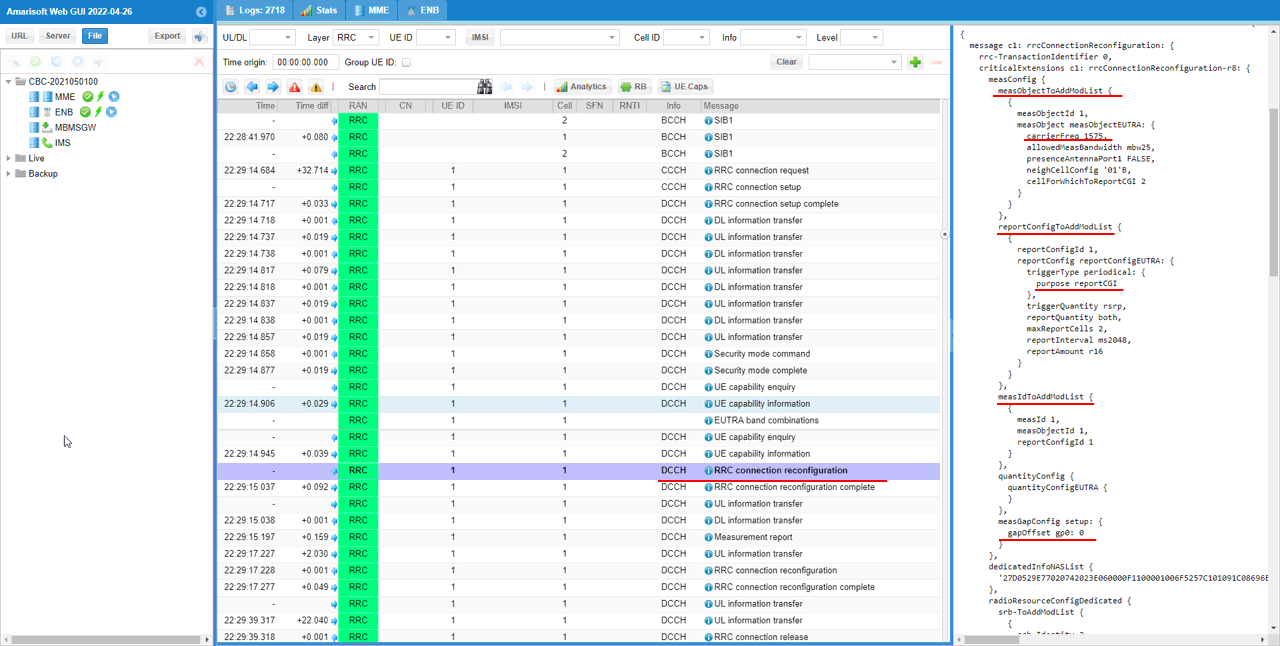
Ensure that the UE sends measResultNeighCells with cgi-Info.
In this example, the selected log entry is Measurement report. The decoded RRC message shows message c1: measurementReport, which confirms that the UE sent the CGI measurement result to the eNB.
Inside measResults, measId is 1. This matches the measurement identity configured earlier in the ASN.1 file. It links measObjectId 1 with reportConfigId 1, so this report is associated with the inter-frequency CGI reporting configuration.
The measResultPCell section shows the serving cell measurement result. In this example, rsrpResult is 53 and rsrqResult is 31. These values represent the serving cell radio measurement result.
The most important part is measResultNeighCells. In this example, measResultNeighCells contains measResultListEUTRA, and the reported physCellId is 2. This confirms that the UE is reporting the intended target LTE cell.
Inside the neighbour cell result, cgi-Info is included. This is the key confirmation for this test. The UE did not only measure the target cell by PCI and radio quality. It also read the required system information from the target cell and reported its CGI-related information.
The cgi-Info section includes cellGlobalId. Under cellGlobalId, plmn-Identity is shown with MCC 001 and MNC 01. The cellIdentity is shown as 1A2E002H. This identifies the target LTE cell globally. The trackingAreaCode is shown as 0001H.
So the key confirmation point is the presence of measResultNeighCells with cgi-Info. This proves that the UE successfully measured the inter-frequency target cell, read the target cell identity information, and reported the CGI information back to the eNB.
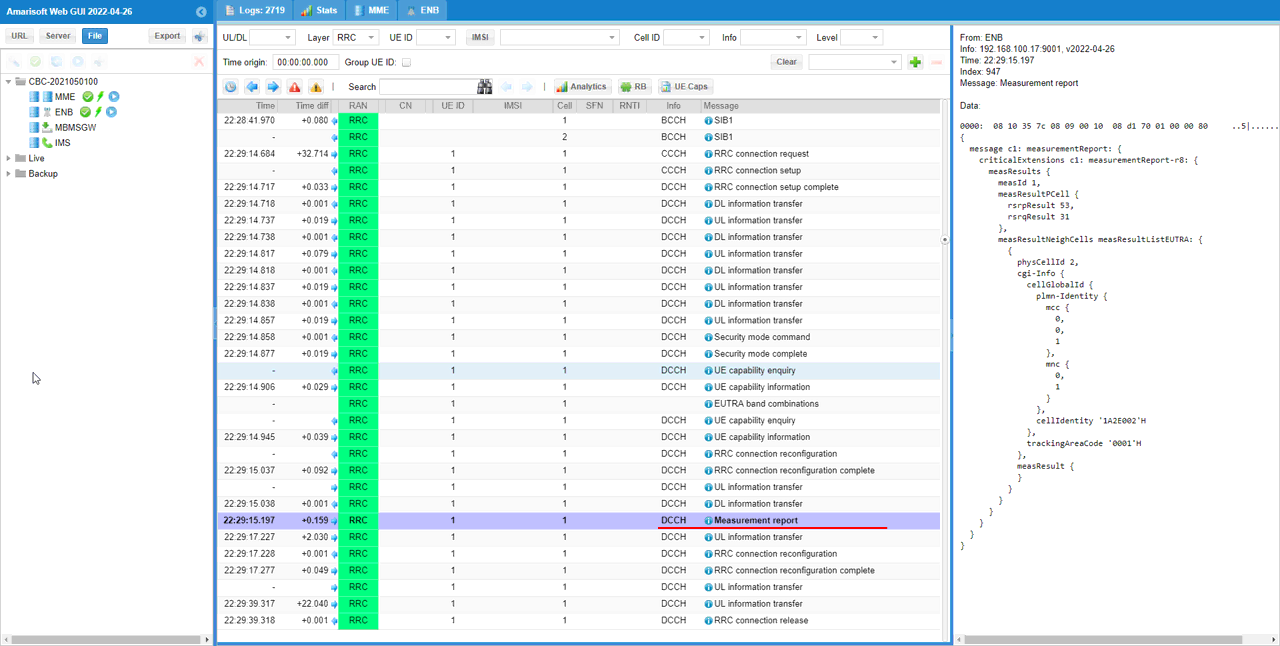
RRC / NAS Signaling
RrcConnectionReconfiguration
: This is the RrcConnectionReconfiguration message sent by eNB to configure Measurement Report. (
{
message c1: rrcConnectionReconfiguration: {
rrc-TransactionIdentifier 0,
criticalExtensions c1: rrcConnectionReconfiguration-r8: {
measConfig {
measObjectToAddModList {
{
measObjectId 1,
measObject measObjectEUTRA: {
carrierFreq 1575,
allowedMeasBandwidth mbw25,
presenceAntennaPort1 FALSE,
neighCellConfig '01'B,
cellForWhichToReportCGI 2
}
}
},
reportConfigToAddModList {
{
reportConfigId 1,
reportConfig reportConfigEUTRA: {
triggerType periodical: {
purpose reportCGI
},
triggerQuantity rsrp,
reportQuantity both,
maxReportCells 2,
reportInterval ms2048,
reportAmount r16
}
}
},
measIdToAddModList {
{
measId 1,
measObjectId 1,
reportConfigId 1
}
},
quantityConfig {
quantityConfigEUTRA {
}
},
measGapConfig setup: {
gapOffset gp0: 0
}
},
dedicatedInfoNASList {
'...'H
},
...
}
}
}