UE Capability Enquiry
This tutorial show how Amari Callbox configures items in UE Capabiility Enquiry message by default and how we can add additional enquiry items in the message. UE capability Enquiry/UE capability Information is a signaling mechanism by which UE inform RAN (Radio Access Network) about its RRC capability. During the initial attach procedure, there are several steps in which UE and Network exchange its capability so that they can setup a proper data pipes that can be supported by both of them. Following is overall procedure of this capability information exchange mechanism.
Step 1 : SIB <-- Basic Network RRC Capability
Step 2 : Attach Request <-- UE NAS Capability
Step 3 : UE Capability Enquiry
Step 4 : UE Capability Information <-- UE RRC Capability
Step 5 : AttachAccept <-- Basic Network NAS Capability
Table of Contents
Introduction
The Amari Callbox is a versatile test platform widely used for emulating and analyzing wireless network procedures, especially in environments focused on LTE and 5G technologies. Central to cellular communications is the exchange of capability information between the User Equipment (UE) and the Radio Access Network (RAN), which ensures that both ends of the connection can negotiate and agree upon supported features and configurations. The UE Capability Enquiry and UE Capability Information signaling procedures play a pivotal role in this negotiation, enabling the network to dynamically adjust its behavior based on the UE's capabilities. Architecturally, this exchange occurs during the initial attach process, leveraging both RRC (Radio Resource Control) and NAS (Non-Access Stratum) protocols to systematically convey information about supported radio technologies, bearers, and advanced features (such as carrier aggregation or dual connectivity). Unlike basic protocol test equipment, the Amarisoft solution emulates real-world network behavior by not only transmitting but also thoroughly analyzing the content of capability messages, adapting network configuration in real time according to the actual capabilities reported by the UE. This approach is critical for validating interoperability, enabling feature testing, and ensuring that the live network experience can be accurately replicated and troubleshooted in a controlled test environment. Understanding how the Amari Callbox handles UE Capability Enquiry message configuration—and how it can be customized—provides valuable insight into both protocol mechanics and practical network deployment considerations.
-
Context of the Technology
- The Amari Callbox serves as a comprehensive network emulator, supporting testing and validation of UE and RAN interactions in LTE and 5G systems.
- UE Capability Enquiry and Information exchanges are foundational to the attach procedure, allowing both UE and network to optimize and align supported services and features.
- Accurate emulation of capability exchange is crucial for validating device interoperability and ensuring real-world deployment readiness.
-
Relevance and Importance of the Tutorial Topic
- Understanding and customizing UE Capability Enquiry messages is essential for engineers and testers aiming to evaluate device performance with specific network features.
- The Amarisoft mechanism provides deeper analysis compared to traditional protocol test equipment, making it a powerful tool for realistic testing scenarios.
- Mastery of capability configuration enables troubleshooting and validation of advanced features, directly impacting device certification and network optimization.
-
Learner Outcomes
- Gain knowledge of the end-to-end UE capability exchange procedure within the attach flow.
- Learn how the Amari Callbox configures default enquiry items and how to extend these with additional capabilities.
- Understand the implications of capability signaling on feature enablement and network behavior.
- Acquire practical skills for troubleshooting and verifying UE/network compatibility issues.
-
Prerequisite Knowledge and Skills
- Basic understanding of cellular network architecture, particularly LTE and/or 5G NR.
- Familiarity with signaling procedures such as RRC and NAS attach flows.
- Experience with protocol testing equipment or network emulators is beneficial but not mandatory.
- General knowledge of UE and network capability definitions and their impact on feature negotiation.
Summary of the Tutorial
This tutorial demonstrates test procedures for configuring and verifying UE Capability Enquiry messages using the Amarisoft Callbox. The tests focus on how different configurations impact the content of UE Capability Enquiry messages, serving as a baseline and guide for user-defined modifications.
-
Test 1: UE Capability Enquiries in Default Configuration
- Purpose: Establishes a baseline for UE Capability Enquiry messages using the default configuration (gnb-sa.cfg) without any modifications.
- Procedure:
- Use the provided SIM card and default cell configuration.
- Run the Callbox with the default configuration file.
- Check the log to confirm that the UE Capability Enquiry message is generated based on the cell configuration.
- Note: The presence of certain Information Elements (IEs), such as capabilityRequestFilter, may depend on the software release.
-
Test 2: UE Capability Enquiries with Additional Enquiries
- Purpose: Illustrates how to customize UE Capability Enquiry messages by specifying additional parameters, such as targeted NR bands.
- Procedure:
- Copy and modify the default configuration to create gnb-sa-uecap.cfg.
- Add specific parameters (e.g., requested_freq_bands_nr) within nr_cell_list to define desired NR bands.
- Run the Callbox using the customized configuration file.
- Verify in the log that the UE Capability Enquiry message includes the specified bands in the frequencyBandListFilter of capabilityRequestFilter IE.
- Check the UE capability information message for each band, ensuring no other bands outside those specified appear.
- Review the channel bandwidth configuration for each band to confirm compatibility with the UE under test.
- Examine the printed band combination information and tabular capability display output by the Callbox software.
-
Test 3: UE Capability Enquiries with All Additional Enquiries (as of 20250211)
- Purpose: Demonstrates enabling all supported UE capability enquiry parameters in a single configuration for comprehensive testing and parameter mapping illustration.
- Procedure:
- Create gnb-sa-uecap-all.cfg by copying and modifying the default configuration.
- Insert all available parameters (as of release 20250211) into nr_cell_list, such as requested_freq_bands_nr, request_reduced_format, mr_dc_request_nr_dc, srs_switching_time_request, and others.
- Run the Callbox with the comprehensive configuration.
- Inspect the log to ensure all configured parameters are present in the UE Capability Enquiry message and mapped correctly to corresponding IEs.
- Observe that the UE may not report all requested capabilities if they are not mandatory or not supported by the device.
Key Points Across All Tests:
- Start with a working default configuration and verify baseline behavior.
- Create copies of configuration files for user-defined changes, targeting specific test objectives (e.g., band restrictions, additional parameters).
- After each configuration change, run the test and examine the corresponding log outputs to validate the impact on UE Capability Enquiry messages.
- Use the Callbox’s log and tabular displays to confirm that configuration changes are reflected correctly in the signaling exchange and capability reporting.
Test Setup
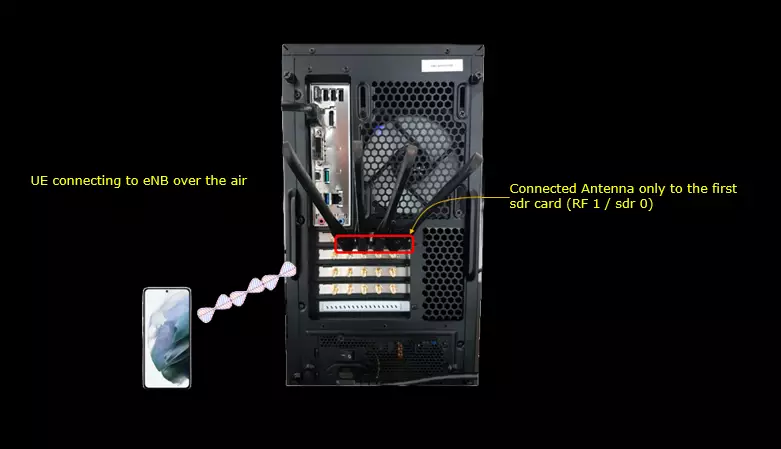
Test setup for this tutorial is as shown below.
- SIM Card used in this tutorial is the one delivered with the system as it is.
- If you want to change the configuration, The tutorial Configuration Guide would help
Key Configuration Parameters
Followings are important configuration parameters for this tutorial. You may click on the items for the descriptions from Amarisoft documents.
- ue_cap_rat_type
- requested_freq_bands_nr
- requested_eutra_freq_bands
- requested_eutra_max_ccs_dl
- requested_eutra_max_ccs_ul
- request_reduced_format
- request_eutra_reduced_int_non_cont_comb
- mr_dc_request_nr_dc
- rrc_ul_segmentation_support
- single_ue_cap_enquiry
- srs_switching_time_request
- uplink_tx_switch_request
- ue_assistance_information
Test 1 : UE Capability Enquiries in default configuraton
This test is just to show how the default configuration of UE Capability Enquiries that is sent by Amarisoft Callbox. This test is mainly for information purpose and setting the baseline. From this baseline, how to add specific user defined configurations will be shown in other test cases.
Configuration
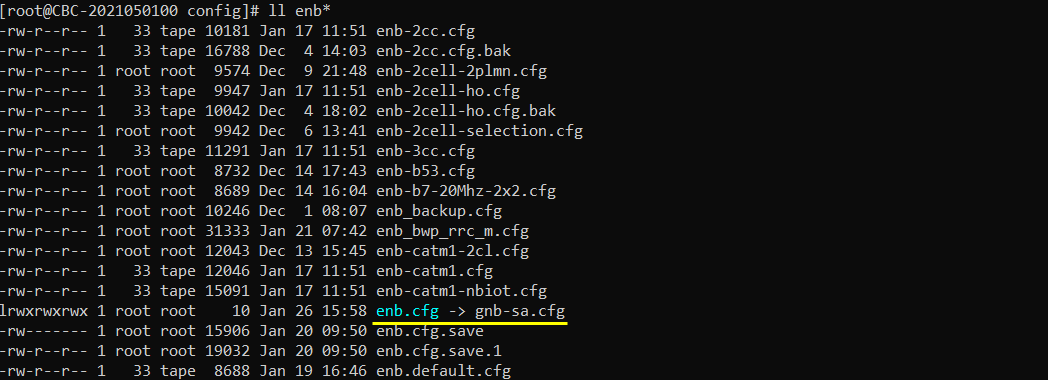
In this test, I am using gnb-sa.cfg (NR SA Default Configuration) without any modification just to show how the default configuration sets UE Capability Enquiry message.
Run and Check in the log
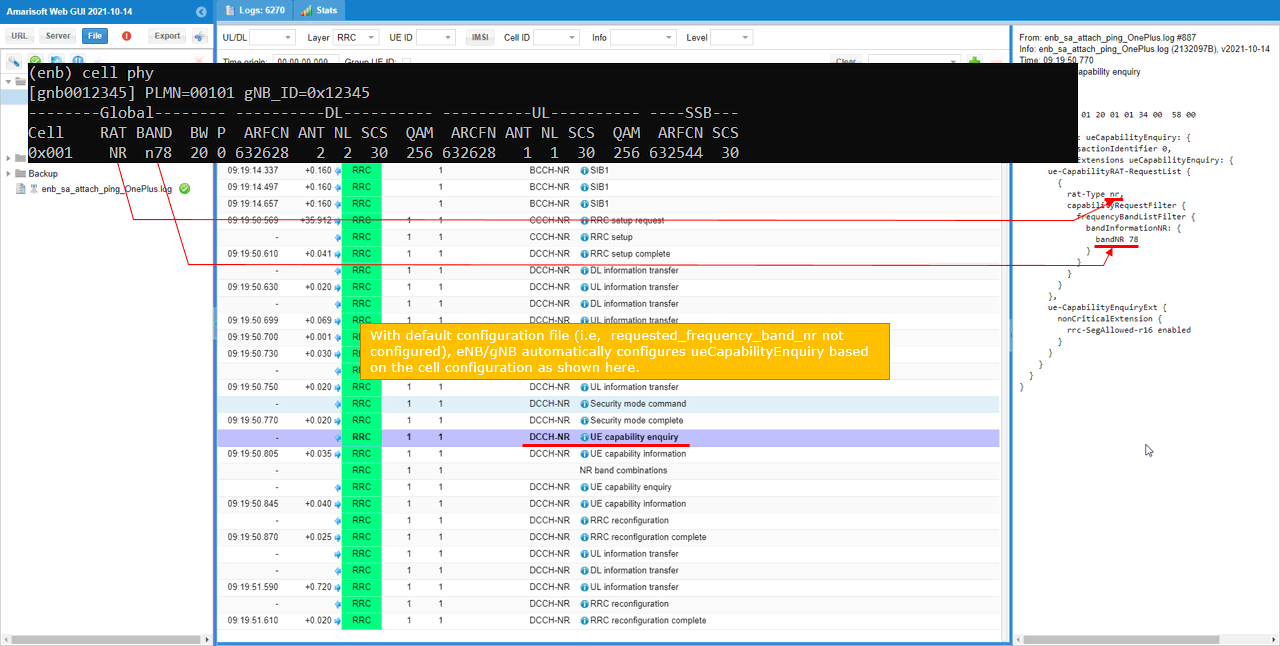
In this test, Amarisoft Callbox is running with the default UE Capability Enquiry behavior. The cell configuration shows NR cell 0x001 on band n78 with 20 MHz bandwidth, DL ARFCN 632628, UL ARFCN 632628, SSB ARFCN 632544, and 30 kHz SCS. Since no explicit requested frequency band list is configured in the UE capability enquiry configuration, the Callbox automatically builds the UE Capability Enquiry based on the serving cell configuration. In the log, the UE Capability Enquiry includes rat-Type set to nr and capabilityRequestFilter with bandInformationNR showing bandNR 78. This means the Callbox is asking the UE to report NR capability related to the configured serving band n78. Depending on the Callbox software release, capabilityRequestFilter IE may or may not appear in the generated message, but the default behavior is still based on the current cell configuration.
Test 2 : UE Capability Enquiries with Additional Enquiries
This test is an example of adding a user defined configuration in UE Capability Enquiries message. The simplest and the most frequently used configuration would be to specify specific bands in the message. In this test, I will show how to specify specific NR bands in the message.
Configuration
In this test, I am using gnb-sa-uecap.cfg which is copied and modified from gnb-sa.cfg
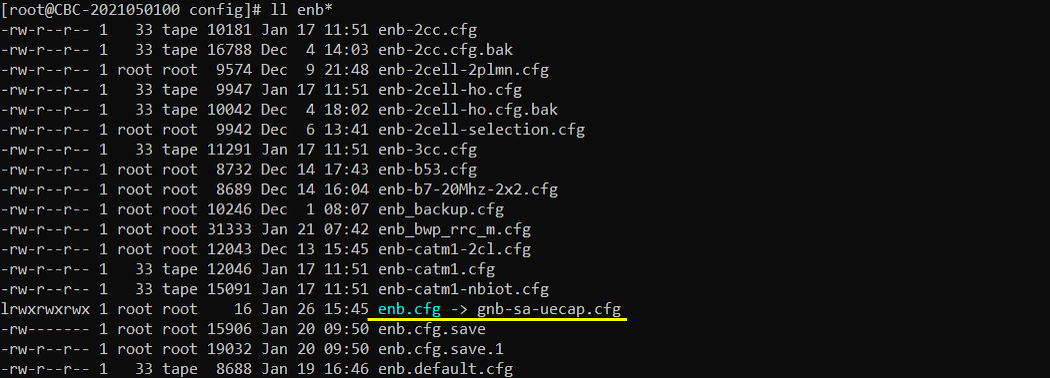
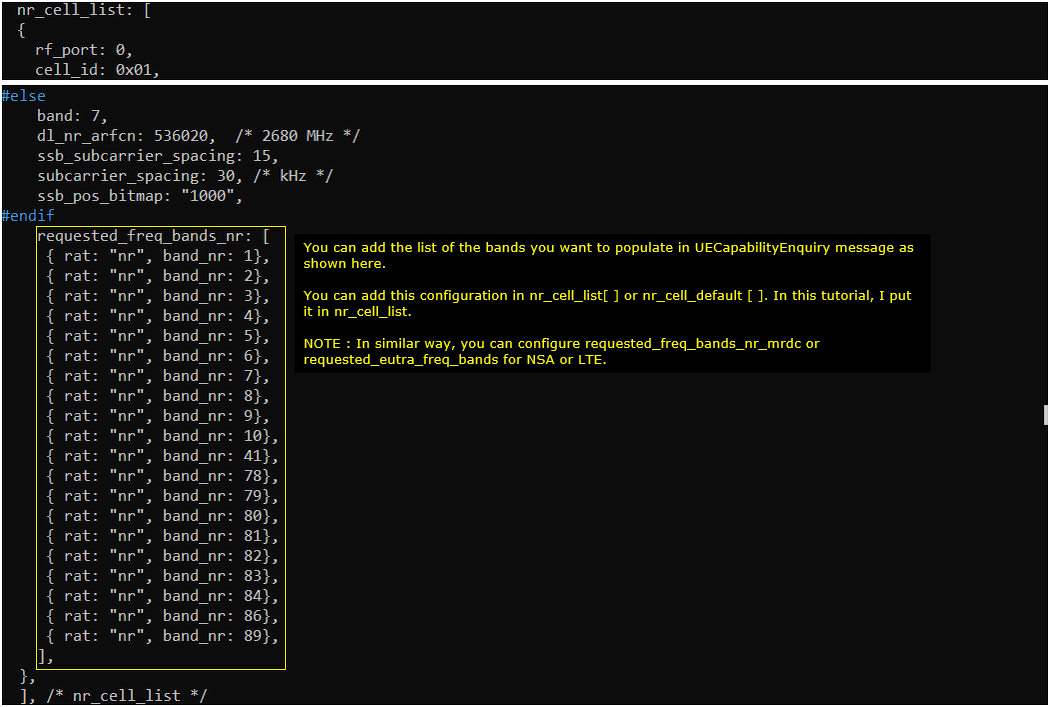
Following is the parameter that I added to gnb-sa-uecap.cfg within nr_cell_list: [ ]. For adding the specific NR bands, you just need to specify the 'rat' type and bands in requested_freq_bands_nr: [ ] configuration.
To request specific NR bands in the UE Capability Enquiry message, configure requested_freq_bands_nr and add each target band with rat set to nr and band_nr set to the NR band number. In this example, the list includes multiple NR bands such as n1, n2, n3, n4, n5, n6, n7, n8, n9, n10, n41, n78, n79, n80, n81, n82, n83, n84, n86, and n89. This configuration can be placed either in nr_cell_list or in nr_cell_default. In this tutorial, it is added under nr_cell_list, so it applies to this specific cell configuration. With this setting, Amarisoft populates the UE Capability Enquiry message with the configured NR band list instead of relying only on the serving cell band. A similar method can also be used for NSA or LTE by configuring requested_freq_bands_nr_mrdc or requested_eutra_freq_bands.
Run and Check in the log
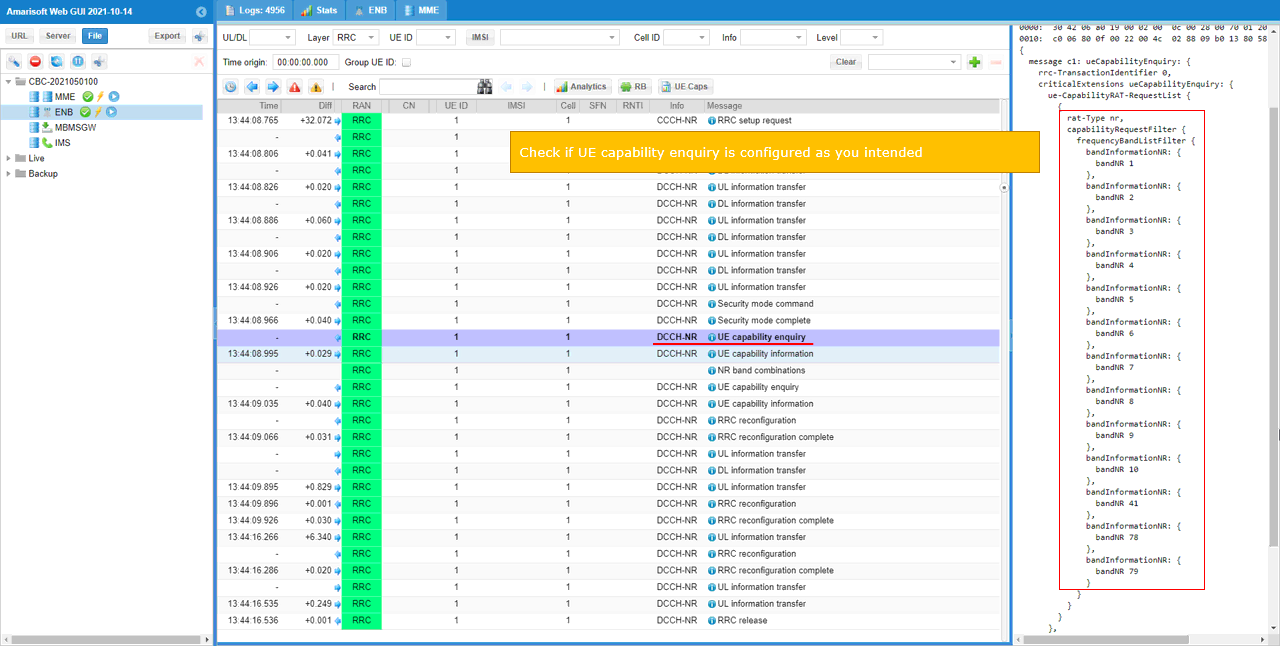
Run the test and check UE capability enquiry message in the log. You can confirm that all the band you specified in the configuration file is added to ueCapabilityEnquiry message. You can see that the specified frequencies are configured in frequencyBandListFilter in capabilityRequestFilter IE (Information Element).
In this example, the UE Capability Enquiry is sent after Security Mode Complete, and the decoded message shows rat-Type set to nr. Under capabilityRequestFilter, frequencyBandListFilter is populated with the NR bands configured in requested_freq_bands_nr. You can confirm that the configured bands are added one by one as bandInformationNR entries, such as bandNR 1, bandNR 2, bandNR 3, bandNR 4, bandNR 5, bandNR 6, bandNR 7, bandNR 8, bandNR 9, bandNR 10, bandNR 41, bandNR 78, and bandNR 79. This confirms that Amarisoft is not using only the serving cell band in this test. Instead, it is generating the UE Capability Enquiry according to the user-defined NR band list in the configuration file.
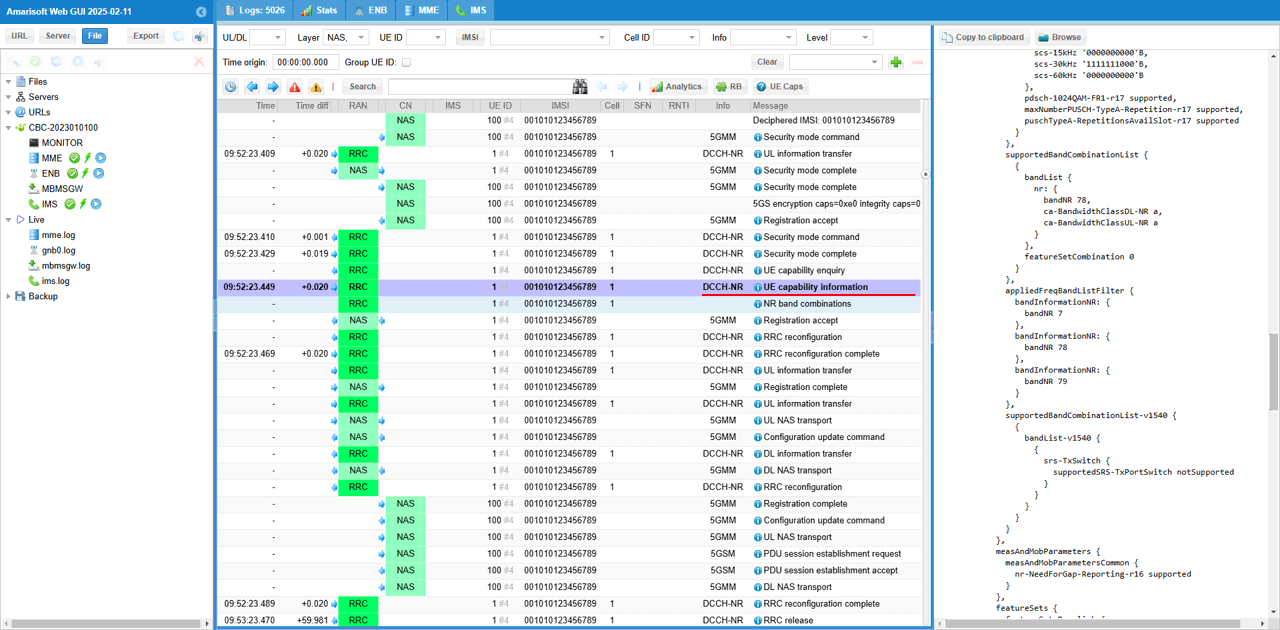
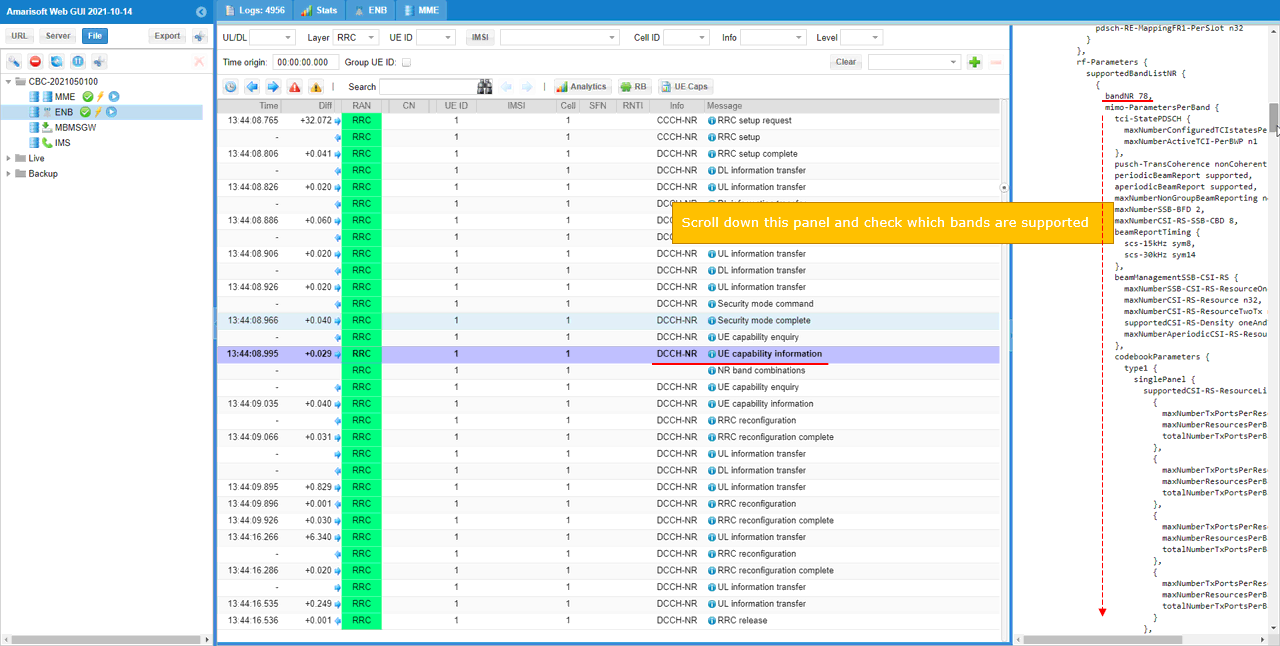
You can also check the detailed UE capability from the UE Capability Information message. After selecting the UE Capability Information log, scroll down in the decoded message panel and check rf-Parameters. Under supportedBandListNR, the UE reports the detailed capability for each supported NR band. In this example, bandNR 78 is shown with related feature information such as mimo-ParametersPerBand, supported SCS, CSI-RS capability, and codebook parameters. This section is useful to confirm not only whether the UE supports the requested band, but also what kind of radio capability the UE reports for that band. When checking the result, make sure that the reported band list matches the bands requested in the UE Capability Enquiry configuration and that there is no unexpected band outside the configured requested_freq_bands_nr list.
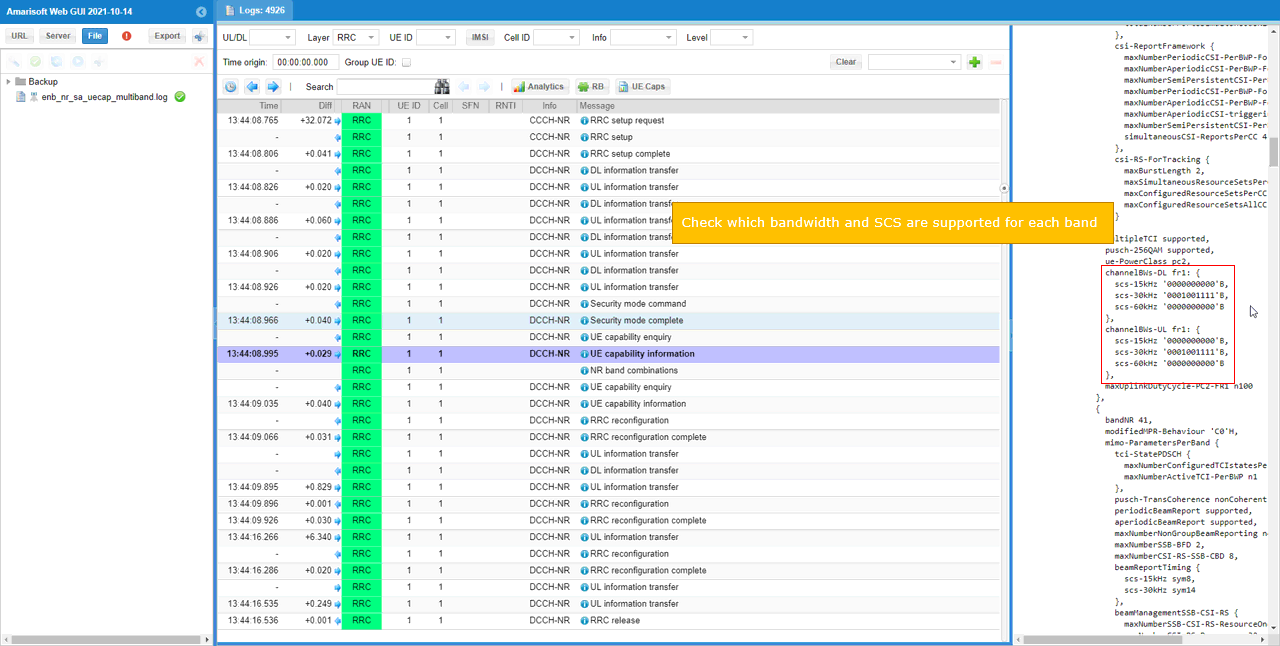
One important item to check in UE Capability Information is the channel bandwidth support for each NR band. Many test issues happen when the test cell is configured with a channel bandwidth that the UE does not support for that band. In the decoded UE Capability Information message, scroll down to rf-Parameters and check the channelBWs-DL or channelBWs-UL field for the target band. In this example, the log shows the supported channel bandwidth bitmap for each SCS, such as scs-15kHz, scs-30kHz, and scs-60kHz. This bitmap tells which channel bandwidths are supported by the UE for that specific band and SCS combination. Before running a test with a specific bandwidth, compare the cell bandwidth configuration with this UE capability value. If the configured bandwidth is not supported by the UE, the UE may fail to camp, attach, register, or complete the intended test scenario. (
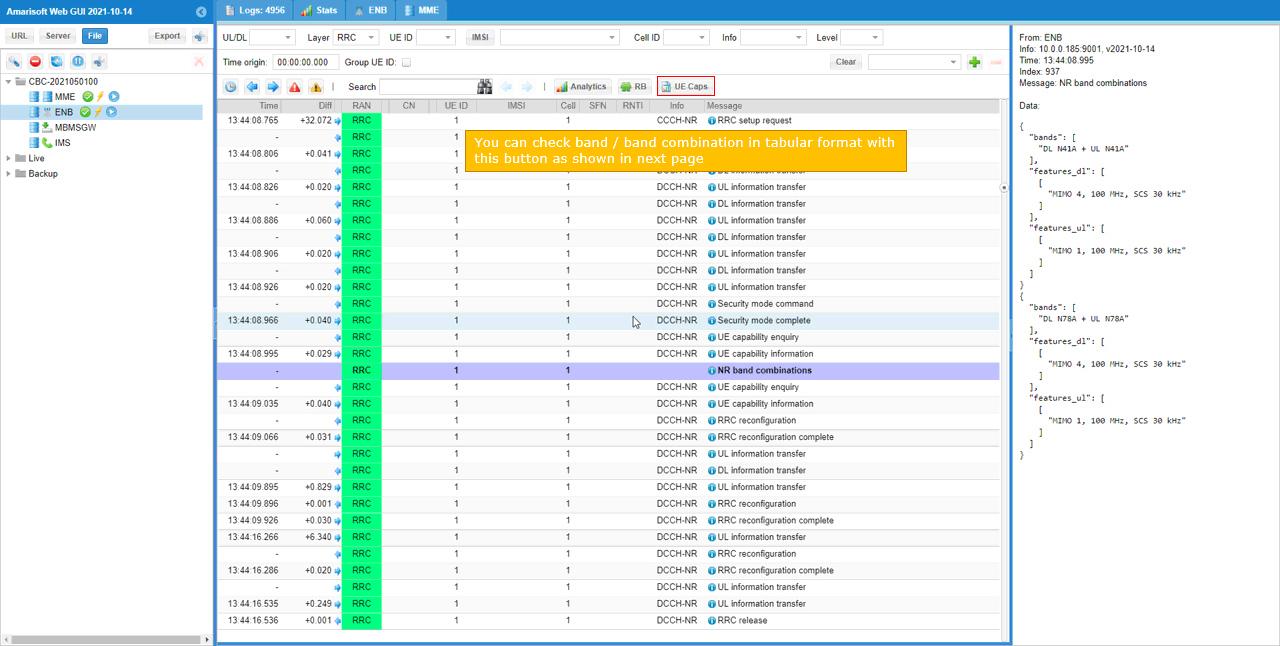
Amarisoft Callbox extracts the NR band combination information from the UE Capability Information message and prints it as a separate log entry. In this example, after the UE sends UE Capability Information, the Callbox generates an additional NR band combinations log. This makes it easier to check the supported CA or band combination information without manually searching through the full UE capability message. The decoded output shows the supported band combinations in a simpler format, such as DL n41A + UL n41A and DL n78A + UL n78A, together with related feature information like MIMO layer, bandwidth, and SCS. You can also use the UE Caps button to view the band and band combination information in a tabular format, which is useful when the UE capability message is large.
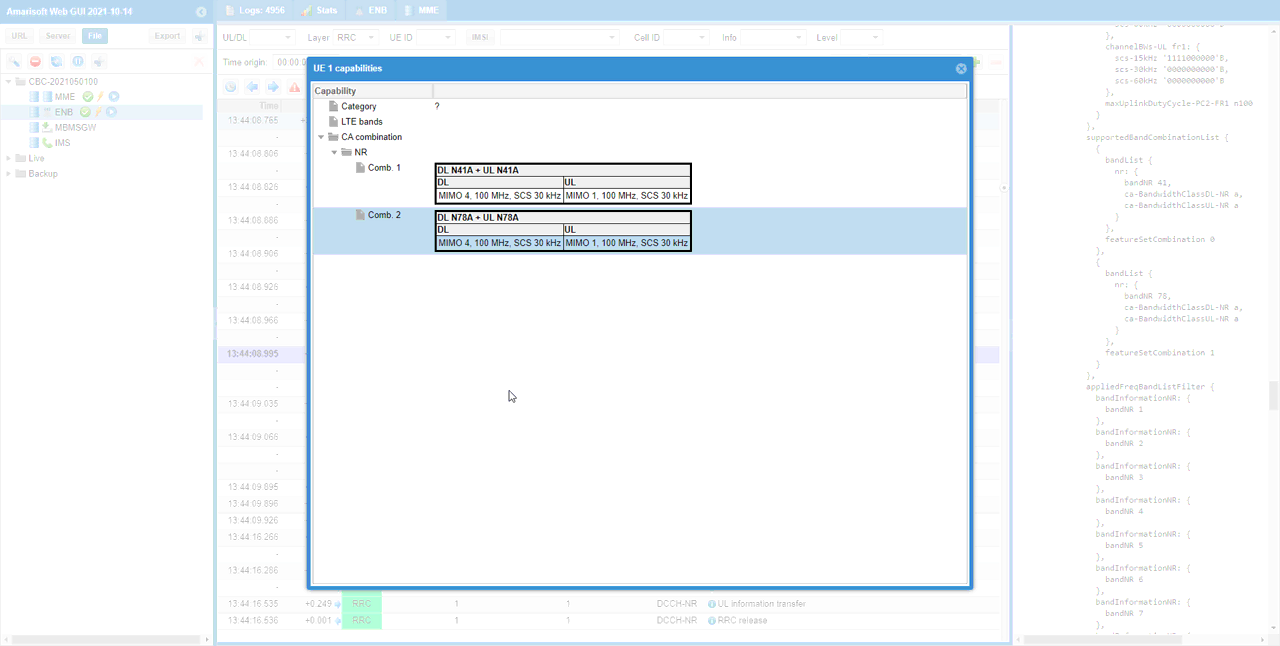
You can check the UE band combination capability in a tabular format from the UE Caps window. In this example, the CA combination section shows the reported NR combinations in a much simpler view than the raw UE Capability Information message. Comb. 1 shows DL n41A + UL n41A, with DL MIMO 4, 100 MHz, SCS 30 kHz, and UL MIMO 1, 100 MHz, SCS 30 kHz. Comb. 2 shows DL n78A + UL n78A with the same type of feature information. This view is useful when you want to quickly confirm the supported band combination, bandwidth, SCS, and MIMO capability without scrolling through the long decoded RRC message. (
Test 3 : UE Capability Enquiries with All Additional Enquiries (as of 20250211)
This test is an example of adding a user defined configuration in UE Capability Enquiries message. In this tutorial, I am putting all the paramters that will be enabled in UE capabiltility Enquiry. This is more of showing the syntax and position of those parmeters in cell configuration.
Configuration
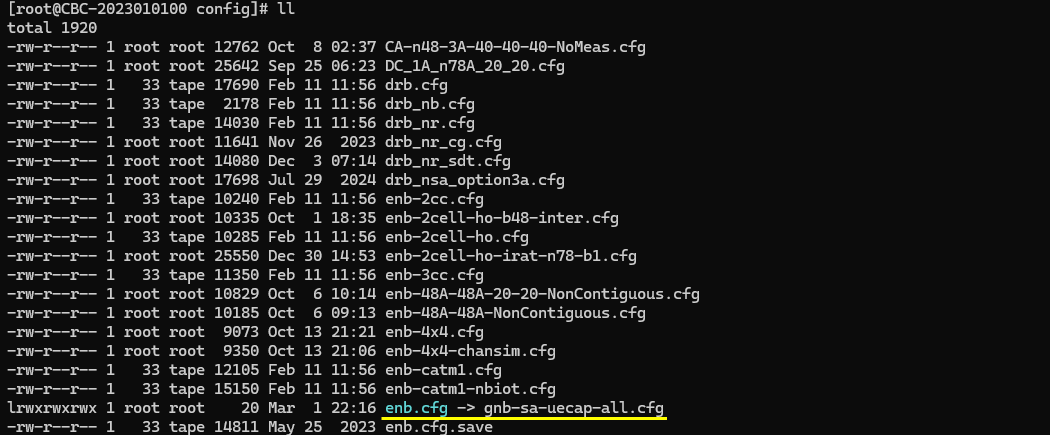
In this test, I am using gnb-sa-uecap-all.cfg which is copied and modified from gnb-sa.cfg
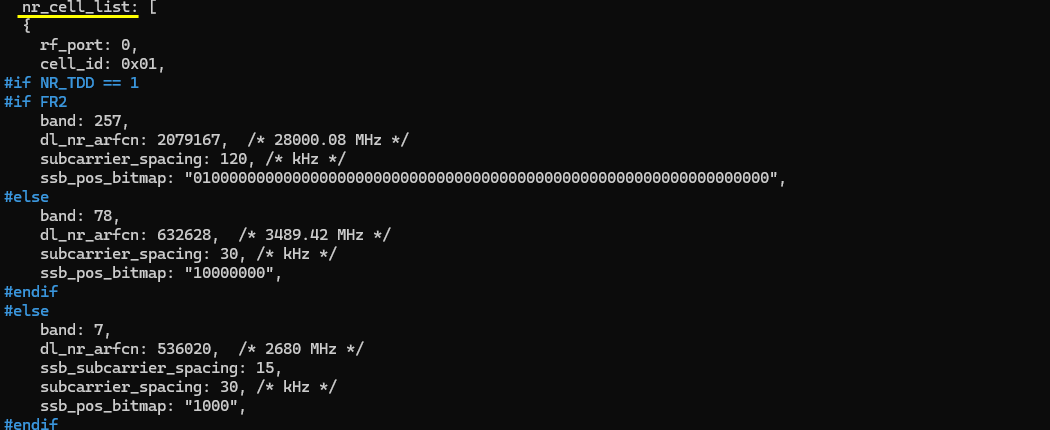
Following is the first part of the configuration added in gnb-sa-uecap.cfg under nr_cell_list. This section defines the serving NR cell before adding the UE Capability Enquiry related parameters. In this example, the configuration supports different cell settings depending on NR_TDD and FR2. For FR2, band 257 is used with DL NR ARFCN 2079167, 120 kHz SSB subcarrier spacing, and a long SSB position bitmap. For FR1 TDD, band 78 is used with DL NR ARFCN 632628, 30 kHz SSB subcarrier spacing, and SSB position bitmap 10000000. For the other FR1 case, band 7 is used with DL NR ARFCN 536020, 15 kHz SSB subcarrier spacing, 30 kHz data subcarrier spacing, and SSB position bitmap 1000. This part sets the basic serving cell condition, and the UE Capability Enquiry parameters added later will be applied under this nr_cell_list cell configuration.
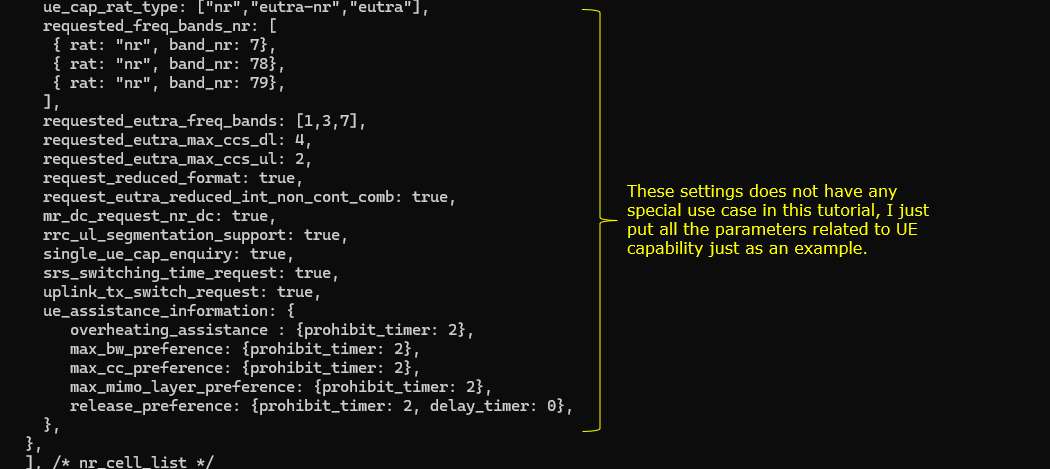
In this example, all available UE Capability Enquiry related parameters are added under the same nr_cell_list configuration. This is mainly to show the syntax and the position of each parameter in the configuration file. It does not mean that all of these parameters should be enabled for a normal test case. The example includes ue_cap_rat_type with nr, eutra-nr, and eutra, NR band requests for n7, n78, and n79, EUTRA band requests for bands 1, 3, and 7, EUTRA CCS limits, reduced format request, EUTRA reduced inter-band non-contiguous combination request, NR-DC request, RRC segmentation support, single UE capability enquiry, SRS switching time request, uplink TX switching request, and UE assistance information. These settings are included as a full reference example based on the Amarisoft release available as of 2025-02-11, so you can later select only the parameters that are useful for your own test scenario.
Run and Check in the log
Run the test and check whether the configured parameters are properly included in the UE Capability Enquiry message.
In this example, requested_freq_bands_nr is configured with NR bands n7, n78, and n79. In the decoded UE Capability Enquiry message, these values are mapped into capabilityRequestFilter and shown under frequencyBandListFilter as bandInformationNR entries for bandNR 7, bandNR 78, and bandNR 79. The same log also shows that srs_switching_time_request is mapped into nonCriticalExtension as srs-SwitchingTimeRequest set to true. This confirms that the parameters added in the configuration file are reflected in the actual UE Capability Enquiry message sent by the Callbox.
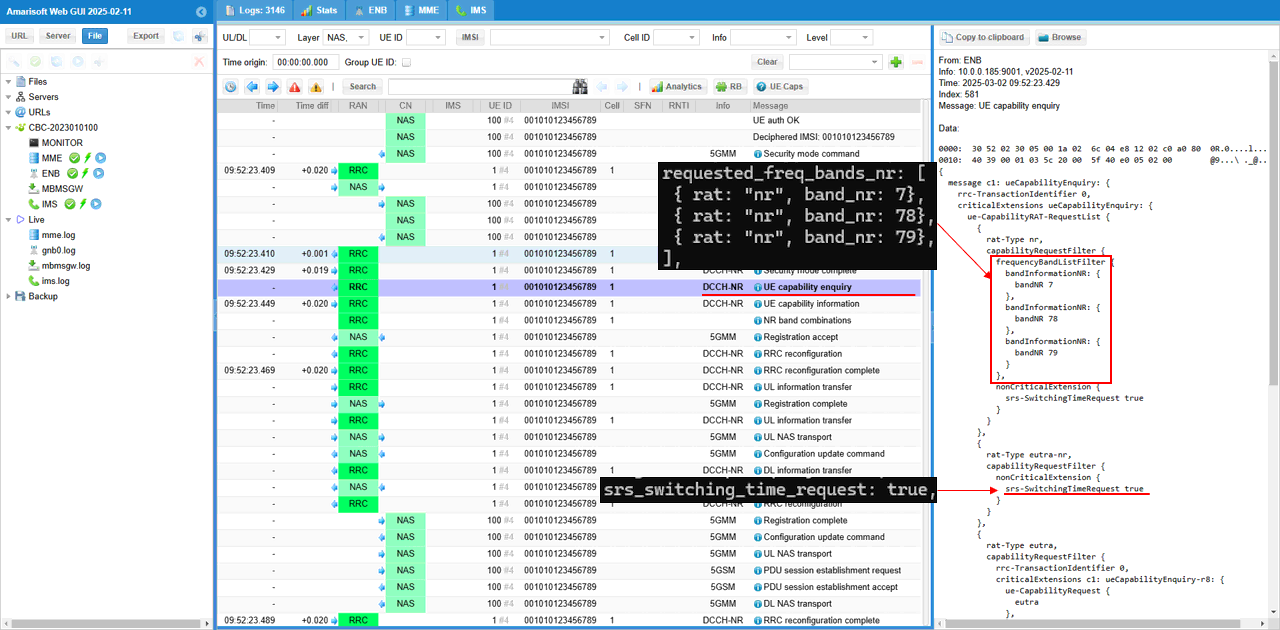
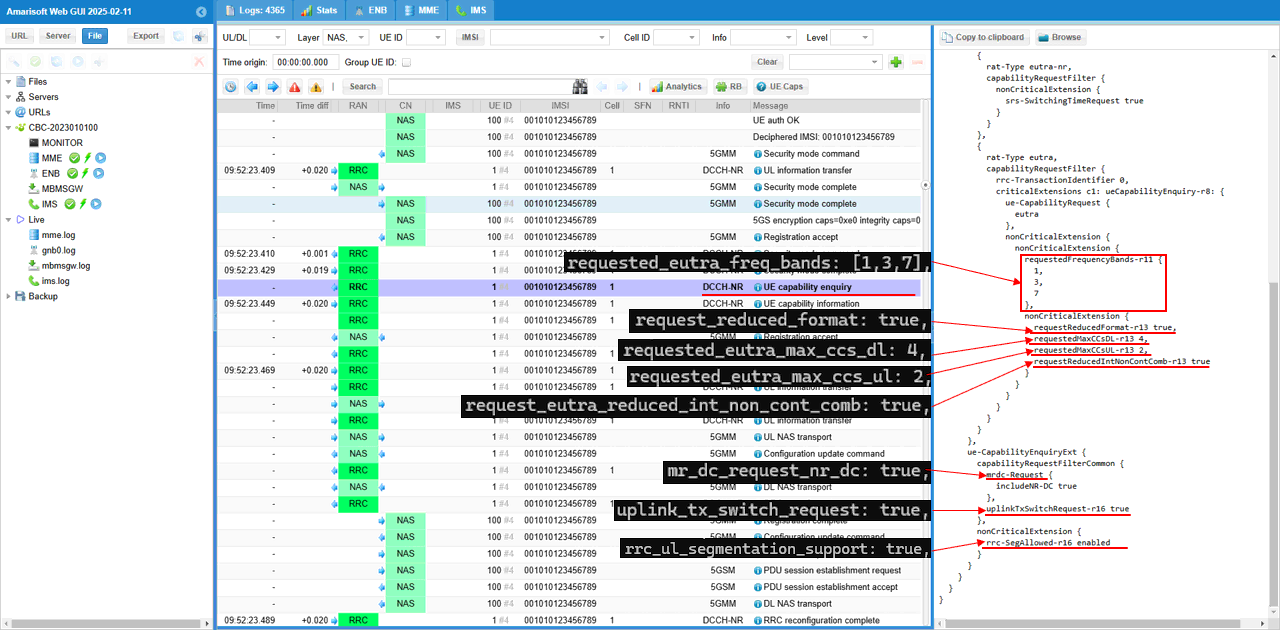
In this screenshot, you will see how the parameters requested_freq_bands, request_reduce_format, requested_eutra_max_ccs_dl, requested_eutra_max_ccs_ul, request_eutra_reduced_int_non_cont_comb, mr_dc_request_nr_dc, uplink_tx_swich_request, srs_switch_time_request and rrc_ul_segmentation_support are mapped to corresponding IEs in the message.
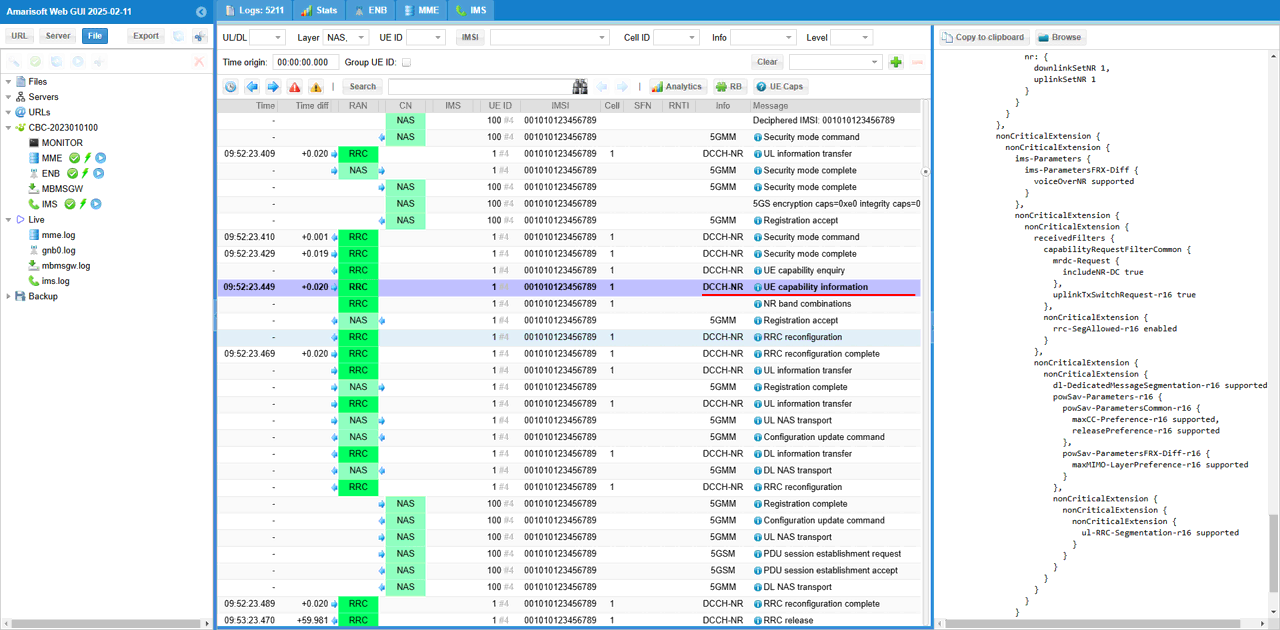
The requested_eutra_freq_bands setting is mapped to requestedFrequencyBands-r11 and shows EUTRA bands 1, 3, and 7. The request_reduced_format setting is mapped to requestReducedFormat-r13 true. The requested_eutra_max_ccs_dl and requested_eutra_max_ccs_ul settings are mapped to requestedMaxCCsDL-r13 4 and requestedMaxCCsUL-r13 2. The request_eutra_reduced_int_non_cont_comb setting is mapped to requestReducedIntNonContComb-r13 true. The mr_dc_request_nr_dc setting is mapped to includeNR-DC true under capabilityRequestFilterCommon. The uplink_tx_switch_request setting is mapped to uplinkTxSwitchRequest-r16 true, and rrc_ul_segmentation_support is mapped to rrc-SegAllowed-r16 enabled. This confirms that the configuration parameters are inserted into the proper UE Capability Enquiry IEs and that the Callbox generates the message according to the user-defined settings.
Then check the UE Capability Information message returned from the UE. Even when a specific capability item is requested in UE Capability Enquiry, the UE may not report the corresponding capability if the item is optional or if the UE does not support that feature. In this example, the UE Capability Information includes the appliedFreqBandListFilter with bandNR 7, bandNR 78, and bandNR 79, which confirms that the UE received and applied the requested NR band filter. However, the actual reported capability still depends on UE implementation and supported features. For example, the log shows supportedSRS-TxPortSwitch as notSupported, even though SRS switching time was requested in the enquiry. In another part of the decoded message, some requested capability areas are reported as supported, such as uplinkTxSwitchRequest-r16 true, rrc-SegAllowed-r16 enabled, dl-DedicatedMessageSegmentation-r16 supported, and full-RRC-Segmentation-r16 supported. This means UE Capability Enquiry can request information, but it does not force the UE to claim support. The final confirmation must always be done from the UE Capability Information message reported by the UE.