NR SA Out of Coverage (OOC)
This tutorial is about Out of Coverage test. It would shows how you can put UE in out of test condition and check if UE gets recovered from the OOC states. In terms of user level operation, OOC is a very simple feature that would not attract much attention. But handling OOC is pretty important in terms of UE implementation. Usually UE manufacturer perform quite long list of test for OOC.
Step 1 : UE performs measurement for the cell
Step 2 : If it lost cell power (or measured cell power is lower than a certain threshold), UE tries to search another suitable cells among neighbouring cell
Step 3 : If UE failes to find any of suitable cell, it goes into OOC state. If it finds any suitable cell, I trigger the initial attach.
Step 4 : In certail time interval, UE wake up briefly and go Step 1.
Table of Contents
- NR SA Out of Coverage (OOC)
Introduction
Out of Coverage (OOC) scenarios are a critical facet of wireless communication technology, particularly in the context of User Equipment (UE) behavior and resilience in mobile networks. In modern cellular architectures, such as LTE and 5G NR, UEs are designed to maintain robust connectivity by continuously monitoring signal strength, performing cell reselection, and ensuring seamless transitions between coverage areas. However, when a UE is unable to detect any suitable serving cell—due to geographical, environmental, or network-side factors—it enters an OOC state. The management of this state is essential for both user experience and device longevity, as improper handling can lead to excessive battery drain and delays in service recovery. While OOC handling is largely transparent to end users, it involves sophisticated algorithms and state machines within the UE modem, balancing the need for prompt recovery with efficient power consumption. The strategy for periodic wake-up, measurement procedures, and back-off interval adjustments is typically vendor-specific, as 3GPP standards provide only broad guidelines, leaving optimization to individual manufacturers. This tutorial provides a comprehensive guide to OOC testing, demonstrating how to simulate OOC conditions, monitor UE behavior, and validate recovery mechanisms, which are vital for ensuring device robustness and compliance with operator requirements.
-
Technology Context and Background
- Out of Coverage testing is relevant for cellular technologies including LTE, 5G NR, and earlier generations, where UEs must intelligently detect and respond to loss of network coverage.
- OOC procedures are implemented within the UE modem firmware, leveraging measurement and cell search algorithms based on received signal strength, cell quality, and network availability.
- Efficient OOC handling ensures minimized battery consumption and maximizes the likelihood of rapid recovery when suitable coverage is restored.
-
Relevance and Importance of OOC Testing
- OOC scenarios are common in areas with sparse cell deployment, such as rural or underground environments, making robust handling essential for uninterrupted service.
- Manufacturers and network operators rigorously test OOC behavior to verify compliance, enhance user satisfaction, and prevent excessive battery drain.
- OOC test cases are a critical component of device validation and certification processes.
-
Learning Outcomes
- Understand the sequence of events leading to a UE entering and recovering from OOC state.
- Gain practical knowledge on how to simulate OOC conditions and assess UE recovery mechanisms.
- Learn about strategies for optimizing wake-up intervals and balancing recovery speed with battery efficiency.
- Acquire insights into the architectural and algorithmic decisions involved in OOC handling.
-
Prerequisite Knowledge
- Familiarity with cellular network concepts, including cell search, reselection, and mobility management.
- Basic understanding of UE architecture and modem state machines.
- Experience with device testing methodologies and network simulation tools is beneficial but not mandatory.
Summary of the Tutorial
This tutorial outlines the procedures for performing a low-layer Out of Coverage (OOC) test on a 5G standalone (NR SA) system using Amarisoft equipment.
-
Test Setup:
- Use the provided SIM card that comes with the system. For different configurations, refer to the provided Configuration Guide.
- No complex IP layer setup is required; the test focuses on low-layer behaviors.
-
Key Configuration Parameters:
- Ensure correct tx_gain setting as per the documentation, as it will be adjusted during the test to simulate OOC conditions.
-
Configuration:
- Utilize the default gnb-sa.cfg configuration for the gNB and mme-ims.cfg for the MME. No modifications are required for this test.
-
Test Procedure:
- Power on the UE and allow it to attach to the network. Wait until the UE transitions to idle mode, as the OOC test targets idle state behavior.
- Verify that the UE is in idle mode with strong signal strength. If signal strength is not visible on the device, use AT commands to check.
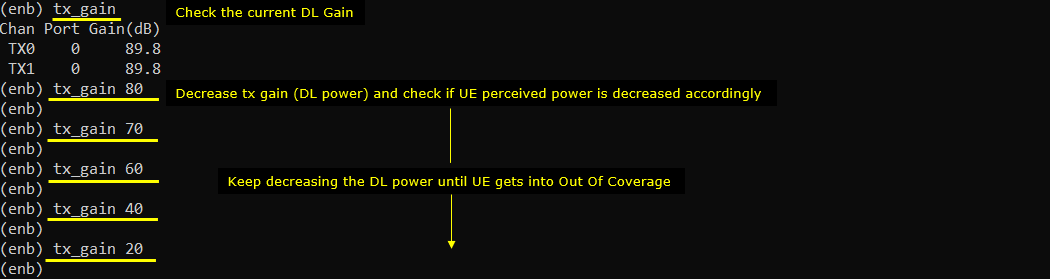
- Check and record the current cell power using the tx_gain command.
- Gradually decrease the cell gain in steps using tx_gain until the UE enters the Out of Coverage state. The reduction required will vary by device, so experimentation may be needed.
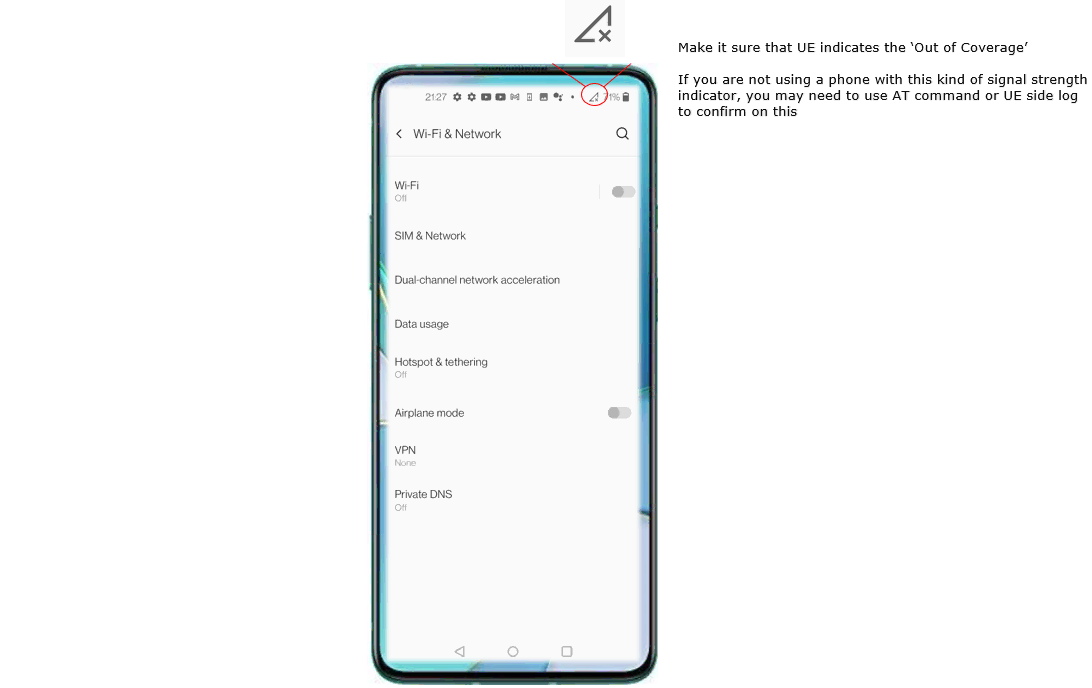
- Confirm the UE is in Out of Coverage by observing the 'No Signal' indicator on the device display.
- Maintain the UE in the Out of Coverage state for a period of time.
- Restore the cell power to normal by increasing tx_gain to its original value.
- Wait for the UE to reattach to the cell. The duration will depend on how long the UE was out of coverage and its recovery algorithm.
- When the connection is restored, verify with the signal strength indicator that the UE is back in service.
This procedure allows for systematic verification of idle mode Out of Coverage detection and recovery mechanisms in the UE under controlled cell power conditions. All steps preserve the integrity of the UE’s idle/attach state transitions and signal monitoring.
Test Setup
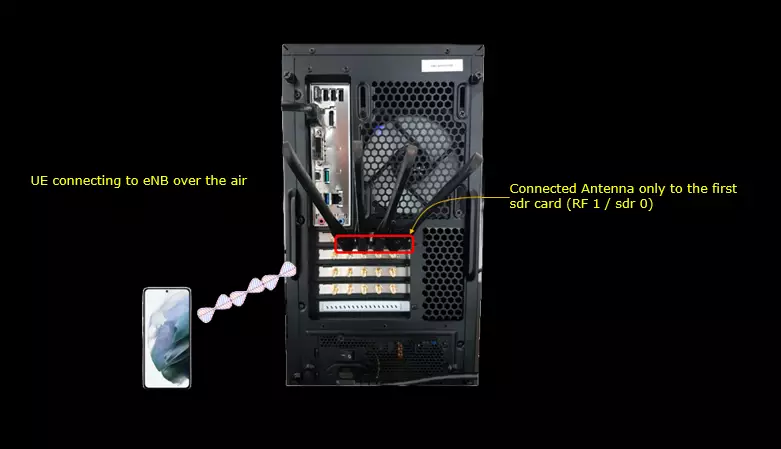
Test setup for this tutorial is as shown below. This is just for low layer testing, you may not need any complicated IP layer setup.
- SIM Card used in this tutorial is the one delivered with the system as it is.
- If you want to change the configuration, The tutorial Configuration Guide would help
Key Configuration Parameters
Followings are important configuration parameters for this tutorial. You may click on the items for the descriptions from Amarisoft documents.
- tx_gain (see this for tx_gain tutorial)
Configuration
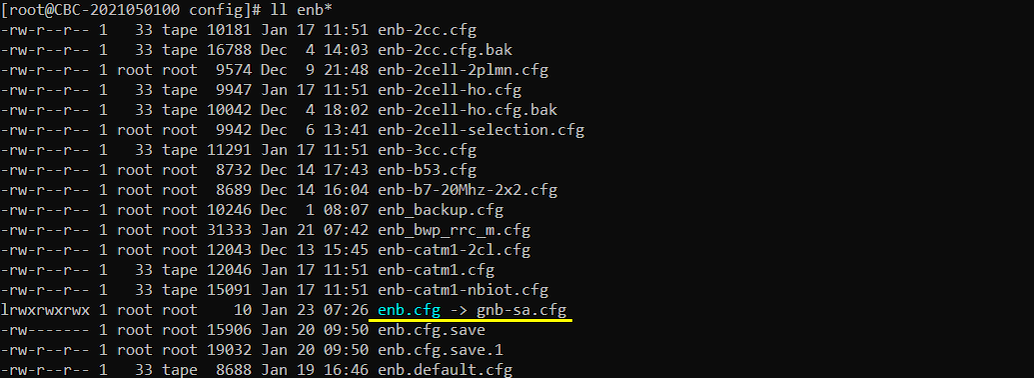
I have used gnb-sa.cfg which is installed by default without any modification.
I am using the default mme (mme-ims.cfg), ims config as shown below.

Perform the Test
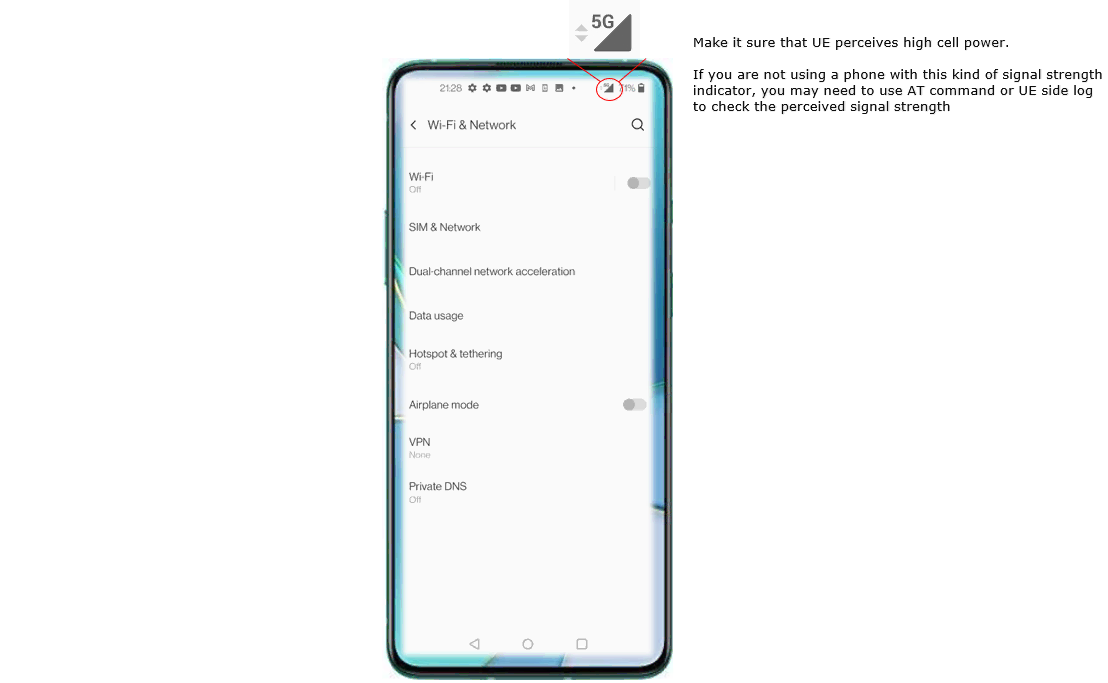
Power on UE and let it attach. You may wait until it gets into idle because OOC (Out Of Coverage) is mainly for idle mode test. If the cell goes out of coverage during the connected mode, call drop would happen.
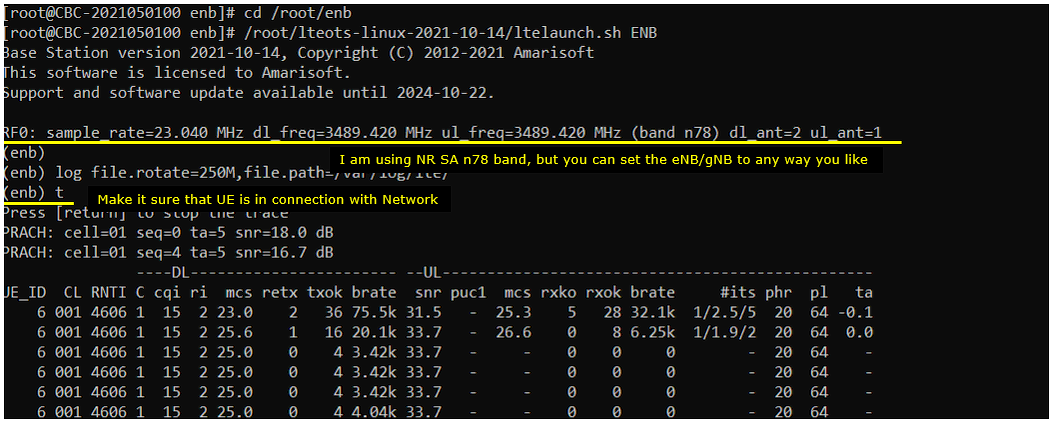
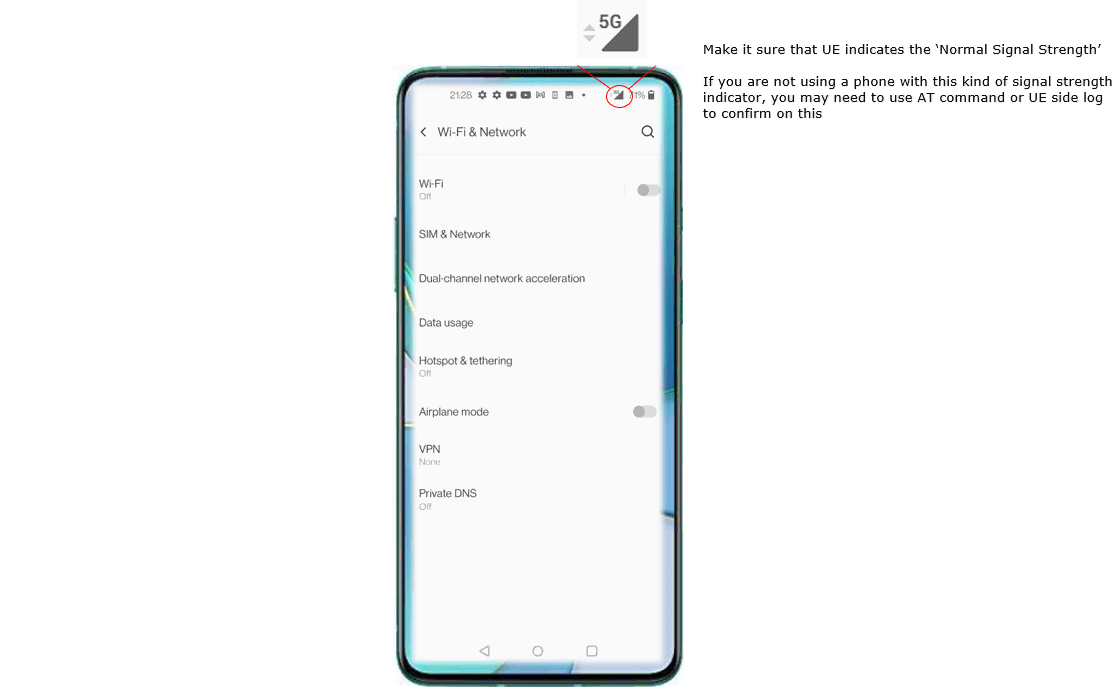
Make it sure that UE is in idle mode and it indicates a relatively strong signal strength before the OOC test. If you are not using a phone that can display signal strength, you may use AT command to check the signal strength.
Check on the current cell power using tx_gain command. And then decrease the cell gain step by step until UE gets into Out Of Coverage states.
If UE gets into OOC (Out Of Coverage) states, the signal indicator on the display would show 'No Signal' icon.
Stay in Out of Coverage for some time. And then increase the cell power to normal

Wait until UE reattach to the cell. How long you have to wait until UE reattach varies depending on how long the UE was in Out of Coverage status and UE implementation of Out of Coverage recovery algorithm.

Once the connection is recovered to In Service, you can confirm it with signal strength indicator on display.