
LTE TM(Transmission Mode)
The purpose of this tutorial is to show you how to configure various TM(Transmission Mode). Main focus in this tutorial is to show how the parameters in the configuration is reflected to RRC message and how to verify the operation with CSI message and DCI.
Transmission Mode in LTE is a configuration that determines the transmission mode for eNB antenna. For example, let's assume that an eNB is using 2 TX antenna. With this two antenna, eNB can implement various different transmission scheme as listed below.
- Tx Diversity
- Open Loop 2x2 MIMO (2x2 MIMO that does not require CSI report from UE)
- Closed Loop 2x2 MIMO (2x2 MIMO that requires CSI report from UE for proper precoding matrix selection)
Each of these use case (implementation) is called 'Transmission Mode'. Then the question arises on how UE can figure out what kind of transmission mode that eNB applies ? This is done by RRC parameters sent by eNB which informs on the details of transmission mode. As of now, there are 10 different transmission mode (TM1 ~ TM10) defined in 3GPP specification and this tutorial would covers some of the transmission mode that are relatively widely used or tested.
Table of Contents
- LTE TM(Transmission Mode)
- Introduction
- Summary of the Tutorial
- Test Setup
- Key Configuration Parameters
- Test 1 : TM3 - 2x2 MIMO
- Test 2 : TM4 - 2x2 MIMO
- Test 3 : TM3 - 4x4 MIMO
- Test 4 : TM4 - 4x4 MIMO
- Test 5 : TM4 - 4x4 MIMO, Codebook Subset Restriction
- Test 6 : TM9 - 2x2 MIMO, Periodic CSI Report
- Test 7 : TM9 - 2x2 MIMO, Aperiodic CQI Report
- Test 8 : TM10 - 2x2 MIMO, Periodic CSI Report
- RRC / NAS Signaling
Introduction
Transmission Mode (TM) configuration in LTE is a fundamental aspect of the radio interface that governs how data is transmitted between the eNodeB (eNB) and user equipment (UE) using multiple antennas. The choice of transmission mode directly affects system performance, throughput, coverage, and spectrum efficiency by enabling advanced techniques such as transmit diversity, spatial multiplexing, and beamforming. Each transmission mode defines a specific approach for managing antenna resources, feedback mechanisms, and channel adaptation, aligning with 3GPP standards to support a variety of deployment scenarios and device capabilities. In the LTE framework, the eNB communicates the selected transmission mode to the UE through RRC signaling, ensuring that both the network and device operate with a synchronized understanding of the antenna transmission scheme. The correct configuration and validation of transmission modes are essential for optimizing link reliability and exploiting the full potential of MIMO (Multiple Input, Multiple Output) technologies. This tutorial explores the configuration process for various transmission modes, discusses their operational principles, and demonstrates practical methods to verify their effects using Channel State Information (CSI) and Downlink Control Information (DCI). Understanding these modes is crucial for engineers and network professionals striving to maximize LTE network performance and ensure robust, standards-compliant operation.
-
Context and Background
- Transmission Mode is an LTE configuration that determines how the eNB utilizes its antenna resources for downlink transmission.
- There are 10 transmission modes defined in 3GPP standards (TM1–TM10), each supporting different MIMO and diversity techniques.
- The eNB informs the UE of the selected transmission mode via RRC signaling, allowing the UE to adapt its reception and feedback accordingly.
-
Relevance and Importance of the Tutorial
- Accurate configuration of transmission modes directly impacts network throughput, coverage, and user experience.
- This tutorial provides step-by-step guidance on how to set up transmission modes and validate their operation using CSI and DCI analysis.
- Understanding these concepts is vital for professionals involved in LTE network planning, optimization, and troubleshooting.
-
Learning Outcomes
- Gain an in-depth understanding of LTE transmission modes, their configuration, and operational principles.
- Learn how to correlate configuration parameters with their effects as observed in network signaling and feedback messages.
- Acquire practical skills for verifying and troubleshooting transmission mode operation using CSI reports and DCI decoding.
-
Prerequisite Knowledge
- Familiarity with LTE architecture, including eNB and UE functions.
- Basic understanding of MIMO technology and radio link adaptation strategies.
- Experience interpreting network signaling, especially RRC and DCI messages, is beneficial.
Summary of the Tutorial
This tutorial demonstrates multiple LTE MIMO transmission mode test procedures with various configurations and reporting modes. The tests cover Transmission Modes 3, 4, 9, and 10 with both 2x2 and 4x4 MIMO setups, including codebook subset restriction and both periodic and aperiodic CSI/CQI reporting.
-
Test 1: TM3 - 2x2 MIMO
- Configure eNB using enb-tm3-2x2.cfg (set N_ANTENNA_DL to 2 and TM to 3).
- Use appropriate mme and ims configurations.
- Verify configuration via cell PHY status.
- Run the test: power on UE, ensure successful attach.
- Analyze logs to confirm that UE supports intended MIMO and TM, and verify transmission mode and CQI report configuration.
- Check DCI for MIMO scheduling and PUCCH format for CQI reporting.
-
Test 2: TM4 - 2x2 MIMO
- Configure eNB with enb-tm4-2x2.cfg (set N_ANTENNA_DL to 2 and TM to 4).
- Follow similar steps as Test 1 for configuration, execution, and log analysis with focus on TM4 operation.
- Verify MIMO scheduling and CQI reporting in logs.
-
Test 3: TM3 - 4x4 MIMO
- Configure eNB using enb-tm3-4x4.cfg (N_ANTENNA_DL = 4, TM = 3).
- Execute test and analyze logs for 4x4 capabilities; confirm maxLayerMIMO is set to fourLayers.
-
Test 4: TM4 - 4x4 MIMO
- Configure eNB with enb-tm4-4x4.cfg (N_ANTENNA_DL = 4, TM = 4).
- Run and verify as in prior tests, ensuring maxLayerMIMO is set to fourLayers in logs.
- Check DCI for correct MIMO scheduling and PUCCH format.
-
Test 5: TM4 - 4x4 MIMO, Codebook Subset Restriction
- Configure eNB using enb-tm4-4x4-codebook.cfg (N_ANTENNA_DL = 4, TM = 4, set CODEBOOK_SUBSET).
- Verify codebookSubsetRestriction settings in logs and maxLayersMIMO for 4x4 operation.
- Check DCI and PUCCH for correct MIMO and reporting behavior.
-
Test 6: TM9 - 2x2 MIMO, Periodic CSI Report
- Configure eNB with enb-tm9-2x2.cfg (N_ANTENNA_DL = 2, TDD 1, transmission_mode hardcoded to 3, transmission_mode_opt to 9).
- Set codebook_subset_restriction_opt, n_scid, ue_specific_port, csi_rs_nzp, and csi_rs_zp as required.
- Verify configuration, execute attach, and analyze logs for transmission mode, CQI, and CSI-RS settings.
- Check DCI (format 2c for TM9) and PUCCH for periodic reporting.
-
Test 7: TM9 - 2x2 MIMO, Aperiodic CQI Report
- Configure eNB with enb-tm9-2x2-ap.cfg (N_ANTENNA_DL = 2, TDD 1, cqi_period = 0 to disable periodic CQI, enable aperiodic CQI via ap_cqi_period, ap_cqi_rm, ap_cqi_rm_opt).
- Set transmission_mode = 3, transmission_mode_opt = 9, and configure other relevant parameters.
- Verify aperiodic reporting: DCI 0 (UL grant) should set csi_request to 1; aperiodic CQI is reported via PUSCH.
- Confirm operation and reporting in logs.
-
Test 8: TM10 - 2x2 MIMO, Periodic CSI Report
- Configure eNB using enb-tm10-2x2.cfg as described in the tutorial.
- Verify cell configuration and execute attach procedure.
- Check transmission mode, CQI report, and CSI-RS configuration in logs.
- For TM10, DCI format 2d is used for MIMO scheduling and reporting.
Each test follows a general methodology:
- Prepare eNB, MME, and IMS configurations with the target parameters for MIMO, transmission mode, and reporting options.
- Start the system, power on the UE, and make sure it completes the attach procedure.
- Verify intended configuration by checking cell PHY status and detailed log analysis.
- Analyze logs for correct UE capability, correct configuration of transmission mode, MIMO layers, codebook subset restrictions, and CQI/CSI reporting (periodic or aperiodic).
- Check DCI format and reporting channels (PUCCH/PUSCH) to ensure expected behavior for each transmission mode and reporting type.
Key configuration parameters such as n_antenna_dl, transmission_mode, codebook_subset_restriction, and various CSI/CQI reporting options are adjusted according to the test objectives. For each test, results are verified through both on-screen configuration views and log analysis, ensuring that the system is operating in the intended mode and reporting structure.
Test Setup
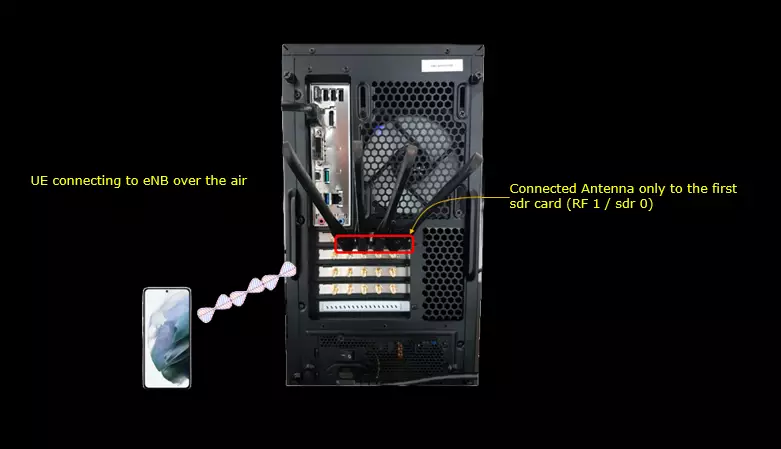
Test setup for this tutorial is as shown below.
- SIM Card used in this tutorial is the one delivered with the system as it is.
- If you want to change the configuration, The tutorial Configuration Guide would help
Key Configuration Parameters
Followings are important configuration parameters for this tutorial. You may click on the items for the descriptions from Amarisoft documents.
- n_antenna_dl
- transmission_mode
- transmission_mode_opt
- codebook_subset_restriction
- codebook_subset_restriction_opt
- n_scid
- ue_specific_port
- csi_rs_nzp
- csi_rs_zp
- ap_cqi_period
- ap_cqi_rm
- ap_cqi_rm_opt
Test 1 : TM3 - 2x2 MIMO
This test is to show how to configure TM3 (Transmission Mode 3) with 2x2 MIMO and test it.
Configuration
I used the eNB configuration enb-tm3-2x2.cfg which is copied from enb.default.cfg and modified for this tutorial.

I used the mme configuration mme-ims.cfg and ims configuration ims.default.cfg
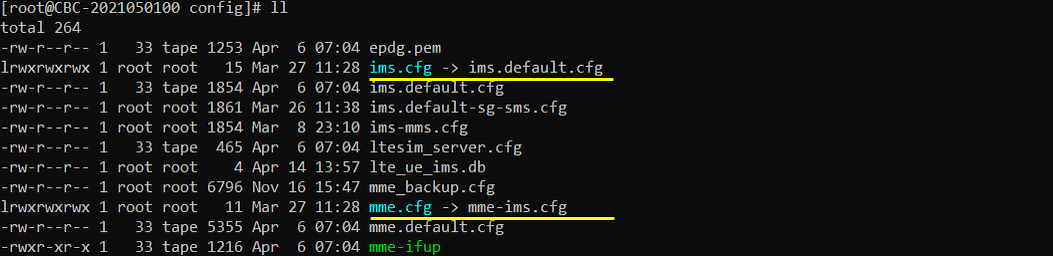
In enb-tm3-2x2.cfg , the configurations are set as follows.
In this example, the LTE eNB configuration file is enb-tm3-2x2.cfg.
The first important setting is N_ANTENNA_DL. It is set to 2. This means the eNB is configured to use two downlink transmit antennas. In the comment, this is described as MIMO 2x2. This is the basic antenna configuration required for this TM3 2x2 MIMO test.
The second important setting is TM. It is set to 3. This enables LTE downlink Transmission Mode 3. TM3 is used for open-loop spatial multiplexing. In this mode, the eNB can transmit multiple layers without relying on closed-loop PMI feedback from the UE.
The other parameters are kept as part of the common LTE cell configuration. TDD is set to 0, so this test uses FDD. N_RB_DL is set to 25, which means the LTE channel bandwidth is 5 MHz. N_ANTENNA_UL is set to 1, so the uplink uses one antenna. CHANNEL_SIM is set to 0, so the channel simulator is disabled. NG_ENB is set to 0, so this is configured as a normal eNB, not an ng-eNB.
So the key point of this configuration is simple. Set N_ANTENNA_DL to 2 for 2x2 MIMO, and set TM to 3 for Transmission Mode 3. These two parameters define the main purpose of this test.

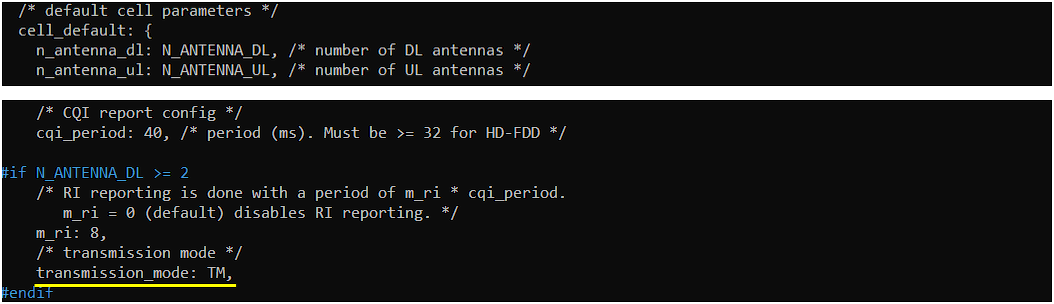
Set configure the parameter transmission_mode with TM you defined before. In most of sample configuration, this parameter would be set with a specific hardcoded number. But I used a predefined constant in this test just to make the configuration easier.
In this part, the parameter transmission_mode is configured inside the cell_default section.
The first part defines the antenna configuration. n_antenna_dl is set to N_ANTENNA_DL, and n_antenna_ul is set to N_ANTENNA_UL. Since N_ANTENNA_DL was already defined as 2 in the previous section, this cell is configured with two downlink antennas. This is the required antenna setup for the 2x2 MIMO test.
The CQI report configuration is also shown here. cqi_period is set to 40 ms. This defines how often the UE reports CQI information. Since this test uses more than one downlink antenna, the additional RI reporting configuration is enabled by the condition N_ANTENNA_DL >= 2.
In this example, m_ri is set to 8. This means RI reporting is configured with a period related to the CQI report period. The comment says RI reporting is done with a period of m_ri multiplied by cqi_period. Since cqi_period is 40 ms and m_ri is 8, the RI reporting period becomes 320 ms.
The most important line in this section is transmission_mode: TM. Here, TM is the predefined constant that was defined earlier as 3. So this line finally applies Transmission Mode 3 to the LTE cell configuration.
In many sample configurations, transmission_mode may be written directly as a fixed number, such as transmission_mode: 3. In this test, TM is used instead. This makes the configuration easier to modify. If you want to test another transmission mode later, you only need to change the value of TM in one place.
Run and Check
Now run the eNB and check whether the physical cell configuration is applied as intended.
In this example, the command cell phy is used from the eNB console. This command shows the physical layer configuration of the LTE cell. It is useful because it allows you to confirm the actual running configuration, not only the values written in the configuration file.
The output shows one LTE cell, cell 0x001. The RAT is LTE and the bandwidth is 5 MHz. This matches the previous configuration where N_RB_DL was set to 25. The downlink EARFCN is 3350 and the uplink EARFCN is 21350. The downlink SCS is 15 kHz and the downlink QAM value is 256. The uplink also uses 15 kHz SCS and the uplink QAM value is 64.
The most important value in this check is the downlink antenna number. In the DL section, ANT is shown as 2. This confirms that the cell is running with two downlink antennas. Since this test is for TM3 2x2 MIMO, this is the first thing we need to verify.
So this result confirms that the LTE cell is configured as a 5 MHz LTE cell with two downlink antennas. This means the basic physical layer condition for TM3 2x2 MIMO is correctly applied.

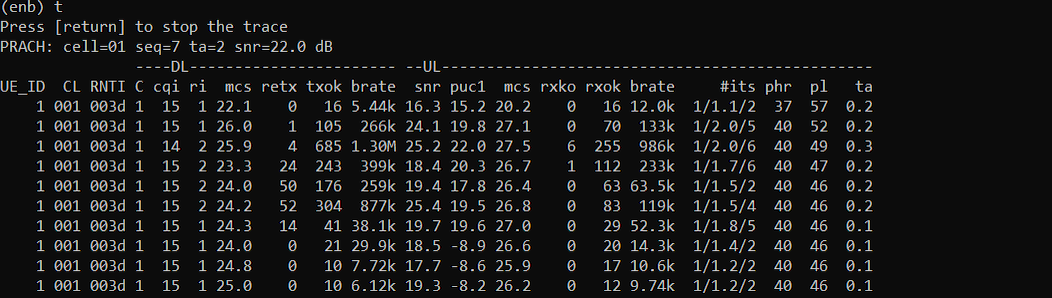
After the eNB is running, enter the t command in the eNB console and power on the UE.
The t command starts the live trace display. This allows you to monitor the UE connection status and the radio link behavior in real time. After the UE is powered on, check that the UE completes the attach procedure and starts showing normal PHY statistics in the trace.
In this example, the PRACH line shows that the UE has sent random access. It shows cell=01, seq=7, ta=2, and snr=22.0 dB. This indicates that the eNB detected the UE random access preamble successfully.
After the UE is connected, the trace shows UE_ID 1 on cell 001 with RNTI 003d. The DL section shows CQI and RI values. The CQI is mostly 15, which indicates very good downlink channel quality. The RI value changes between 1 and 2. RI 2 is especially important in this test because it means the UE can report rank 2, which is required to use two spatial layers in 2x2 MIMO.
The DL MCS is around 24 to 26 in several lines, and the downlink bitrate reaches values such as 1.30M and 399k. The PUCCH SNR values are also shown, mostly around 18 to 25 dB. This indicates that the uplink control channel quality is good enough for stable feedback reporting.
So this trace confirms two things. First, the UE completed the attach and is actively connected to the LTE cell. Second, the UE is reporting RI and CQI values, which are needed for TM3 MIMO operation. At this stage, the TM3 2x2 MIMO test is running and the link is ready for further traffic or throughput verification.
Log Analysis
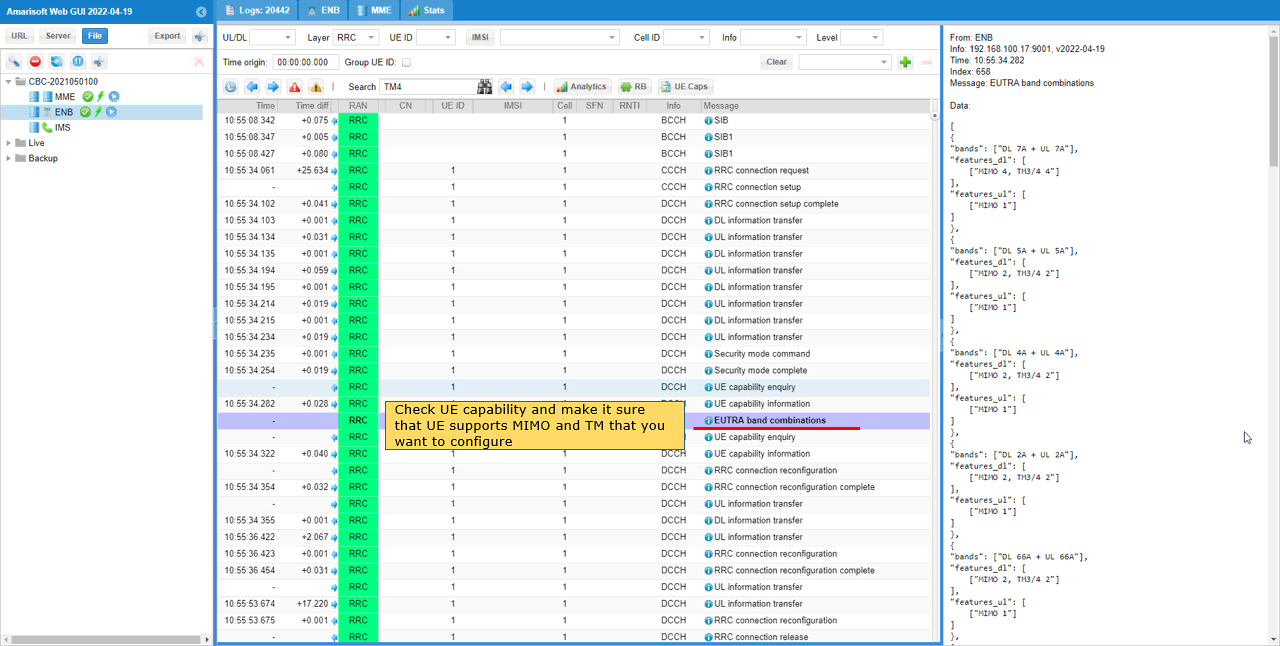
In the log analysis step, check the UE capability information and confirm that the UE supports the MIMO and transmission mode that you intended to configure.
In this example, the Amarisoft Web GUI shows the RRC message flow during UE attach. After the UE sends RRC connection request and completes the RRC connection setup, the eNB sends UE capability enquiry. Then the UE responds with UE capability information.
The important item to check here is EUTRA band combinations inside the UE capability information. This part tells what LTE bands and MIMO combinations are supported by the UE. In the decoded capability information, several band combinations are shown. For example, one entry shows DL 7A + UL 7A with features_dl including MIMO 4, TM3/4. Another entry shows DL 5A + UL 5A with MIMO 2, TM3/4. Other entries also show MIMO 1 or MIMO 2 depending on the band combination.
For this test, the main point is to confirm that the UE supports TM3 and the required MIMO capability for the selected band. Since this test is for TM3 2x2 MIMO, the UE capability should include a combination that supports MIMO 2 and TM3/4. In the example, this kind of capability is visible in the EUTRA band combinations list.
So this log confirms that the UE is not just attached to the cell. It also confirms that the UE has reported LTE MIMO and transmission mode capability. This is an important check because the eNB configuration alone is not enough. The UE also needs to support the corresponding MIMO mode for the test to work as intended.
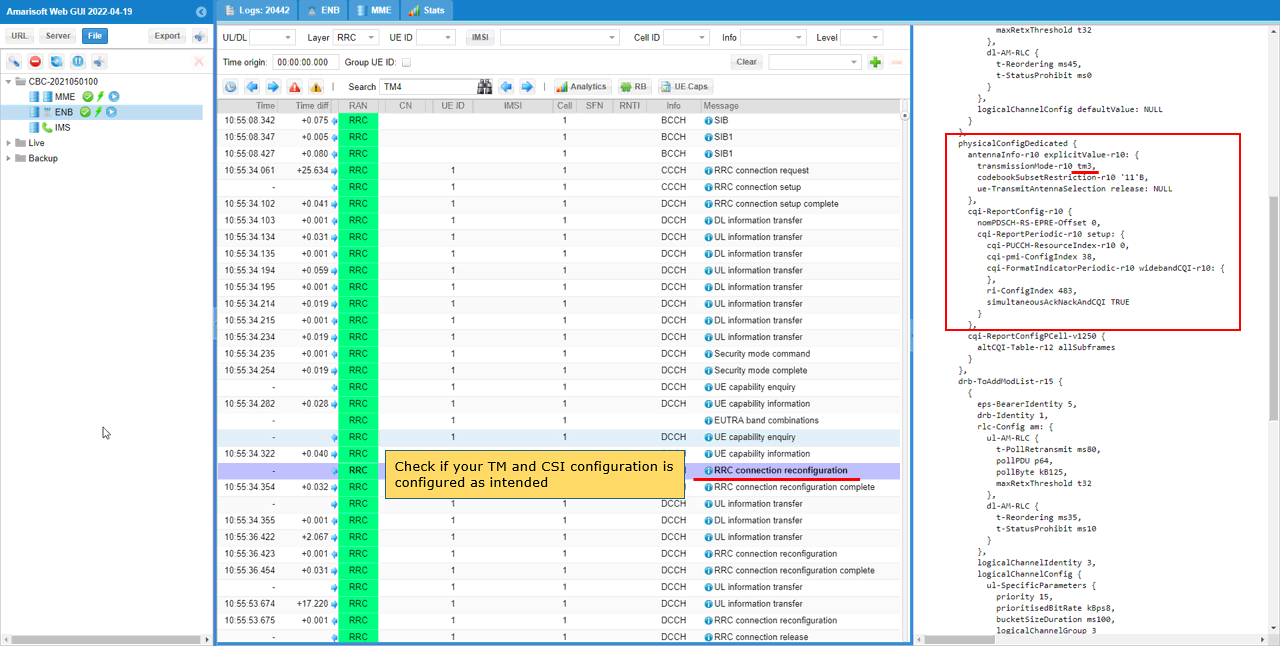
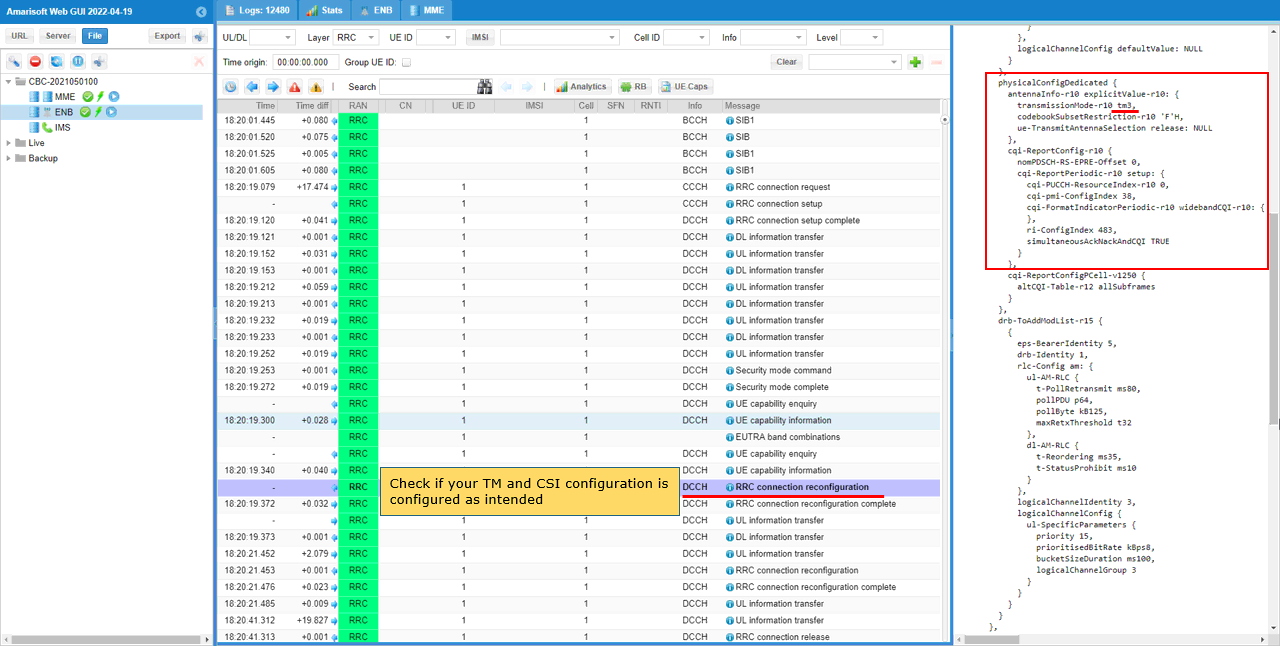
In this step, check the physicalConfigDedicated IE inside the RRC Connection Reconfiguration message.
This message is important because it shows the actual dedicated radio configuration that the eNB sends to the UE after the UE capability check. So this is the best place to confirm whether the configured transmission mode and CSI/CQI reporting configuration are really delivered to the UE.
In this example, the RRC Connection Reconfiguration message includes physicalConfigDedicated. Inside physicalConfigDedicated, antennaInfo is configured as explicitValue-r10. The transmissionMode is set to tm3. This confirms that the eNB is configuring the UE to operate with LTE Transmission Mode 3.
The same section also shows codebookSubsetRestriction-r10 and ue-TransmitAntennaSelection set to release. These are part of the antenna-related configuration delivered to the UE.
Next, check cqi-ReportConfig. In this example, nomPDSCH-RS-EPRE-Offset is set to 0. cqi-ReportPeriodic is configured with setup, and cqi-PUCCH-ResourceIndex is set to 0. The cqi-pmi-ConfigIndex is set to 38. This is the periodic CQI/PMI reporting configuration. The cqi-FormatIndicatorPeriodic is set to widebandCQI-r10, meaning the UE reports wideband CQI.
The ri-ConfigIndex is set to 483, and simultaneousAckNackAndCQI is set to TRUE. This confirms that RI reporting is also configured. This is important for TM3 MIMO operation because RI tells the eNB whether the UE can receive one layer or two layers.
So this log confirms that the eNB has sent the intended TM and CSI/CQI configuration to the UE. The key check point is transmissionMode tm3 under physicalConfigDedicated, together with cqi-ReportConfig and ri-ConfigIndex. This means the TM3 configuration is not only written in the configuration file, but also actually signaled to the UE through RRC.
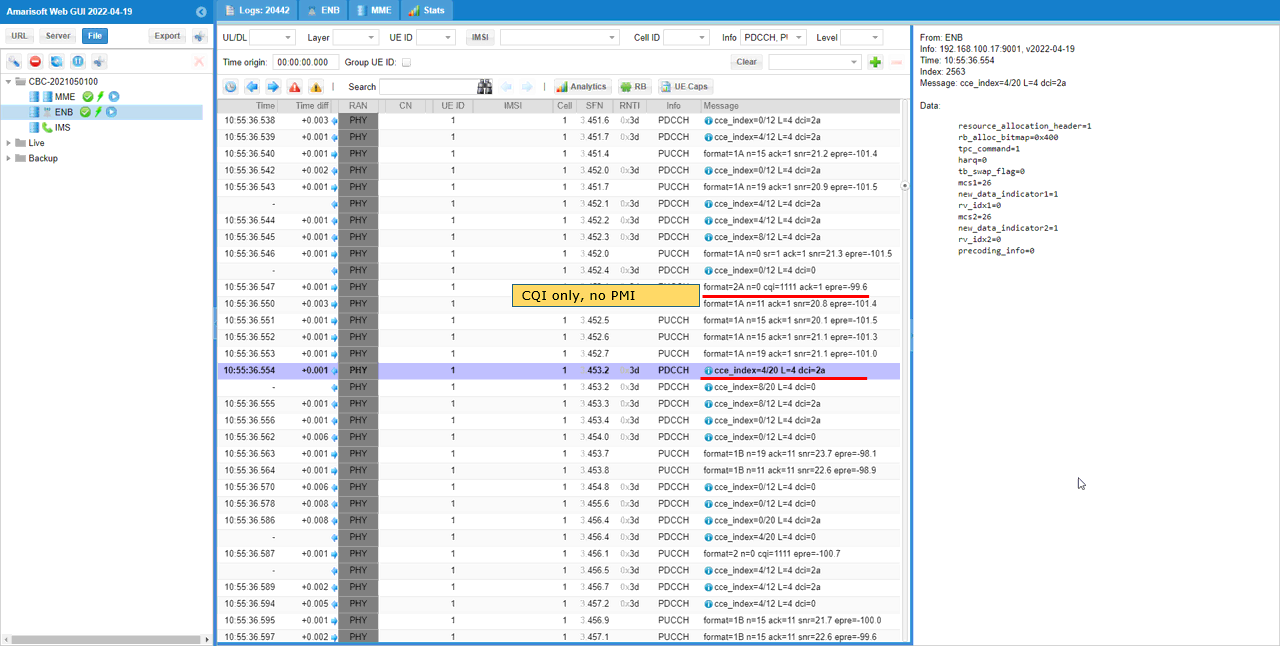
In this step, check the DCI and PUCCH messages to confirm that MIMO scheduling and feedback reporting are working as expected.
In this example, the log is filtered around PDCCH and PUCCH. The PDCCH entry shows the downlink scheduling information sent from the eNB to the UE. The selected DCI message shows cce_index=42, L=4, and dci=2a. This means the eNB is using DCI Format 2A for downlink scheduling. DCI Format 2A is used for MIMO-related downlink scheduling, so this is an important indication that the UE is being scheduled in the intended MIMO transmission mode.
On the right side, the decoded DCI details show several important fields. The resource_allocation_header is set to 1, rb_alloc_bitmap is present, and harq_process is 0. The mcs1 value is 26, and new_data_indicator1 is set to 1 with rv_idx1 set to 0. The second transport block is also shown with mcs2 set to 6, new_data_indicator2 set to 1, and rv_idx2 set to 0. This indicates that the scheduler is assigning two transport blocks, which is the expected behavior for spatial multiplexing.
The same DCI also shows precoding_info=0. For this TM3 test, the main point is not closed-loop PMI-based precoding. TM3 is open-loop spatial multiplexing, so the scheduling is mainly checked through the use of MIMO DCI and the presence of two transport blocks.
Next, check the PUCCH entries. In this example, the PUCCH messages show format 1A, format 1B, and format 2A. The format 2A entry includes cqi=1111 and ack information. The note in the example says CQI only, no PMI. This matches the TM3 behavior because TM3 does not depend on UE-reported PMI in the same way as closed-loop TM4.
So this log confirms both directions of the MIMO operation. On the downlink side, the eNB schedules the UE using MIMO-related DCI Format 2A with two transport blocks. On the uplink control side, the UE reports CQI through PUCCH, and the eNB receives the feedback as expected. This verifies that the TM3 2x2 MIMO configuration is active at the scheduling and feedback level.
Test 2 : TM4 - 2x2 MIMO
This test is to show how to configure TM4 (Transmission Mode 4) with 2x2 MIMO and test it.
Configuration
I used the eNB configuration enb-tm4-2x2.cfg which is copied from enb.default.cfg and modified for this tutorial.

I used the mme configuration mme-ims.cfg and ims configuration ims.default.cfg
In enb-tm4-2x2.cfg , the configurations are set as follows.
The basic antenna configuration is the same as the previous TM3 test. N_ANTENNA_DL is set to 2, so the eNB uses two downlink transmit antennas. This enables the 2x2 MIMO downlink configuration. N_ANTENNA_UL is set to 1, so the uplink uses one antenna.
The key difference is the TM value. In this test, TM is set to 4. This means the LTE downlink transmission mode is configured as Transmission Mode 4.
TDD is set to 0, so this test uses FDD. N_RB_DL is set to 25, so the LTE bandwidth is 5 MHz. CHANNEL_SIM is set to 0, so the channel simulator is disabled. NG_ENB is set to 0, so this is a normal eNB configuration.
So the main configuration point is very simple. Set N_ANTENNA_DL to 2 for 2x2 MIMO, and set TM to 4 for Transmission Mode 4. Compared to TM3, TM4 uses closed-loop spatial multiplexing. So in later log analysis, we need to check not only CQI and RI, but also PMI-related feedback and scheduling behavior.

In this part, configure transmission_mode inside the cell_default section in the same way as the previous test.
The antenna configuration is still based on the predefined constants. n_antenna_dl is set to N_ANTENNA_DL, and n_antenna_ul is set to N_ANTENNA_UL. Since N_ANTENNA_DL was already defined as 2, this cell is configured with two downlink antennas for 2x2 MIMO.
The CQI report configuration is also configured in the same section. cqi_period is set to 40 ms. This means the UE periodically reports CQI every 40 ms. Since the downlink antenna number is 2, the RI reporting part is enabled by the condition N_ANTENNA_DL >= 2.
Here, m_ri is set to 8. This means RI reporting is configured based on m_ri times cqi_period. With cqi_period 40 ms and m_ri 8, the RI report period becomes 320 ms.
The most important line is transmission_mode: TM. In this test, TM was defined as 4, so this line applies Transmission Mode 4 to the LTE cell.
In many sample configurations, this value may be written directly as transmission_mode: 4. In this tutorial, TM is used as a predefined constant. This makes the configuration easier to reuse. To switch to another transmission mode, you only need to change the TM definition at the top of the configuration file.
Run and Check
Now run the eNB and check whether the physical cell configuration is applied correctly.
In this example, the command cell phy is used from the eNB console. This command shows the current PHY configuration of the LTE cell. It is useful because it confirms the actual running configuration after the eNB has started.
The output shows cell 0x001 with RAT set to LTE. The LTE band is 7 and the bandwidth is 5 MHz. This matches the previous configuration where N_RB_DL was set to 25.
In the downlink section, the EARFCN is 3350. The downlink antenna number is shown as 2. This is the most important value to check for this test because TM4 2x2 MIMO requires two downlink transmit antennas. The downlink SCS is 15 kHz and the downlink QAM value is 256.
In the uplink section, the EARFCN is 21350. The uplink antenna number is 1. The uplink SCS is also 15 kHz and the uplink QAM value is 64.
So this result confirms that the LTE cell is running as a 5 MHz LTE cell with two downlink antennas. This means the basic PHY condition for TM4 2x2 MIMO is correctly configured. The transmission mode itself is not directly shown in this cell phy output, so it should be checked later from the RRC configuration and PHY scheduling logs.
After confirming the cell PHY configuration, run the t command in the eNB console and power on the UE.
The t command starts the live trace display. This is useful to check whether the UE performs random access, completes attach, and starts normal downlink and uplink scheduling.
In this example, the PRACH line shows cell=01, seq=7, ta=2, and snr=22.0 dB. This means the eNB detected the UE random access preamble successfully. After this, the trace starts showing UE_ID 1 with RNTI 003d, which indicates that the UE is connected to the LTE cell.
In the DL section, the CQI value is mostly 15. This indicates that the downlink channel condition is very good. The RI value changes between 1 and 2. RI 2 is important for this TM4 2x2 MIMO test because it means the UE is reporting that it can receive two spatial layers.
The DL MCS values are around 23 to 26 in several entries, and the downlink bitrate reaches values such as 1.30M and 399k. This shows that downlink scheduling is active. The PUCCH SNR is also shown, mostly around 18 to 25 dB, which means the uplink control channel condition is good enough for CQI, PMI, RI, and HARQ feedback.
So this trace confirms that the UE completed attach and is actively connected. It also confirms that the UE is reporting CQI and RI values. For TM4, this is the first runtime check before going deeper into RRC configuration and PHY logs to verify closed-loop MIMO behavior, especially PMI feedback and DCI scheduling.
Log Analysis
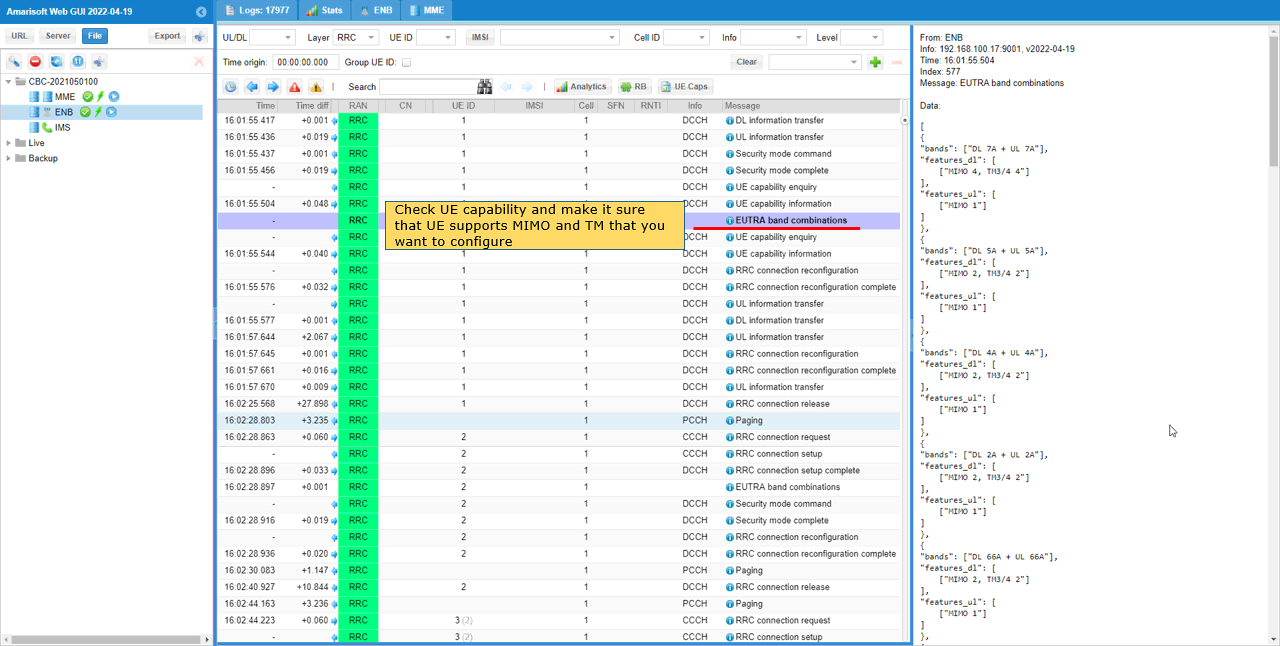
In this step, check the UE capability information and confirm that the UE supports the MIMO and transmission mode required for this TM4 test.
In this example, the Amarisoft Web GUI shows the RRC message flow during UE attach. After RRC connection setup and security procedure, the eNB sends UE capability enquiry. Then the UE responds with UE capability information. This is the message that should be checked before analyzing the actual TM4 scheduling behavior.
The important part is EUTRA band combinations. This section shows what LTE band combinations, MIMO capability, and transmission mode capability are supported by the UE.
In the decoded capability information, several combinations are shown. For example, one entry shows DL 7A + UL 7A with features_dl including MIMO 4 and TM3/4. Another entry shows DL 5A + UL 5A with features_dl including MIMO 2 and TM3/4. Other entries also show MIMO 2, TM3/4 or MIMO 1 depending on the band combination.
For this test, the key point is to find a band combination that supports TM3/4 and at least MIMO 2. Since this test is TM4 with 2x2 MIMO, the UE must support closed-loop spatial multiplexing and two-layer reception for the target LTE band.
So this log confirms that the UE capability is suitable for this test. The UE supports TM3/4 and MIMO capability in the reported EUTRA band combinations. This means the UE side does not block the TM4 2x2 MIMO configuration, and we can continue to check the actual RRC reconfiguration, DCI scheduling, and PMI/CQI/RI feedback behavior.
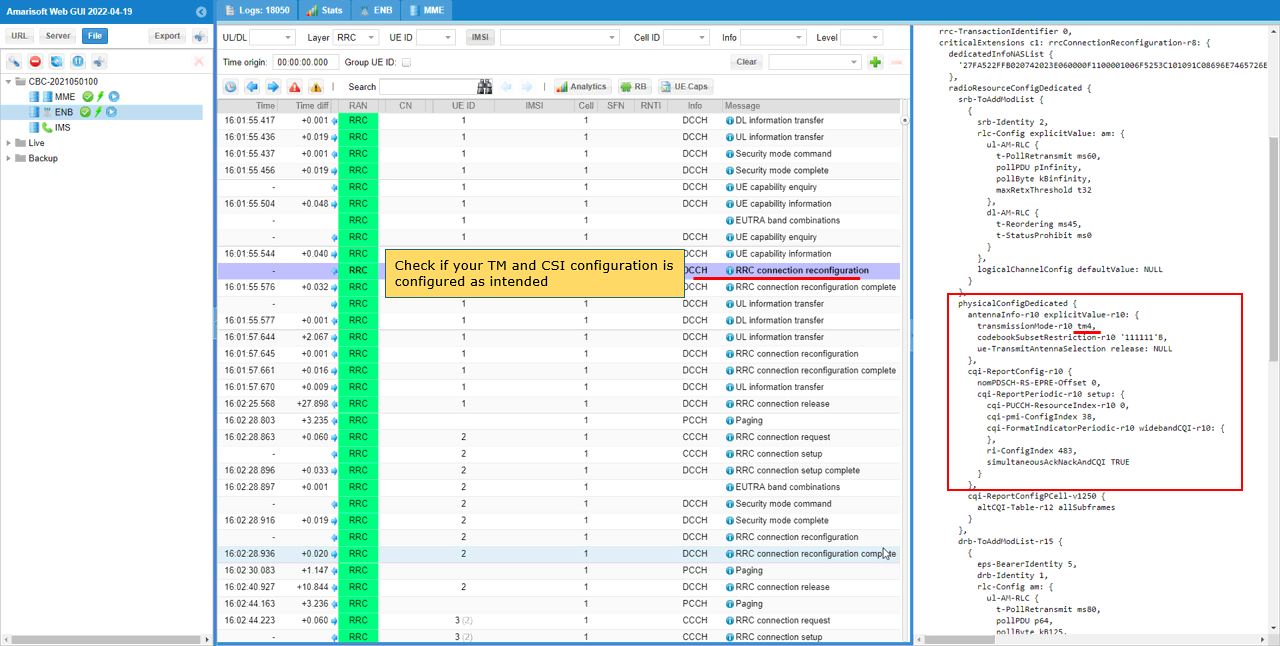
In this step, check the physicalConfigDedicated IE inside the RRC Connection Reconfiguration message.
This is where the eNB sends the actual dedicated PHY configuration to the UE. So this message is one of the most important checkpoints for confirming that TM4 is really configured at the RRC level.
In this example, physicalConfigDedicated includes antennaInfo with explicitValue-r10. Inside this field, transmissionMode is set to tm4. This confirms that the eNB is configuring the UE to use LTE Transmission Mode 4.
This is the key difference from the previous TM3 test. In TM3, the RRC configuration showed transmissionMode tm3. In this test, it shows transmissionMode tm4, which means the UE is configured for closed-loop spatial multiplexing.
The same section also includes cqi-ReportConfig. The cqi-ReportPeriodic field is set to setup, and cqi-PUCCH-ResourceIndex is set to 0. The cqi-pmi-ConfigIndex is set to 38. This means periodic CQI/PMI reporting is configured for the UE.
The cqi-FormatIndicatorPeriodic is set to widebandCQI-r10. This means the UE reports wideband CQI. The ri-ConfigIndex is set to 483, so RI reporting is also configured. In addition, simultaneousAckNackAndCQI is set to TRUE, which means HARQ ACK/NACK and CQI reporting can be handled together as configured.
So this log confirms that the intended TM4 and CSI reporting configuration is delivered to the UE through RRC Connection Reconfiguration. The most important check points are transmissionMode tm4, cqi-pmi-ConfigIndex 38, and ri-ConfigIndex 483. This confirms that the configuration is not only written in the eNB configuration file, but also actually signaled to the UE.
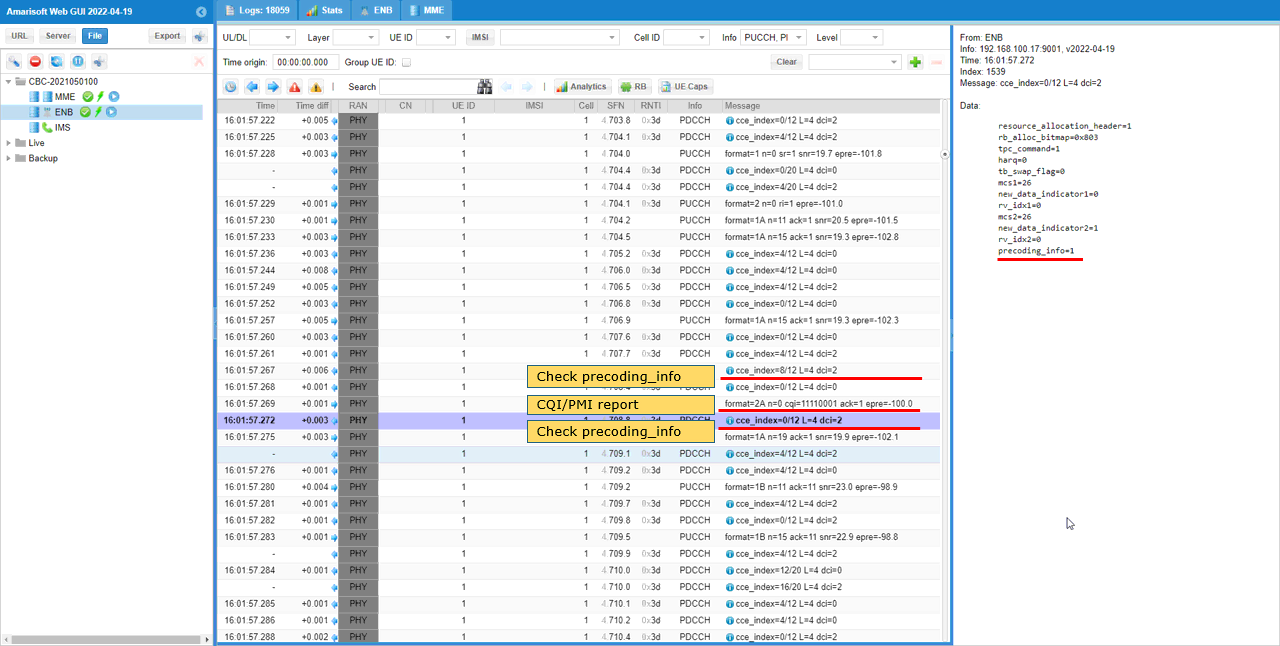
In this step, check the DCI and PUCCH messages to confirm that TM4 MIMO scheduling and feedback reporting are working as expected.
In this example, the log is filtered around PDCCH and PUCCH. The selected PDCCH message shows dci=2. This is an important point for TM4 because DCI Format 2 is used for closed-loop spatial multiplexing. So this confirms that the eNB is scheduling the UE using a DCI format suitable for TM4 MIMO operation.
On the right side, the decoded DCI shows the detailed downlink scheduling information. The resource_allocation_header is set to 1, and rb_alloc_bitmap is present. The DCI includes harq_process, mcs1, new_data_indicator1, rv_idx1, mcs2, new_data_indicator2, and rv_idx2. In this example, both transport block 1 and transport block 2 are configured, and both new data indicators are set. This indicates that the scheduler is using two transport blocks, which is expected for 2x2 spatial multiplexing.
The most important field to check for TM4 is precoding_info. In this example, precoding_info is shown as 1. This is the key difference from TM3. TM4 is closed-loop MIMO, so the eNB uses PMI-related feedback from the UE and selects the precoding information for downlink transmission.
Next, check the PUCCH messages. In this example, the PUCCH entries include format 2A with CQI and PMI information. One line shows format2A n=0 cqi=1111001 ack=1 epre=-100.0. This indicates that the UE is sending CQI/PMI-related feedback on PUCCH. This is expected for TM4 because the eNB needs this feedback to perform closed-loop precoding.
So this log confirms both sides of TM4 operation. On the downlink side, the eNB schedules the UE using DCI Format 2 with two transport blocks and precoding information. On the uplink control side, the UE reports CQI/PMI information through PUCCH. This verifies that TM4 2x2 MIMO is active at the PHY scheduling and feedback level.
Test 3 : TM3 - 4x4 MIMO
This test is to show how to configure TM3 (Transmission Mode 3) with 4x4 MIMO and test it.
Configuration
I used the eNB configuration enb-tm3-4x4.cfg which is copied from enb.default.cfg and modified for this tutorial.

I used the mme configuration mme-ims.cfg and ims configuration ims.default.cfg
In enb-tm3-4x4.cfg , the configurations are set as follows.
This test is similar to the previous TM3 2x2 MIMO test, but the downlink antenna configuration is changed to 4 antennas. N_ANTENNA_DL is set to 4. This means the eNB is configured to use four downlink transmit antennas for 4x4 MIMO operation.
The TM value is set to 3. This means the LTE downlink transmission mode is configured as Transmission Mode 3. TM3 is open-loop spatial multiplexing, so the eNB can perform MIMO transmission without relying on closed-loop PMI-based precoding feedback from the UE.
The other basic parameters are kept the same. TDD is set to 0, so this test uses FDD. N_RB_DL is set to 25, so the LTE bandwidth is 5 MHz. N_ANTENNA_UL is set to 1, so the uplink uses one antenna. CHANNEL_SIM is set to 0, so the channel simulator is disabled. NG_ENB is set to 0, so this is configured as a normal eNB.
So the key point of this configuration is to set N_ANTENNA_DL to 4 and TM to 3. This prepares the eNB for TM3 4x4 MIMO testing. In the later steps, we need to check whether the cell is really running with four downlink antennas, whether the UE reports 4x4 MIMO capability, and whether the RRC and PHY logs show the expected TM3 behavior.

Set configure the parameter transmission_mode with TM you defined before.
In this part, configure transmission_mode inside the cell_default section.
The antenna configuration uses the predefined constants again. n_antenna_dl is set to N_ANTENNA_DL, and n_antenna_ul is set to N_ANTENNA_UL. Since N_ANTENNA_DL was defined as 4 in this test, the cell is configured with four downlink antennas.
The CQI report configuration is also included in the same section. cqi_period is set to 40 ms. This means the UE reports CQI periodically every 40 ms. Since N_ANTENNA_DL is greater than or equal to 2, the RI reporting configuration is enabled.
Here, m_ri is set to 8. According to the comment, RI reporting is done with a period of m_ri multiplied by cqi_period. So with cqi_period 40 ms and m_ri 8, the RI reporting period becomes 320 ms.
The key line is transmission_mode: TM. In this test, TM was defined as 3, so this applies Transmission Mode 3 to the LTE cell.
In many sample configurations, this value may be written directly as transmission_mode: 3. In this tutorial, TM is used as a predefined constant. This makes the configuration easier to reuse. For example, if you want to change the same file structure from TM3 to another transmission mode, you only need to change the TM definition at the top of the file.
So the main point of this section is that the cell uses four downlink antennas and Transmission Mode 3. This prepares the eNB for TM3 4x4 MIMO operation.
Run and Check
Now run the eNB and check the physical cell configuration.
In this example, the command cell phy is used again from the eNB console. This command confirms the actual PHY configuration currently applied to the LTE cell.
The output shows cell 0x001 with RAT set to LTE. The LTE band is 7 and the bandwidth is 5 MHz. This matches the configuration where N_RB_DL was set to 25.
The most important value in this test is the downlink antenna number. In the DL section, ANT is shown as 4. This confirms that the eNB is running with four downlink transmit antennas. This is the required PHY condition for the TM3 4x4 MIMO test.
The downlink EARFCN is 3350, the downlink SCS is 15 kHz, and the downlink QAM value is 256. In the uplink section, the EARFCN is 21350, the antenna number is 1, the SCS is 15 kHz, and the QAM value is 64.
So this result confirms that the LTE cell is configured as a 5 MHz LTE cell with four downlink antennas. This means the basic PHY setup for TM3 4x4 MIMO is correctly applied. The next step is to power on the UE and check whether the UE can attach and report the required MIMO capability.

After confirming the cell PHY configuration, run the t command in the eNB console and power on the UE.
The t command starts the live PHY trace. This allows you to check whether the UE performs PRACH, completes attach, and starts normal downlink and uplink scheduling.
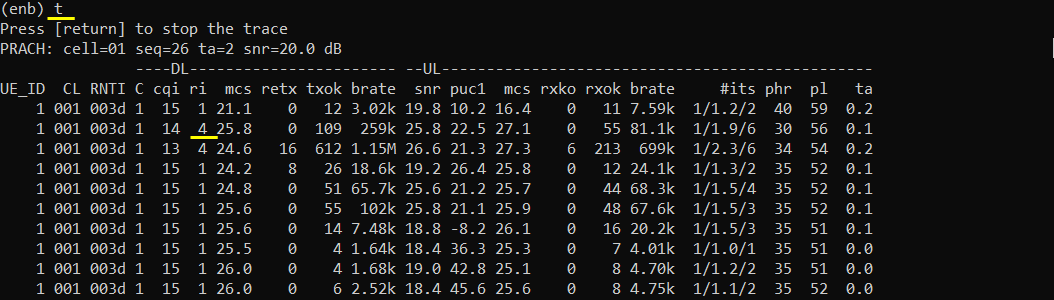
In this example, the PRACH line shows cell=01, seq=26, ta=2, and snr=20.0 dB. This means the eNB detected the UE random access preamble successfully. After the UE is connected, the trace shows UE_ID 1 with RNTI 003d on cell 001.
In the DL section, CQI is mostly around 14 or 15. This indicates good downlink channel quality. The important value for this test is RI. In this example, RI becomes 4 in some trace lines. This is the key difference from the 2x2 MIMO tests. RI 4 means the UE is reporting that it can support rank 4 reception, which matches the purpose of the TM3 4x4 MIMO test.
The downlink MCS values are around 21 to 26 in several entries, and the downlink bitrate reaches values such as 1.15M and 259k. This shows that downlink scheduling is active. The PUCCH SNR is also shown around 18 to 26 dB in several lines, which means the uplink control channel is good enough for CQI, RI, and HARQ feedback.
So this trace confirms that the UE completed attach and is actively connected. More importantly, the UE reports RI 4, which confirms that the 4x4 MIMO capability is being reflected at runtime. For this TM3 4x4 MIMO test, this is an important checkpoint before checking UE capability, RRC configuration, and PHY scheduling logs.
Log Analysis
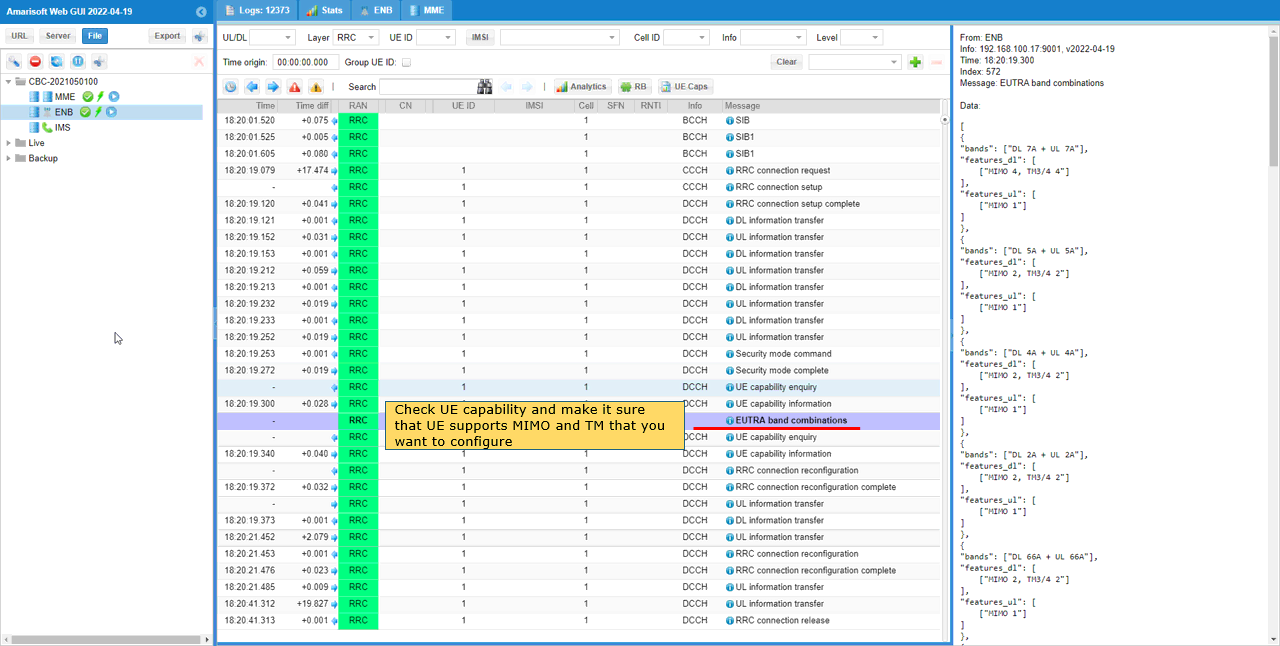
In this log analysis step, check the UE capability information and confirm that the UE supports the required MIMO and transmission mode for TM3 4x4 MIMO.
In this example, the Amarisoft Web GUI shows the RRC message flow during UE attach. After the UE completes the initial RRC connection setup and security procedure, the eNB sends UE capability enquiry. Then the UE responds with UE capability information. This message should be checked before assuming that 4x4 MIMO can be used.
The important part is EUTRA band combinations. This section shows the LTE band combinations and the related downlink MIMO capability reported by the UE.
In the decoded capability information, one entry shows DL 7A + UL 7A with features_dl including MIMO 4, TM3/4 4. This is the most important line for this test. It indicates that, on this band combination, the UE supports 4-layer MIMO operation for TM3/TM4. Since the test cell is using LTE Band 7, this matches the target configuration.
Other band combinations are also shown. For example, DL 5A + UL 5A also shows MIMO 2, TM3/4 2, and DL 4A + UL 4A shows MIMO 2, TM3/4 2. These entries indicate that the UE supports different MIMO ranks depending on the band combination. But for this specific test, the key check is the Band 7 entry with MIMO 4 and TM3/4 4.
So this log confirms that the UE capability is suitable for TM3 4x4 MIMO on the configured LTE band. This means the UE is not limited to 2x2 MIMO in this test condition. The next step is to check the RRC Connection Reconfiguration and confirm that transmissionMode tm3 and the corresponding CQI/RI reporting configuration are actually delivered to the UE.
In this step, check the physicalConfigDedicated IE inside the RRC Connection Reconfiguration message.
This message confirms the actual dedicated PHY configuration that the eNB sends to the UE. Even though the configuration file sets TM to 3 and N_ANTENNA_DL to 4, the final confirmation should be done from this RRC message.
In this example, physicalConfigDedicated includes antennaInfo with explicitValue-r10. Inside antennaInfo, transmissionMode is set to tm3. This confirms that the UE is configured for LTE Transmission Mode 3.
This is the expected result for this test. The cell is configured with four downlink antennas, but the transmission mode is still TM3. So this test is checking open-loop spatial multiplexing with a 4x4 MIMO antenna setup.
The same section also shows codebookSubsetRestriction-r10 and ue-TransmitAntennaSelection set to release. These belong to the antenna-related configuration delivered to the UE.
Next, check cqi-ReportConfig. In this example, cqi-ReportPeriodic is set to setup. The cqi-PUCCH-ResourceIndex is set to 0, and cqi-pmi-ConfigIndex is set to 38. The cqi-FormatIndicatorPeriodic is set to widebandCQI-r10, so the UE reports wideband CQI.
The ri-ConfigIndex is set to 483. This is important for 4x4 MIMO because RI reporting allows the UE to inform the eNB about the supported rank. In the previous live trace, RI reached 4, so this RRC configuration and the runtime trace are consistent.
The simultaneousAckNackAndCQI field is set to TRUE. This means ACK/NACK and CQI reporting can be handled together according to the configured reporting rule.
So this log confirms that the intended TM3 and CSI/CQI/RI reporting configuration is delivered to the UE through RRC Connection Reconfiguration. The key checkpoints are transmissionMode tm3, cqi-pmi-ConfigIndex 38, and ri-ConfigIndex 483. This confirms that the TM3 4x4 MIMO configuration is not only set in the eNB configuration file, but also actually signaled to the UE.
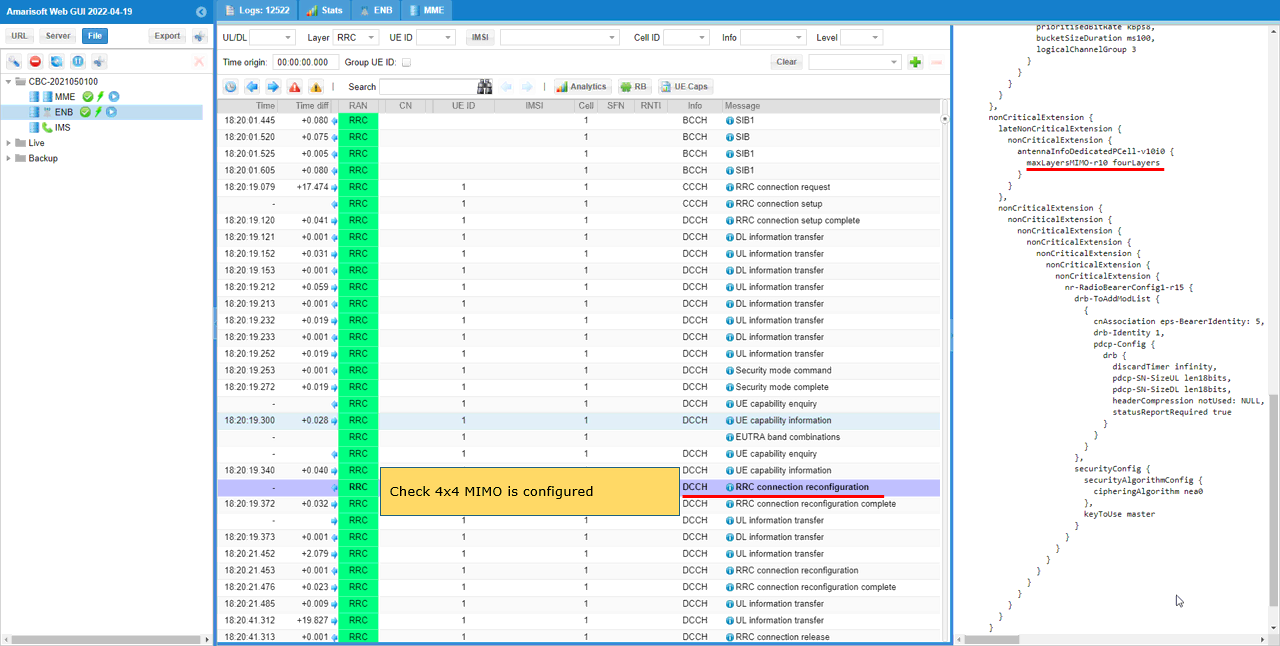
In this additional RRC check, confirm the 4x4 MIMO specific configuration inside the RRC Connection Reconfiguration message.
For the 4x4 MIMO case, it is not enough to check only transmissionMode tm3. You should also check whether the RRC antenna configuration indicates that four-layer MIMO is allowed.
In this example, the right side shows nonCriticalExtension and antennaInfoDedicatedPCell-v10i0. Inside this field, maxLayersMIMO-r10 is set to fourLayers. This is the key checkpoint for the 4x4 MIMO test.
This value means the UE is configured to support up to four downlink MIMO layers for the PCell. This matches the previous configuration where N_ANTENNA_DL was set to 4, and it also matches the live trace where RI was reported as 4.
So for the TM3 4x4 MIMO test, there are three important confirmations from RRC and runtime logs. First, physicalConfigDedicated shows transmissionMode tm3. Second, the CQI/RI reporting configuration is present, including ri-ConfigIndex. Third, maxLayersMIMO-r10 is set to fourLayers. Together, these confirm that the UE is configured for TM3 operation with 4-layer MIMO capability.
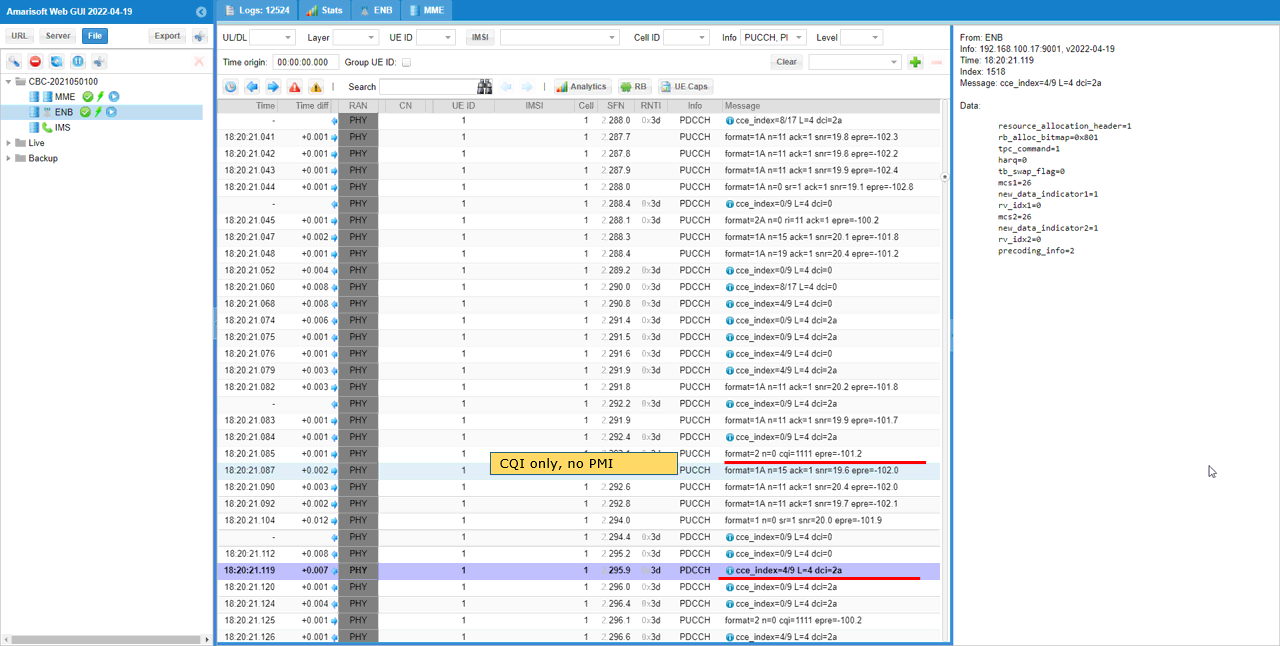
In this PHY log check, verify the DCI and PUCCH feedback for the TM3 4x4 MIMO case.
In this example, the selected PDCCH message shows dci=2a. This is the expected MIMO scheduling DCI format for TM3. Since TM3 is open-loop spatial multiplexing, the eNB uses DCI Format 2A rather than the closed-loop DCI Format 2 used in TM4.
On the right side, the decoded DCI shows the scheduling details. It includes mcs1 and mcs2, new_data_indicator1 and new_data_indicator2, and rv_idx1 and rv_idx2. This means the scheduler is assigning two transport blocks. This confirms that MIMO spatial multiplexing scheduling is active.
The decoded DCI also shows precoding_info=2. In TM3, this value is related to the open-loop MIMO transmission configuration. The important point is that this is not PMI-driven closed-loop precoding as in TM4. So for TM3, we mainly check that the eNB uses DCI 2A and that the UE reports CQI and RI properly.
The PUCCH log shows format2 with cqi=1111. The annotation says CQI only, no PMI. This matches TM3 behavior. In TM3, the UE reports CQI and RI, but PMI is not the main feedback used for closed-loop precoding.
So this log confirms the expected TM3 4x4 MIMO behavior. The eNB schedules downlink MIMO using DCI Format 2A, the DCI includes two transport blocks, and the UE reports CQI on PUCCH without PMI. Together with the previous RI 4 trace and maxLayersMIMO-r10 fourLayers configuration, this confirms that the TM3 4x4 MIMO test is working as intended.
Test 4 : TM4 - 4x4 MIMO
This test is to show how to configure TM4 (Transmission Mode 4) with 4x4 MIMO and test it.
Configuration
I used the eNB configuration enb-tm4-4x4.cfg which is copied from enb.default.cfg and modified for this tutorial.

I used the mme configuration mme-ims.cfg and ims configuration ims.default.cfg
In enb-tm4-4x4.cfg , the configurations are set as follows.
This test is for Transmission Mode 4 with 4x4 MIMO. So the main configuration difference is that the downlink antenna number is set to 4, and the transmission mode is set to 4.
N_ANTENNA_DL is set to 4. This means the eNB is configured with four downlink transmit antennas. This is the required antenna configuration for 4x4 MIMO testing.
TM is set to 4. This means the LTE downlink transmission mode is configured as Transmission Mode 4. TM4 is closed-loop spatial multiplexing, so the UE should report CQI, RI, and PMI, and the eNB can use that feedback for precoding selection.
The other parameters are the same as in the previous tests. TDD is set to 0, so this is FDD. N_RB_DL is set to 25, so the LTE bandwidth is 5 MHz. N_ANTENNA_UL is set to 1, so the uplink uses one antenna. CHANNEL_SIM is set to 0, so the channel simulator is disabled. NG_ENB is set to 0, so this is configured as a normal eNB.
So the key point of this configuration is simple. Set N_ANTENNA_DL to 4 for 4x4 MIMO, and set TM to 4 for Transmission Mode 4. In the later log analysis, we should confirm that the cell is running with four downlink antennas, RRC shows transmissionMode tm4, maxLayersMIMO is set to fourLayers, and PHY logs show DCI Format 2 with precoding information and CQI/PMI feedback.

In this part, configure transmission_mode inside the cell_default section.
The antenna configuration uses the predefined constants. n_antenna_dl is set to N_ANTENNA_DL, and n_antenna_ul is set to N_ANTENNA_UL. Since this test is for 4x4 MIMO, N_ANTENNA_DL should be defined as 4 in the upper part of the configuration file. This means the LTE cell is configured with four downlink transmit antennas.
The CQI report configuration is also included here. cqi_period is set to 40 ms. This means the UE reports CQI periodically every 40 ms.
Since N_ANTENNA_DL is greater than or equal to 2, the RI reporting configuration is enabled. In this example, m_ri is set to 8. According to the comment, RI reporting is done with a period of m_ri multiplied by cqi_period. So the RI reporting period becomes 8 x 40 ms, which is 320 ms.
The most important line is transmission_mode: TM. In this test, TM should be defined as 4, so this line applies Transmission Mode 4 to the LTE cell.
This is the main difference from the previous TM3 4x4 test. The antenna configuration is still 4 downlink antennas, but the transmission mode is changed from TM3 to TM4. So this configuration prepares the cell for closed-loop 4x4 MIMO operation. Later, this should be confirmed from RRC by checking transmissionMode tm4, maxLayersMIMO-r10 fourLayers, and CSI feedback configuration for CQI, PMI, and RI.
Run and Check
Now run the eNB and check the physical cell configuration.
In this example, the command cell phy is used from the eNB console. This command shows the actual PHY configuration currently applied to the LTE cell after the eNB starts.
The output shows cell 0x001 with RAT set to LTE. The LTE band is 7 and the bandwidth is 5 MHz. This matches the configuration where N_RB_DL was set to 25.
The most important value in this check is the downlink antenna number. In the DL section, ANT is shown as 4. This confirms that the eNB is running with four downlink transmit antennas. This is the required antenna configuration for the TM4 4x4 MIMO test.
The downlink EARFCN is 3350, the downlink SCS is 15 kHz, and the downlink QAM value is 256. In the uplink section, the EARFCN is 21350, the uplink antenna number is 1, the uplink SCS is 15 kHz, and the uplink QAM value is 64.
So this result confirms that the LTE cell is configured as a 5 MHz LTE cell with four downlink antennas. This means the basic PHY condition for TM4 4x4 MIMO is correctly applied. The transmission mode itself is not directly shown in this output, so it should be confirmed later from RRC Connection Reconfiguration and PHY scheduling logs.
After running the t command, power on the UE and check that the UE completes attach.
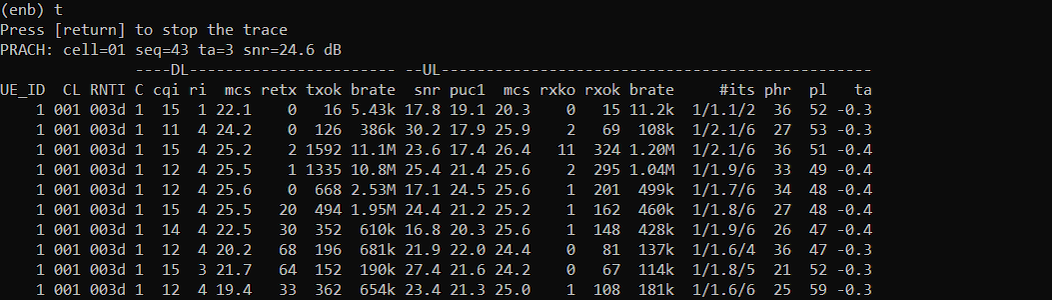
In this example, the PRACH line shows cell=01, seq=43, ta=3, and snr=24.6 dB. This means the eNB successfully detected the UE random access preamble. After this, the trace shows UE_ID 1 with RNTI 003d, so the UE is connected to the LTE cell.
The important part for this TM4 4x4 MIMO test is the DL ri column. In several lines, RI is shown as 4. This means the UE is reporting rank 4, which matches the 4x4 MIMO configuration. This is one of the strongest runtime indicators that the UE and eNB are operating with four-layer MIMO capability.
The CQI value changes between around 11, 12, and 15. This means the UE is reporting downlink channel quality dynamically. The DL MCS values are around 19 to 25, and the downlink bitrate reaches values such as 11.1M, 10.8M, 4.95M, and 2.53M. This shows that downlink scheduling is active and using high throughput in some moments.
The PUCCH SNR is also shown, mostly around 17 to 25 dB. This is important for TM4 because the eNB depends on uplink control feedback such as CQI, PMI, RI, and HARQ ACK/NACK. If the PUCCH quality is poor, closed-loop MIMO feedback may not be reliable.
So this trace confirms that the UE completed attach and is actively connected. More importantly, the UE reports RI 4, which matches the TM4 4x4 MIMO test target. The next step is to confirm the same behavior from RRC and PHY logs by checking transmissionMode tm4, maxLayersMIMO-r10 fourLayers, DCI Format 2, precoding_info, and CQI/PMI feedback on PUCCH.
Log Analysis
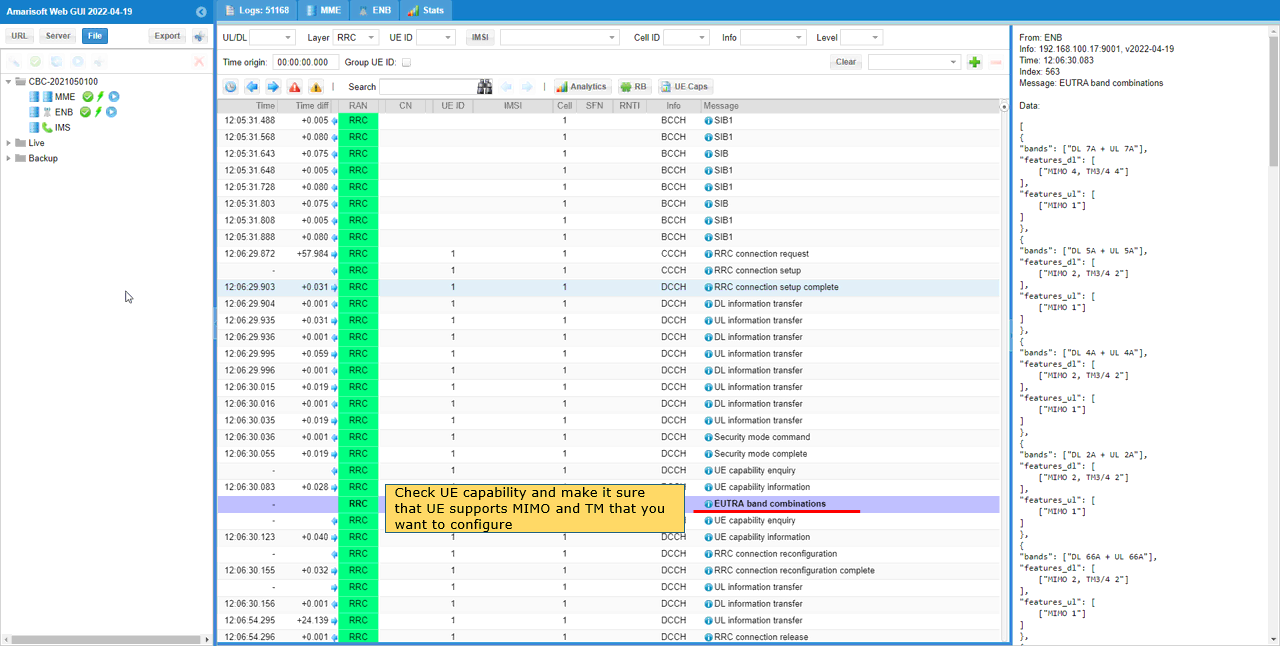
In this log analysis step, check the UE capability information and confirm that the UE supports the required MIMO and transmission mode for TM4 4x4 MIMO.
In this example, the Amarisoft Web GUI shows the RRC message flow during UE attach. After the UE completes RRC connection setup and the security procedure, the eNB sends UE capability enquiry. Then the UE responds with UE capability information. This is the message we need to check before assuming that 4x4 TM4 can be used.
The important section is EUTRA band combinations. This section shows the LTE band combinations and the downlink MIMO capability reported by the UE.
In the decoded capability information, the Band 7 combination is shown as DL 7A + UL 7A. Under features_dl, it shows MIMO 4 and TM3/4 4. This is the key line for this test. It means that, on LTE Band 7, the UE supports 4-layer MIMO operation for TM3 and TM4.
Other band combinations are also shown. For example, DL 5A + UL 5A shows MIMO 2 and TM3/4 2. DL 4A + UL 4A also shows MIMO 2 and TM3/4 2. This means the UE capability depends on the band combination. The UE may support 4x4 MIMO on one band, but only 2x2 MIMO on another band.
For this test, the configured LTE cell is using Band 7. So the Band 7 entry with MIMO 4 and TM3/4 4 is the most important confirmation.
This log confirms that the UE supports TM4 4x4 MIMO for the configured band. So the UE capability is not limiting the test to 2x2 MIMO. The next step is to check RRC Connection Reconfiguration and confirm that transmissionMode tm4, CQI/PMI/RI reporting, and maxLayersMIMO-r10 fourLayers are actually configured for the UE.
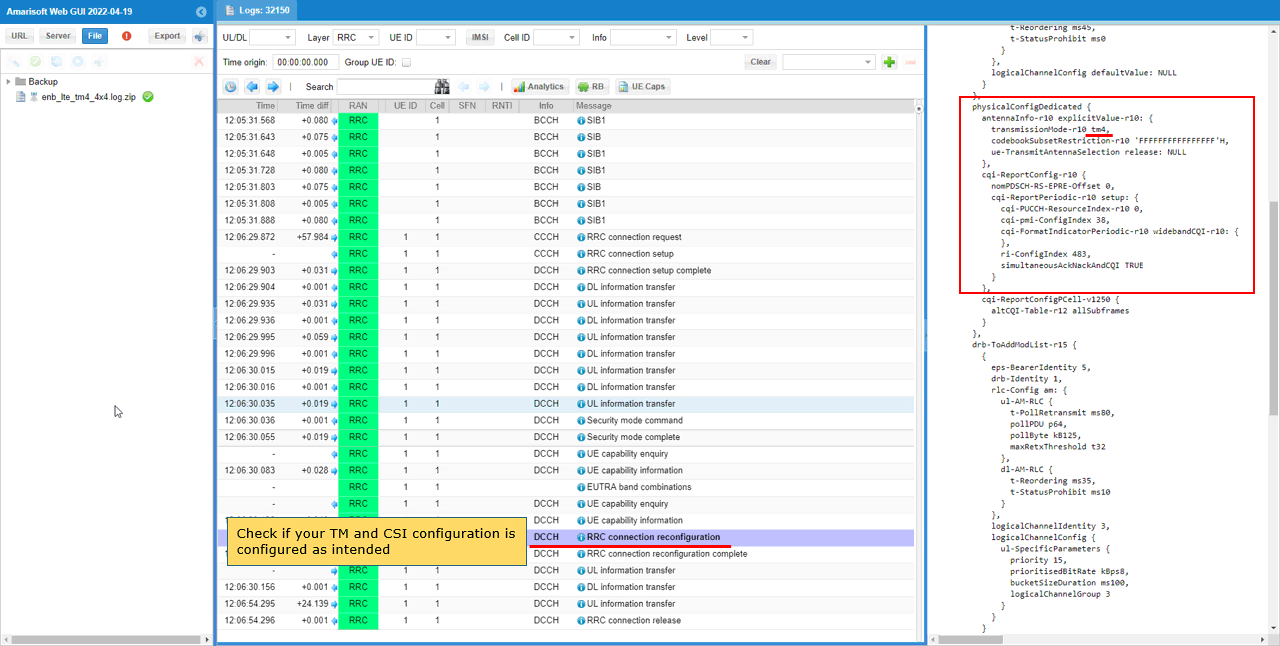
In this step, check the physicalConfigDedicated IE inside the RRC Connection Reconfiguration message.
This message confirms the actual dedicated PHY configuration that the eNB sends to the UE. For the TM4 4x4 MIMO test, this is one of the most important checkpoints because it shows whether the UE is really configured with Transmission Mode 4 and the proper CSI reporting setup.
In this example, physicalConfigDedicated includes antennaInfo with explicitValue-r10. Inside antennaInfo, transmissionMode is set to tm4. This confirms that the eNB configured the UE for LTE Transmission Mode 4.
The same antennaInfo section also shows codebookSubsetRestriction-r10. In this example, it is shown as a long bit string with all bits set. This means the UE is not tightly restricted to only a small subset of codebook entries. This is relevant for TM4 because TM4 uses closed-loop spatial multiplexing and depends on precoding-related feedback.
Next, check cqi-ReportConfig. The cqi-ReportPeriodic field is configured as setup. The cqi-PUCCH-ResourceIndex is set to 0, and cqi-pmi-ConfigIndex is set to 38. This means periodic CQI/PMI reporting is configured for the UE.
The cqi-FormatIndicatorPeriodic is set to widebandCQI-r10. This means the UE reports wideband CQI. The ri-ConfigIndex is set to 483, so RI reporting is also configured. This is important for 4x4 MIMO because the UE needs to report the rank, and in this test we expect the UE to be able to report rank 4.
The simultaneousAckNackAndCQI field is set to TRUE. This means ACK/NACK and CQI reporting can be handled together according to the configured reporting rule.
So this log confirms that the intended TM4 and CSI reporting configuration is delivered to the UE through RRC Connection Reconfiguration. The key checkpoints are transmissionMode tm4, cqi-pmi-ConfigIndex 38, and ri-ConfigIndex 483. For the 4x4 case, this should be checked together with maxLayersMIMO-r10 fourLayers in the RRC extension part.
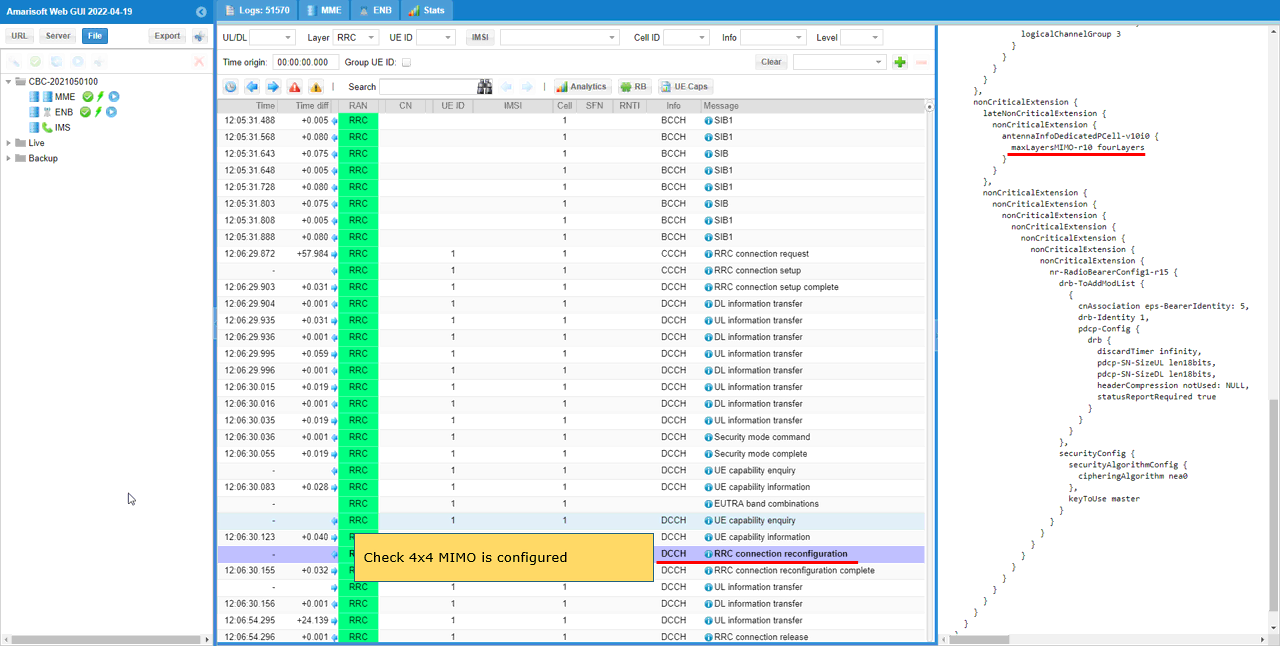
In this additional RRC check, confirm that the 4x4 MIMO layer configuration is actually included in the RRC Connection Reconfiguration message.
For the 4x4 MIMO case, checking transmissionMode tm4 is necessary, but it is not the full confirmation. You should also check the antenna extension field and make sure that the maximum MIMO layer setting allows four layers.
In this example, the RRC message shows antennaInfoDedicatedPCell-v10i0 inside the nonCriticalExtension part. Under this field, maxLayersMIMO-r10 is set to fourLayers.
This is the key checkpoint for the 4x4 MIMO configuration. It means the UE is configured to support up to four downlink MIMO layers on the PCell. This matches the eNB configuration where N_ANTENNA_DL is set to 4. It also matches the runtime trace where RI is reported as 4.
So for TM4 4x4 MIMO, the important RRC confirmations are transmissionMode tm4, cqi-pmi-ConfigIndex 38, ri-ConfigIndex 483, and maxLayersMIMO-r10 fourLayers. Together, these show that the UE is configured for closed-loop 4x4 MIMO operation, with CQI/PMI/RI feedback and four-layer MIMO capability enabled.
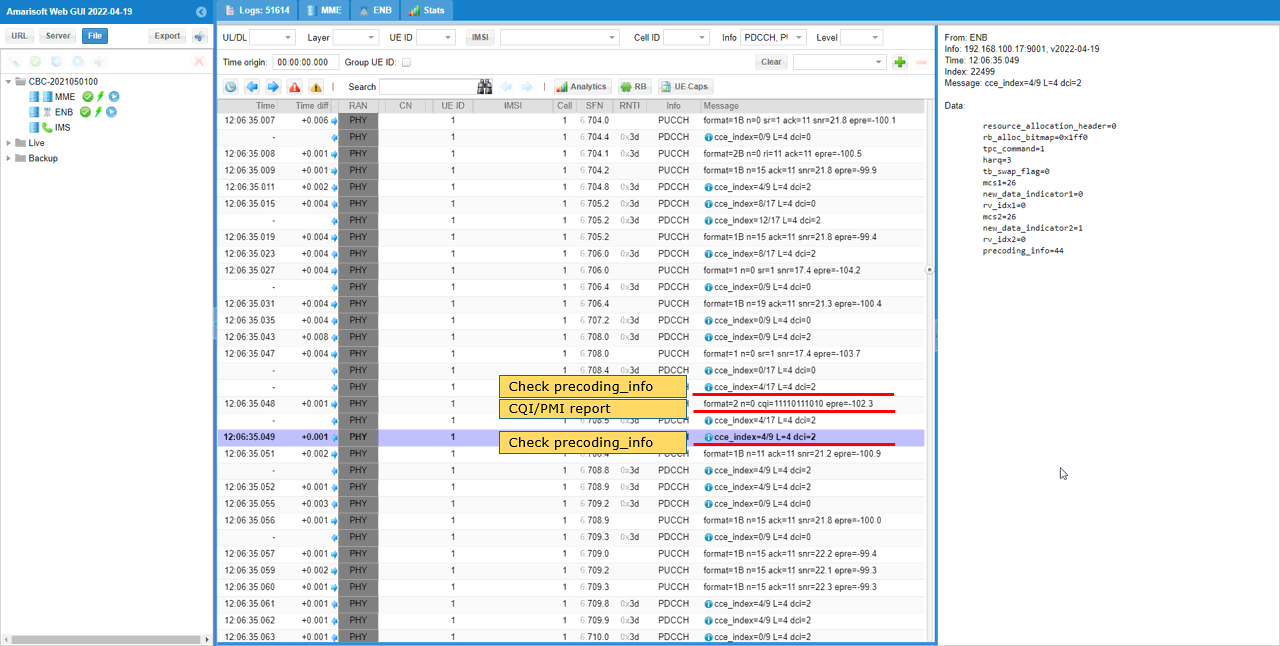
In this PHY log check, verify the DCI and PUCCH feedback for the TM4 4x4 MIMO case.
In this example, the log is filtered around PDCCH and PUCCH. The selected PDCCH message shows dci=2. This is the expected DCI format for TM4 closed-loop spatial multiplexing. This is different from TM3, where we checked DCI Format 2A.
On the right side, the decoded DCI shows the downlink scheduling information. It includes resource allocation information, harq_process, mcs1, new_data_indicator1, rv_idx1, mcs2, new_data_indicator2, and rv_idx2. This means the eNB is scheduling two transport blocks for the UE, which is expected for MIMO spatial multiplexing.
The most important field to check here is precoding_info. In this example, precoding_info is set to 44. This is an important confirmation for TM4 because TM4 is closed-loop MIMO. The eNB uses the UE feedback and selects the precoding information for downlink transmission.
Next, check the PUCCH messages. The highlighted PUCCH line shows format2 with cqi=11110110. This is the CQI/PMI report. This is another key difference from TM3. In TM3, the feedback was CQI only without PMI. In TM4, the UE reports CQI/PMI information, and the eNB can use this feedback for closed-loop precoding.
So this log confirms the expected TM4 4x4 MIMO behavior. The eNB schedules downlink MIMO using DCI Format 2, the DCI includes two transport blocks, and precoding_info is present. On the uplink control side, the UE reports CQI/PMI through PUCCH. Together with transmissionMode tm4 and maxLayersMIMO-r10 fourLayers in RRC, this confirms that TM4 4x4 MIMO is configured and operating as intended.
Test 5 : TM4 - 4x4 MIMO, Codebook Subset Restriction
This test is to show how to configure TM4 (Transmission Mode 4) with 4x4 MIMO and codebook subset restriction and test it.
Configuration
I used the eNB configuration enb-tm4-4x4-Codebook.cfg which is copied from enb.default.cfg and modified for this tutorial.

I used the mme configuration mme-ims.cfg and ims configuration ims.default.cfg
In enb-tm4-4x4-Codebook.cfg , the configurations are set as follows.
This test is based on TM4 4x4 MIMO, but one additional parameter is added for codebook subset restriction.
N_ANTENNA_DL is set to 4. This means the eNB is configured with four downlink transmit antennas. This is required for the 4x4 MIMO test.
TM is set to 4. This means the LTE downlink transmission mode is configured as Transmission Mode 4. Since TM4 is closed-loop spatial multiplexing, the UE reports CQI, PMI, and RI, and the eNB uses this feedback to select the downlink precoding.
The new parameter in this test is CODEBOOK_SUBSET. It is defined as a long bit string. This bit string controls which codebook entries are allowed or restricted for TM4 operation. In the previous TM4 4x4 test, the codebook subset restriction was effectively open, so the eNB had more freedom in selecting the precoding information. In this test, the allowed codebook subset is intentionally controlled by this parameter.
The other parameters are the same as before. TDD is set to 0, so this is FDD. N_RB_DL is set to 25, so the LTE bandwidth is 5 MHz. N_ANTENNA_UL is set to 1, so the uplink uses one antenna. CHANNEL_SIM is set to 0, so the channel simulator is disabled. NG_ENB is set to 0, so this is a normal eNB configuration.
So the key point of this configuration is to set N_ANTENNA_DL to 4, set TM to 4, and define CODEBOOK_SUBSET with the intended restriction pattern. Later, we should check whether this value appears in RRC as codebookSubsetRestriction-r10, and whether the PHY log shows TM4 scheduling with DCI Format 2 and precoding_info under the restricted codebook condition.

In this part, configure transmission_mode inside the cell_default section in the same way as the previous TM4 4x4 test.
The antenna configuration uses the predefined constants. n_antenna_dl is set to N_ANTENNA_DL, and n_antenna_ul is set to N_ANTENNA_UL. Since N_ANTENNA_DL was defined as 4, this cell is configured with four downlink transmit antennas.
The CQI report configuration is also included here. cqi_period is set to 40 ms. This means the UE reports CQI periodically every 40 ms.
Since N_ANTENNA_DL is greater than or equal to 2, the RI reporting configuration is enabled. In this example, m_ri is set to 8. So the RI reporting period becomes 8 x 40 ms, which is 320 ms.
The most important line is transmission_mode: TM. In this test, TM was defined as 4, so this applies Transmission Mode 4 to the LTE cell.
This part is still the same as the normal TM4 4x4 MIMO configuration. The codebook subset restriction itself is not applied in this specific line. The transmission_mode line only selects TM4. The codebook restriction is applied separately through the antenna configuration, and later it should appear in RRC as codebookSubsetRestriction-r10.
So the main point of this section is that the cell is configured for TM4 operation with four downlink antennas. This prepares the basic closed-loop 4x4 MIMO setup. The additional purpose of this test is to verify that the restricted CODEBOOK_SUBSET value is also delivered to the UE through RRC.
Run and Check
Now run the eNB and check the physical cell configuration.
In this example, the cell phy command is used from the eNB console. This command shows the actual PHY configuration currently applied to the LTE cell after the eNB starts.
The output shows cell 0x001 with RAT set to LTE. The LTE band is 7 and the bandwidth is 5 MHz. This matches the configuration where N_RB_DL was set to 25.
The most important value in this check is the downlink antenna number. In the DL section, ANT is shown as 4. This confirms that the eNB is running with four downlink transmit antennas. This is the required antenna configuration for the TM4 4x4 MIMO test.
The downlink EARFCN is 3350, the downlink SCS is 15 kHz, and the downlink QAM value is 256. In the uplink section, the EARFCN is 21350, the uplink antenna number is 1, the uplink SCS is 15 kHz, and the uplink QAM value is 64.
So this result confirms that the basic PHY setup is correct for this test. The cell is running as a 5 MHz LTE cell with four downlink antennas. The codebook subset restriction itself is not shown in this cell phy output. It should be checked later in the RRC Connection Reconfiguration message as codebookSubsetRestriction-r10.

After running the t command, power on the UE and check that the UE completes attach.
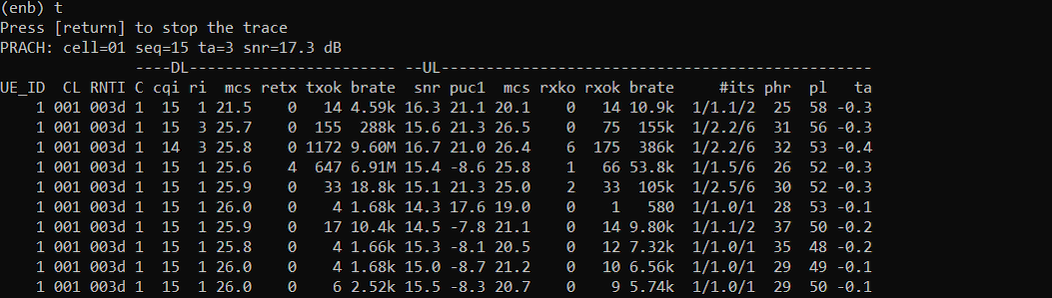
In this example, the PRACH line shows cell=01, seq=15, ta=3, and snr=17.3 dB. This means the eNB successfully detected the UE random access preamble. After this, the trace shows UE_ID 1 with RNTI 003d, so the UE is connected to the LTE cell.
The important part in this test is the DL ri column. In this example, RI is shown as 3 in some lines. This is different from the previous unrestricted TM4 4x4 test, where RI 4 was observed. Since this test applies codebook subset restriction, the UE feedback and usable MIMO rank can be affected by the restricted codebook condition.
The CQI value is mostly 14 or 15, which indicates good downlink channel quality. The DL MCS is around 21 to 26, and the downlink bitrate reaches values such as 9.60M and 288k. This shows that downlink scheduling is active.
The PUCCH SNR is around 15 to 21 dB in several lines. This confirms that uplink control feedback is being received by the eNB. For TM4, this feedback is important because the eNB uses CQI, PMI, RI, and HARQ ACK/NACK to control closed-loop MIMO scheduling.
So this trace confirms that the UE completed attach and is actively connected. It also shows that the UE is reporting RI values under the codebook subset restriction condition. The next step is to check the RRC log and confirm that transmissionMode tm4, maxLayersMIMO-r10 fourLayers, and the intended codebookSubsetRestriction-r10 value are actually delivered to the UE.
Log Analysis
In this log analysis step, check the UE capability information and confirm that the UE supports the required MIMO and transmission mode for this test.
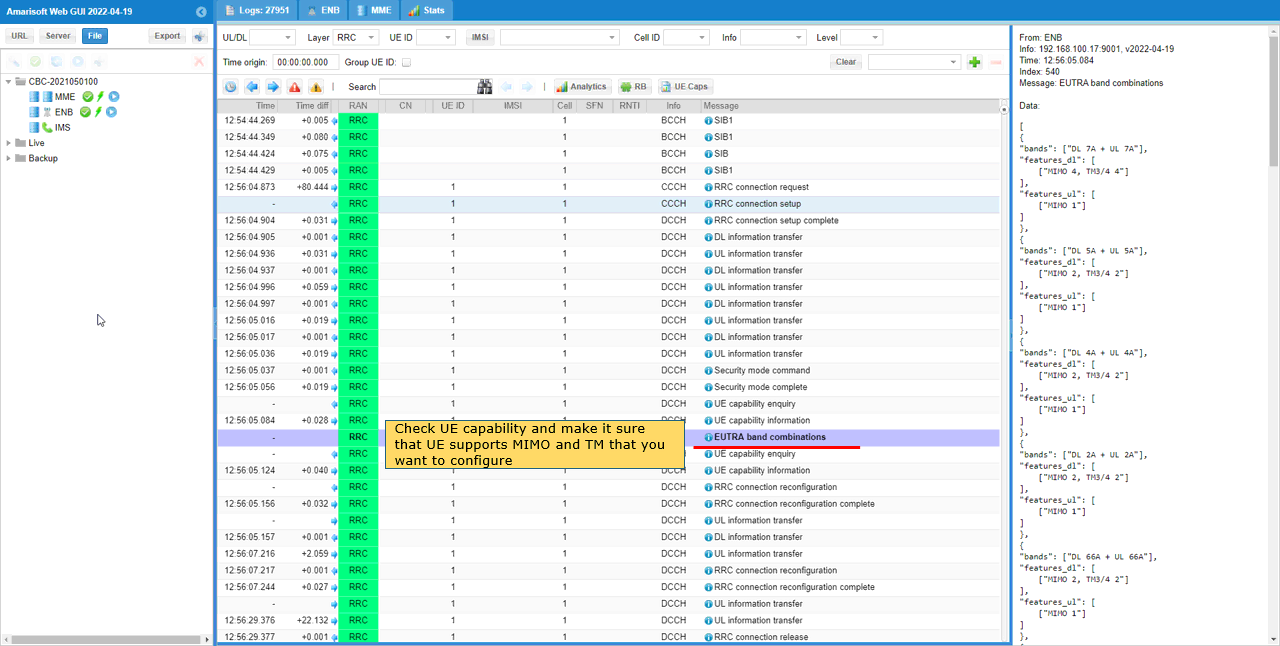
In this example, the Amarisoft Web GUI shows the RRC message flow during UE attach. After the UE completes RRC connection setup and the security procedure, the eNB sends UE capability enquiry. Then the UE responds with UE capability information.
The important part is EUTRA band combinations. This section shows the LTE band combinations and the downlink MIMO capability reported by the UE.
In the decoded capability information, the Band 7 combination is shown as DL 7A + UL 7A. Under features_dl, it shows MIMO 4 and TM3/4 4. This is the key line for this test. It means that, on LTE Band 7, the UE supports 4-layer MIMO operation for TM3 and TM4.
Other band combinations are also shown. For example, DL 5A + UL 5A shows MIMO 2 and TM3/4 2. DL 4A + UL 4A also shows MIMO 2 and TM3/4 2. This means the UE may support different MIMO ranks depending on the band combination.
For this test, the configured LTE cell is using Band 7. So the Band 7 entry with MIMO 4 and TM3/4 4 is the most important confirmation.
This log confirms that the UE supports TM4 4x4 MIMO for the configured band. This is the basic UE-side capability required before testing codebook subset restriction. The codebook restriction itself is not confirmed in UE capability. It should be checked later in RRC Connection Reconfiguration, especially in codebookSubsetRestriction-r10, together with transmissionMode tm4 and maxLayersMIMO-r10 fourLayers.
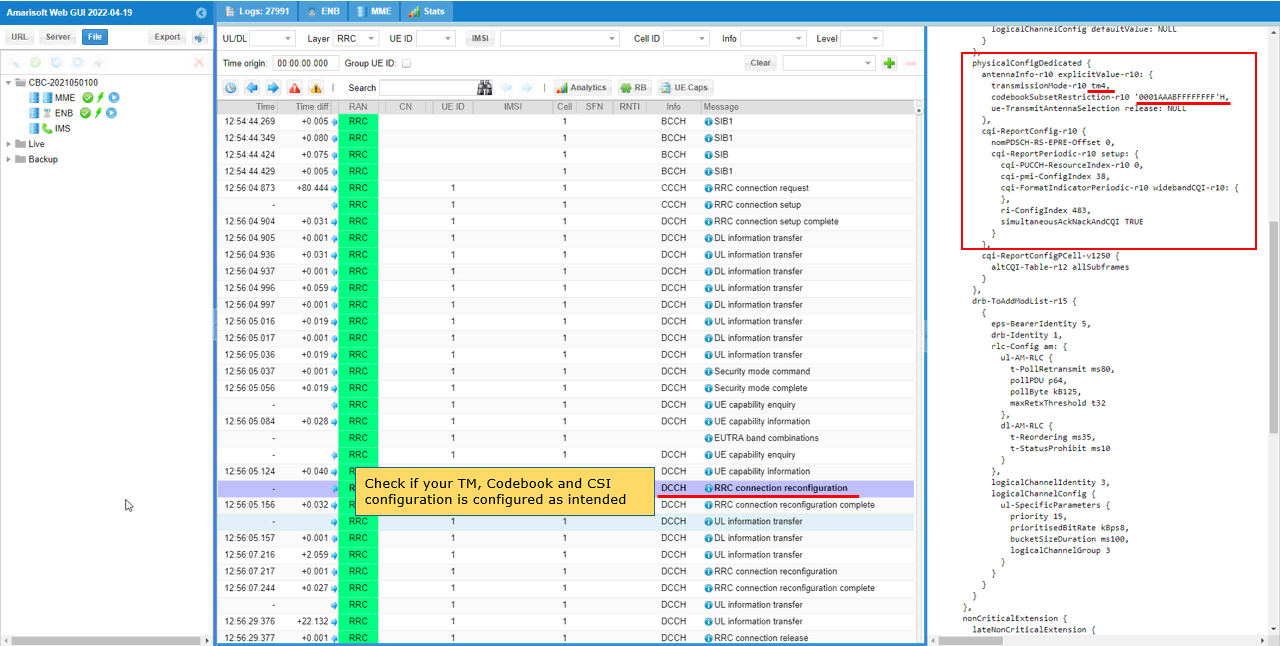
In this step, check the physicalConfigDedicated IE inside the RRC Connection Reconfiguration message and confirm three things: transmission mode, codebook subset restriction, and CSI reporting configuration.
In this example, physicalConfigDedicated includes antennaInfo with explicitValue-r10. Inside antennaInfo, transmissionMode is set to tm4. This confirms that the UE is configured for LTE Transmission Mode 4.
The important difference in this test is codebookSubsetRestriction-r10. In the previous normal TM4 4x4 test, this field was shown with an unrestricted value. In this example, codebookSubsetRestriction-r10 is shown with the configured restricted bit string. This confirms that the CODEBOOK_SUBSET value defined in the configuration file is actually delivered to the UE through RRC.
Next, check cqi-ReportConfig. The cqi-ReportPeriodic field is configured as setup. cqi-PUCCH-ResourceIndex is set to 0, and cqi-pmi-ConfigIndex is set to 38. This means periodic CQI/PMI reporting is configured.
The cqi-FormatIndicatorPeriodic is set to widebandCQI-r10, and ri-ConfigIndex is set to 483. This confirms that RI reporting is also configured. simultaneousAckNackAndCQI is set to TRUE, so ACK/NACK and CQI reporting can be handled together as configured.
So this log confirms that the intended TM4 4x4 MIMO configuration with codebook subset restriction is signaled to the UE. The key checkpoints are transmissionMode tm4, codebookSubsetRestriction-r10 with the restricted bit string, cqi-pmi-ConfigIndex 38, and ri-ConfigIndex 483.
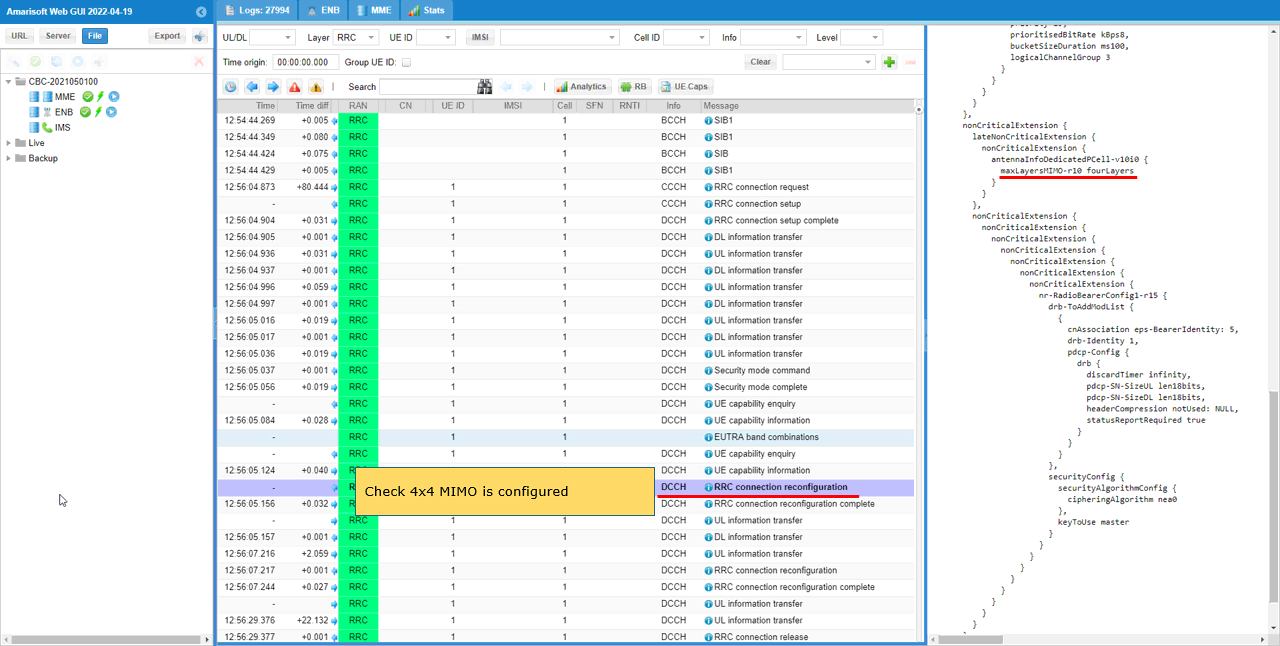
In this additional RRC check, confirm that the 4x4 MIMO layer configuration is still applied even when codebook subset restriction is used.
For this test, transmissionMode tm4 and codebookSubsetRestriction-r10 confirm the TM4 and codebook restriction part. But for the 4x4 MIMO part, you should also check the RRC extension field related to maximum MIMO layers.
In this example, the RRC Connection Reconfiguration message shows antennaInfoDedicatedPCell-v10i0 under nonCriticalExtension. Inside this field, maxLayersMIMO-r10 is set to fourLayers.
This confirms that the UE is configured to support up to four downlink MIMO layers on the PCell. So even though the codebook subset is restricted, the 4-layer MIMO capability itself is still configured.
This is an important distinction. codebookSubsetRestriction-r10 controls which precoding/codebook entries can be used, but maxLayersMIMO-r10 tells whether the UE is allowed to operate up to four layers. In this test, maxLayersMIMO-r10 fourLayers confirms that the 4x4 MIMO layer configuration is still active.
So for this test, the important RRC checkpoints are transmissionMode tm4, codebookSubsetRestriction-r10 with the intended restricted value, cqi-pmi-ConfigIndex 38, ri-ConfigIndex 483, and maxLayersMIMO-r10 fourLayers. Together, these confirm that TM4 4x4 MIMO with codebook subset restriction is correctly signaled to the UE.
In this PHY log check, verify the DCI and PUCCH feedback for the TM4 4x4 MIMO case with codebook subset restriction.
In this example, the selected PDCCH message shows dci=2. This is the expected DCI format for TM4 closed-loop spatial multiplexing. Since this test is based on TM4, this confirms that the eNB is using the correct MIMO scheduling format.
On the right side, the decoded DCI shows the downlink scheduling information. It includes resource allocation information, harq_process, mcs1, new_data_indicator1, rv_idx1, mcs2, new_data_indicator2, and rv_idx2. This means the eNB is scheduling two transport blocks for the UE, which confirms that spatial multiplexing scheduling is active.
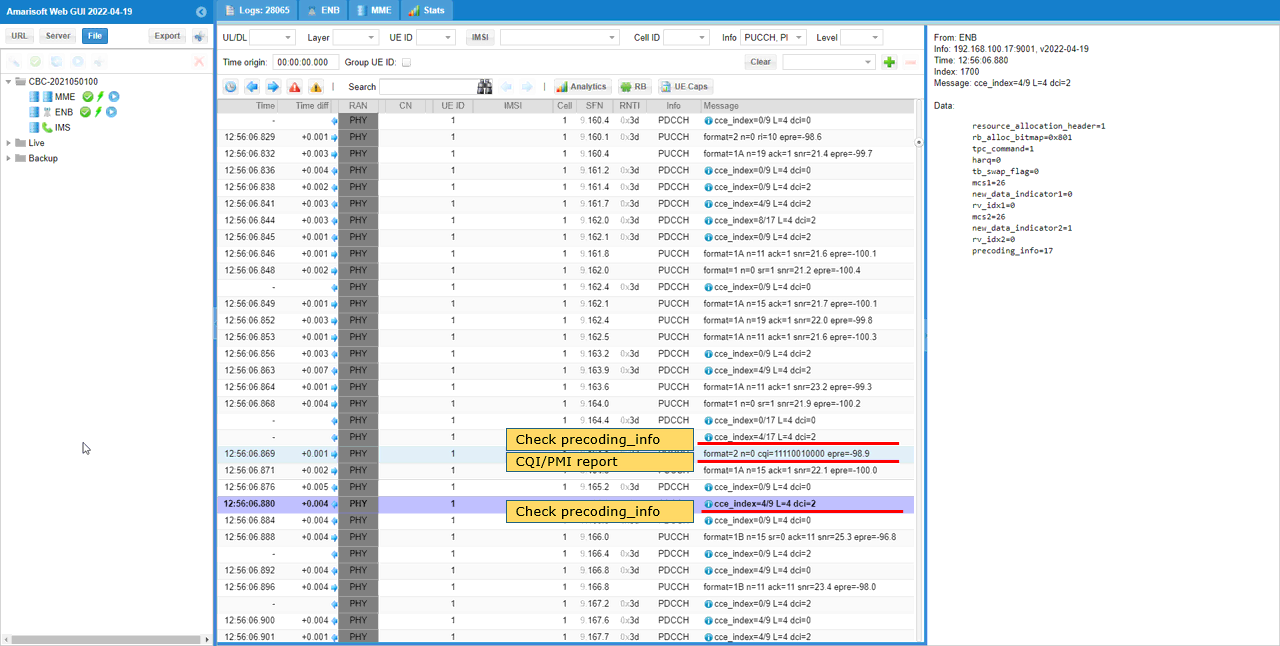
The important field in this test is precoding_info. In this example, precoding_info is set to 17. Since codebook subset restriction is configured, the selected precoding information should follow the restricted codebook condition delivered through RRC. So this value is not just a normal TM4 precoding value. It should be interpreted together with the configured codebookSubsetRestriction-r10.
Next, check the PUCCH message. The highlighted PUCCH line shows format2 with cqi=11110100. This indicates CQI/PMI feedback from the UE. This is expected for TM4 because the eNB needs CQI/PMI/RI feedback to perform closed-loop MIMO scheduling and precoding selection.
So this log confirms that TM4 MIMO scheduling is active under the codebook subset restriction condition. The eNB uses DCI Format 2, schedules two transport blocks, and applies precoding_info. The UE sends CQI/PMI feedback on PUCCH. Together with the previous RRC checks, this confirms that TM4 4x4 MIMO with restricted codebook subset is configured and operating as intended.
Test 6 : TM9 - 2x2 MIMO, Periodic CSI Report
This test is to show how to configure TM9 (Transmission Mode 9) with 2x2 MIMO and Periodic CSI Report and test it.
Configuration
I used the eNB configuration enb-tm9-2x2.cfg which is copied from enb.default.cfg and modified for this tutorial.

I used the mme configuration mme-ims.cfg and ims configuration ims.default.cfg
In enb-tm9-2x2.cfg , the configurations are set as follows.
This test is for TM9 with 2x2 MIMO and periodic CSI reporting. The first important point is that TDD is set to 1. This means the LTE cell is configured as TDD, not FDD. This is different from the previous TM3 and TM4 examples, where TDD was set to 0.
N_RB_DL is set to 25, so the LTE bandwidth is 5 MHz. N_ANTENNA_DL is set to 2, so the eNB is configured with two downlink transmit antennas. This matches the 2x2 MIMO target of this test. N_ANTENNA_UL is set to 1, so the uplink uses one antenna.
CHANNEL_SIM is set to 0, so the channel simulator is disabled. NG_ENB is set to 0, so this is configured as a normal LTE eNB.
In this part of the configuration, the main points are TDD set to 1 and N_ANTENNA_DL set to 2. TDD enables the cell to run in LTE TDD mode, and N_ANTENNA_DL prepares the cell for 2x2 MIMO operation. Since this test is for TM9, the next configuration steps should define Transmission Mode 9 and the CSI reporting configuration, especially the periodic CSI report setup.

The antenna configuration is still based on the predefined constants. n_antenna_dl is set to N_ANTENNA_DL, and n_antenna_ul is set to N_ANTENNA_UL. Since N_ANTENNA_DL was defined as 2, this cell is configured with two downlink antennas for 2x2 MIMO.
The RI reporting configuration is enabled when N_ANTENNA_DL is greater than or equal to 2. In this example, m_ri is set to 4. This means RI reporting is configured with a shorter interval than the previous TM3/TM4 examples, where m_ri was set to 8.
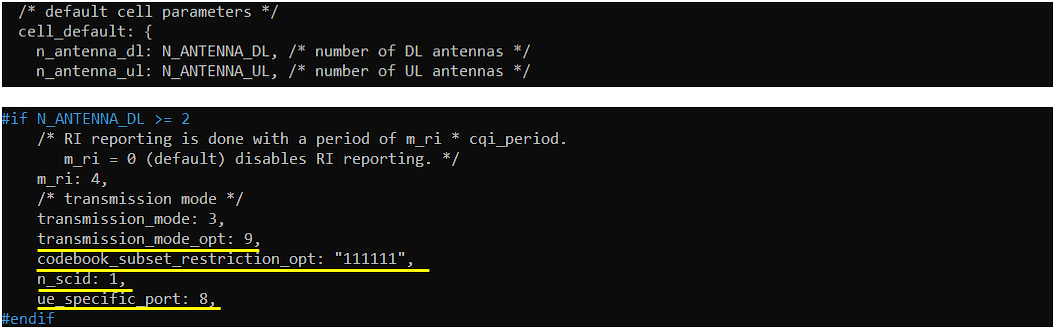
The important difference is how TM9 is configured. In this example, transmission_mode is hardcoded to 3, but transmission_mode_opt is set to 9. This is the Amarisoft-specific way used here to enable TM9 operation. So even though transmission_mode shows 3, the optional transmission mode setting tells the eNB to use TM9.
The codebook_subset_restriction_opt parameter is set to "111111". This defines the allowed codebook subset for the optional transmission mode configuration. Since TM9 uses CSI feedback and precoding-related operation, this parameter controls the codebook restriction used for the TM9 configuration.
The n_scid parameter is set to 1. This is related to the scrambling identity used for UE-specific reference signal based transmission.
The ue_specific_port parameter is set to 8. This indicates that UE-specific antenna port 8 is used. This is an important TM9-related setting because TM9 uses UE-specific reference signals rather than only CRS-based transmission.
So the key point of this configuration is that TM9 is enabled using transmission_mode_opt: 9, together with codebook_subset_restriction_opt, n_scid, and ue_specific_port. These parameters prepare the cell for TM9 2x2 MIMO operation with periodic CSI reporting.
In this part, configure the CSI-RS resources used for the TM9 test.
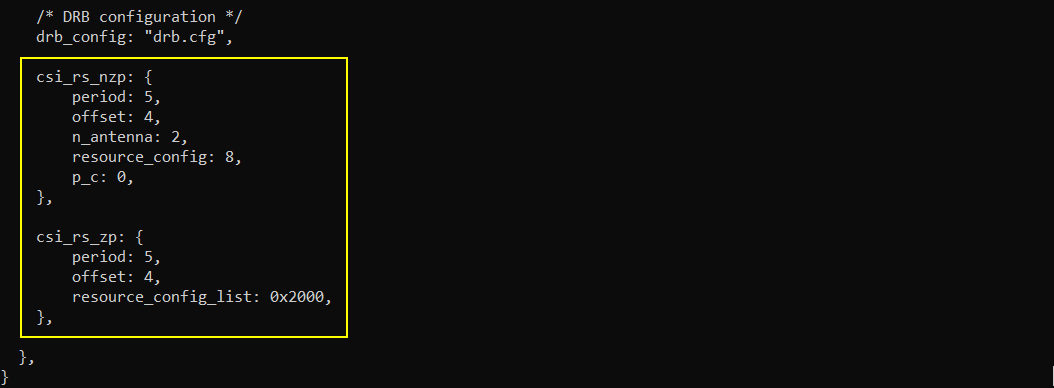
Since this test is for TM9, CSI-RS configuration becomes important. TM9 relies on CSI feedback based on CSI-RS, so we need to configure the non-zero-power CSI-RS and zero-power CSI-RS resources properly.
In this example, csi_rs_nzp is configured first. This is the non-zero-power CSI-RS resource. The period is set to 5, and the offset is set to 4. This means the CSI-RS transmission timing is configured with this periodicity and offset. The n_antenna value is set to 2, which matches the 2x2 MIMO target of this test. The resource_config is set to 8, and p_c is set to 0. These parameters define the CSI-RS resource position and power-related setting.
Next, csi_rs_zp is configured. This is the zero-power CSI-RS resource. The period is also set to 5, and the offset is set to 4. The resource_config_list is set to 0x2000. This defines the zero-power CSI-RS resource pattern.
So the main point of this section is that both NZP CSI-RS and ZP CSI-RS are configured for the TM9 test. The NZP CSI-RS is used by the UE for channel measurement and CSI calculation. The ZP CSI-RS defines muted resource locations, which can be used for CSI measurement and interference-related configuration.
For this test, the important values are n_antenna 2 in csi_rs_nzp, period 5, offset 4, resource_config 8, and resource_config_list 0x2000. These values should later be checked in the RRC log to confirm that the CSI-RS configuration is delivered to the UE as intended.
Run and Check
Now run the eNB and check the physical cell configuration.
In this example, the cell phy command is used from the eNB console. This command shows the actual PHY configuration currently applied to the LTE cell.
The output shows cell 0x001 with RAT set to LTE. The LTE band is 41 and the bandwidth is 5 MHz. This is different from the previous FDD examples that used Band 7. Since this test is configured with TDD set to 1, Band 41 is used as the TDD LTE band.
In the downlink section, the EARFCN is 40620. The downlink antenna number is shown as 2. This confirms that the eNB is running with two downlink transmit antennas, which matches the 2x2 MIMO target of this TM9 test. The downlink SCS is 15 kHz and the downlink QAM value is 256.
In the uplink section, the EARFCN is also 40620. This is expected for TDD because uplink and downlink use the same carrier frequency. The uplink antenna number is 1, the uplink SCS is 15 kHz, and the uplink QAM value is 64.
So this result confirms the basic PHY setup for the test. The cell is running as a 5 MHz LTE TDD cell on Band 41 with two downlink antennas. This means the basic condition for TM9 2x2 MIMO is correctly applied. The TM9-specific configuration, CSI-RS, and periodic CSI report configuration should be checked later from RRC and PHY logs.

After running the t command, power on the UE and check that the UE completes attach.
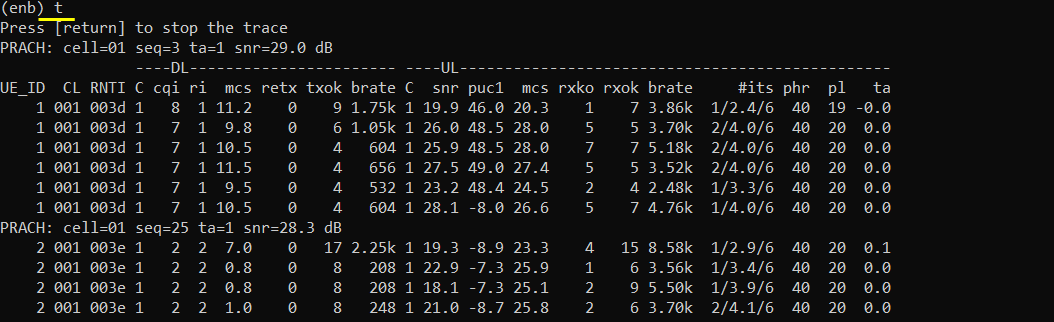
In this example, the PRACH line first shows cell=01, seq=3, ta=1, and snr=29.0 dB. This means the eNB successfully detected the UE random access preamble with a strong PRACH SNR.
After this, the trace shows UE_ID 1 with RNTI 003d. This indicates that the UE is connected to the LTE TDD cell. The CQI value is around 7, and RI is 1 in this first connection. This means the UE is reporting channel quality and rank information, but this specific trace portion is not showing rank 2 operation yet.
Later, another PRACH is detected with cell=01, seq=25, ta=1, and snr=28.3 dB. After this, the trace shows UE_ID 2 with RNTI 003e. In this second connection, CQI is around 2, and RI is shown as 2 in some lines. This is important for the TM9 2x2 MIMO test because RI 2 indicates that the UE is reporting two-layer reception capability.
The DL MCS values are low in this trace, and the downlink bitrate is also relatively small, such as 7.35k, 1.05k, and later 8.58k. This is acceptable for this step because the main purpose here is not throughput measurement yet. The main purpose is to confirm attach, CSI feedback activity, and basic MIMO rank reporting.
The PUCCH SNR values are also shown. In some lines, they are high, around 48 to 49 dB, and in other lines they are negative or low. Since this is a TDD TM9 test with periodic CSI reporting, the later log analysis should focus more directly on RRC CSI-RS configuration and periodic CSI report behavior.
So this trace confirms that the UE completed attach and started reporting CQI and RI. For the TM9 2x2 MIMO periodic CSI report test, the important runtime point is that RI 2 appears, which matches the 2x2 MIMO target. The next step is to check the RRC log and confirm that transmissionMode tm9, CSI-RS configuration, and periodic CSI report configuration are delivered to the UE.
Log Analysis
In this log analysis step, check the physicalConfigDedicated IE inside the RRC Connection Reconfiguration message.
For TM9, this check is more important than in the earlier TM3 and TM4 examples because TM9 depends on additional CSI-RS related configuration. So in this message, we need to confirm not only the transmission mode and CSI report configuration, but also the CSI-RS configuration.
In this example, physicalConfigDedicated includes antennaInfo with explicitValue-r10. Inside antennaInfo, transmissionMode is set to tm9-v1020. This confirms that the UE is configured for LTE Transmission Mode 9.
The same antennaInfo section also shows codebookSubsetRestriction-r10 set to 111111. This matches the codebook_subset_restriction_opt value configured earlier. It means the codebook restriction for the TM9 optional transmission mode is delivered to the UE.
Next, check cqi-ReportConfig. The cqi-ReportPeriodic field is configured as setup. cqi-PUCCH-ResourceIndex is set to 0, and cqi-pmi-ConfigIndex is set to 38. The cqi-FormatIndicatorPeriodic is set to widebandCQI-r10. This means the UE is configured to send periodic wideband CQI/PMI feedback.
The ri-ConfigIndex is set to 322. This means RI reporting is also configured. This is needed for MIMO operation because the UE needs to report the usable rank back to the eNB.
The important TM9-specific part is csi-RS-Config-r10. In this example, csi-RS-r10 is set to setup. The antennaPortsCount is set to an2, which matches the 2x2 MIMO target of this test. The resourceConfig is set to 8, subframeConfig is set to 4, and p-C is set to 0. These values match the csi_rs_nzp configuration defined earlier.
The zero-power CSI-RS configuration is also present. zeroTxPowerCSI-RS-r10 is set to setup, zeroTxPowerResourceConfigList-r10 is set to 2000H, and zeroTxPowerSubframeConfig-r10 is set to 4. These values match the csi_rs_zp configuration.
So this log confirms that the intended TM9 configuration is delivered to the UE through RRC. The key checkpoints are transmissionMode tm9-v1020, codebookSubsetRestriction-r10 111111, cqi-pmi-ConfigIndex 38, ri-ConfigIndex 322, and csi-RS-Config-r10 with antennaPortsCount an2, resourceConfig 8, subframeConfig 4, and zero-power CSI-RS configuration.
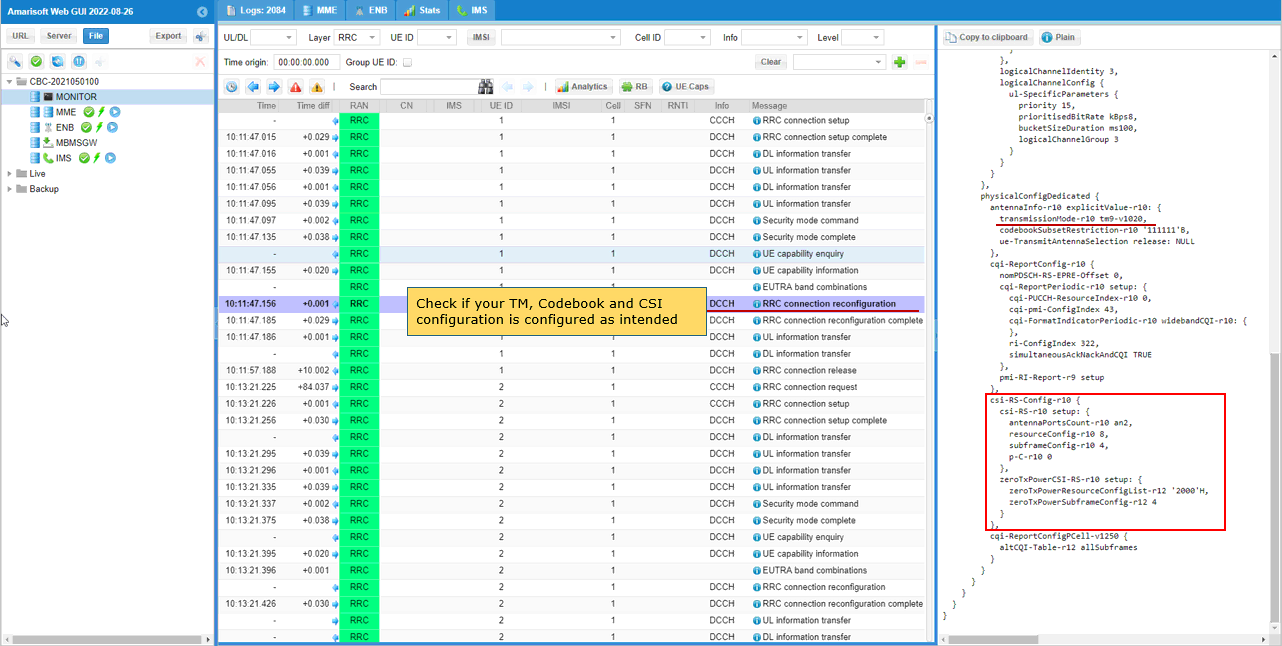
This step is optional, but it can make the lower layer log analysis much easier.
In this example, the log filter is used to select only the physical channels that are useful for this TM9 periodic CSI report test. The selected channels include DCCH, PDCCH, PDSCH, and PUSCH. By filtering the log this way, you can reduce unnecessary messages and focus only on the RRC configuration, downlink scheduling, downlink data transmission, and uplink feedback or data transmission.
DCCH is useful because it carries the RRC Connection Reconfiguration message. This is where you can check transmissionMode tm9-v1020, codebookSubsetRestriction-r10, cqi-ReportConfig, and csi-RS-Config-r10.
PDCCH is useful because it shows the downlink scheduling command from the eNB to the UE. This helps you check whether the UE is being scheduled properly after TM9 is configured.
PDSCH is useful because it shows the actual downlink shared channel transmission. In TM9, this is where UE-specific reference signal based downlink transmission can be observed together with the scheduling behavior.
PUSCH is useful because it can show uplink transmission and feedback-related behavior depending on how the UE sends control or data. For periodic CSI reporting, you may also need to check PUCCH if the report is carried on PUCCH. So the exact filter can be adjusted depending on what part of the lower layer behavior you want to analyze.
The main idea is simple. Filtering is not mandatory, but it helps you focus on the important logs. For this TM9 periodic CSI report test, the most useful information is the RRC configuration on DCCH, the scheduling on PDCCH, the downlink transmission on PDSCH, and the CSI or uplink related feedback path through PUCCH or PUSCH.
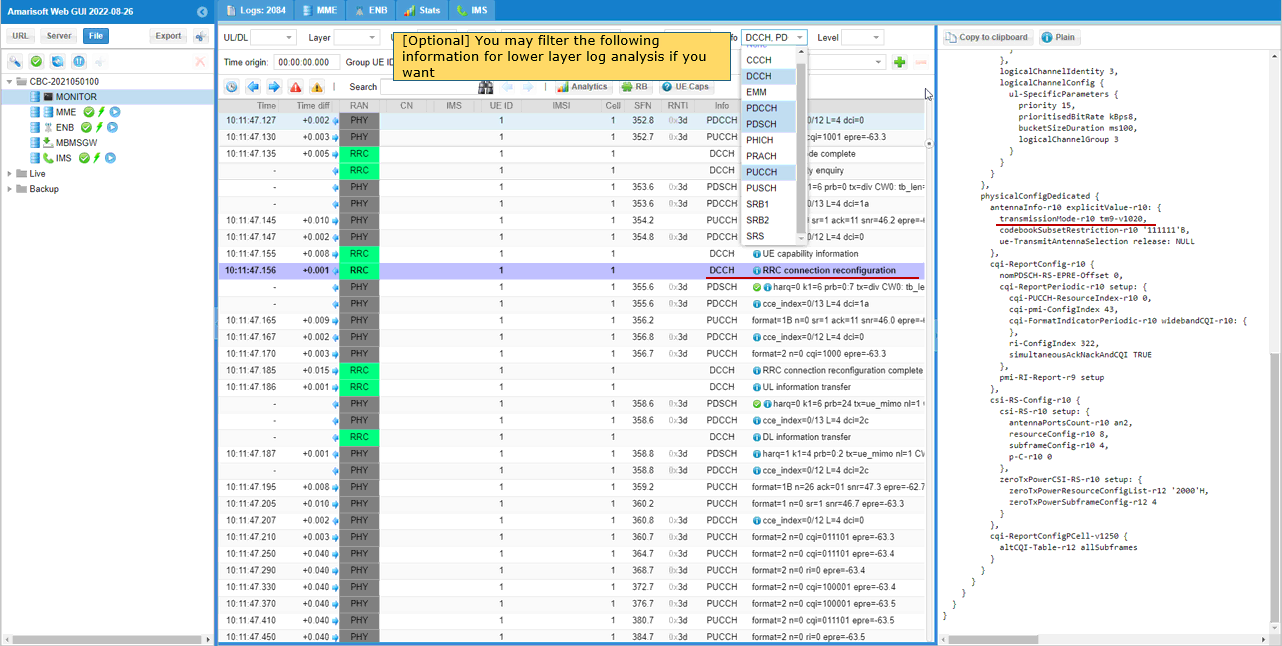
In this PHY log check, verify the DCI and PUCCH feedback for the TM9 2x2 MIMO periodic CSI report test.
In this example, the selected PDCCH message shows dci=2c. This is the key checkpoint for TM9. For TM9 scheduling, DCI Format 2C is used, so seeing dci=2c confirms that the eNB is using the expected downlink MIMO scheduling format for TM9.
On the right side, the decoded DCI shows the scheduling details. It includes resource_allocation_header, rb_alloc_bitmap, tpc_command, harq_process, mcs1, new_data_indicator1, rv_idx1, mcs2, new_data_indicator2, rv_idx2, and precoding_info. This means the eNB is scheduling downlink data with MIMO-related parameters.
The DCI also shows mcs1 and mcs2, which means two transport blocks are present in the scheduling information. This matches the purpose of the TM9 2x2 MIMO test, where two-layer transmission can be used depending on the UE feedback and channel condition.
The precoding_info field is also shown. In this example, precoding_info is set to 1. For TM9, this should be checked together with CSI feedback and CSI-RS based measurement configuration. Unlike TM3 and TM4, TM9 is tied more closely to CSI-RS and UE-specific reference signal based operation.
Next, check the PUCCH messages. In the log, PUCCH format2 entries are shown repeatedly with CQI values such as cqi=01000000. This confirms that the UE is sending periodic CSI feedback and that the eNB is receiving it. Since this test is for periodic CSI report, these periodic PUCCH format2 reports are important.
So this log confirms the expected TM9 behavior at the PHY level. The eNB schedules the UE using DCI Format 2C, the DCI contains MIMO scheduling information, and the UE sends periodic CSI feedback through PUCCH format2. Together with the RRC confirmation of transmissionMode tm9-v1020 and csi-RS-Config-r10, this confirms that TM9 2x2 MIMO with periodic CSI reporting is configured and operating as intended.
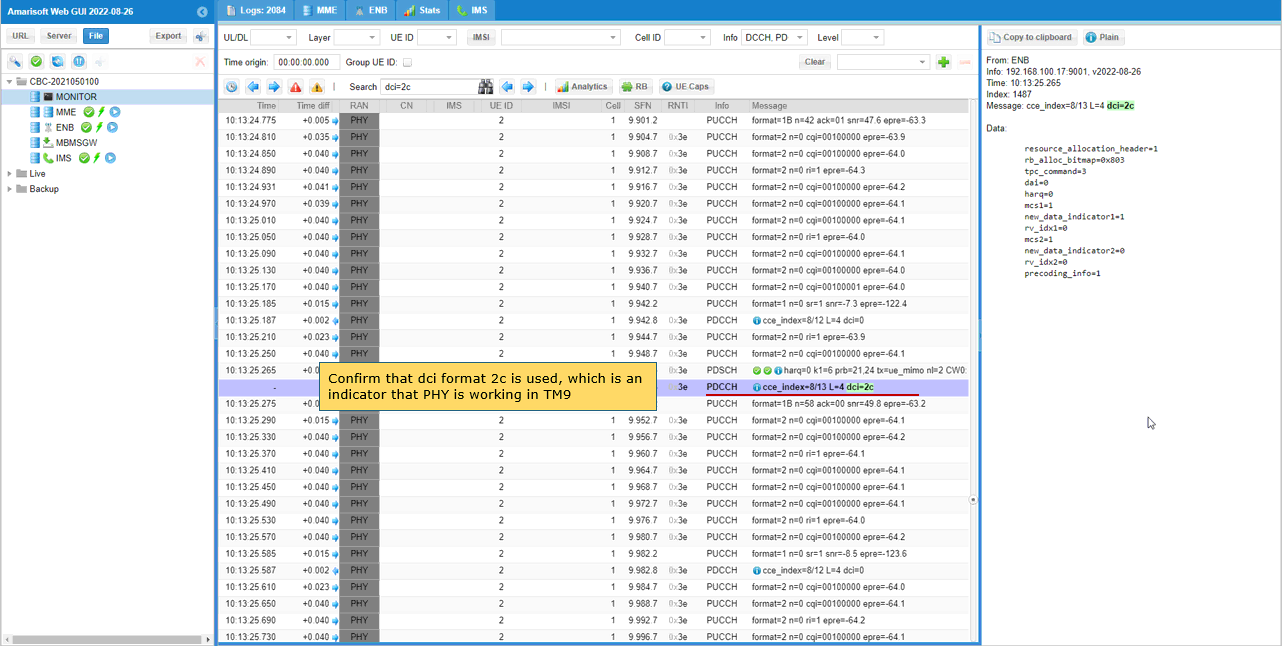
Test 7 : TM9 - 2x2 MIMO, Aperiodic CQI Report
This test is to show how to configure TM9 (Transmission Mode 9) with 2x2 MIMO and Aperiodic CQI Report and test it.
Configuration
I used the eNB configuration enb-tm9-2x2-ap.cfg which is copied from enb.default.cfg and modified for this tutorial.

I used the mme configuration mme-ims.cfg and ims configuration ims.default.cfg
In enb-tm9-2x2-ap.cfg , the configurations are set as follows.
This test is for TM9 with 2x2 MIMO and aperiodic CQI reporting. The basic cell configuration is almost the same as the previous TM9 periodic CSI report test.
TDD is set to 1. This means the LTE cell is configured as a TDD cell. This is why the later cell PHY check should show a TDD band, such as Band 41, and the same EARFCN for downlink and uplink.
N_RB_DL is set to 25, so the LTE bandwidth is 5 MHz. N_ANTENNA_DL is set to 2, so the eNB is configured with two downlink transmit antennas. This matches the 2x2 MIMO target of this test. N_ANTENNA_UL is set to 1, so the uplink uses one antenna.
CHANNEL_SIM is set to 0, so the channel simulator is disabled. NG_ENB is set to 0, so this is configured as a normal LTE eNB.
So the main point of this section is to prepare the basic LTE TDD 2x2 MIMO cell. The TM9-specific part and the aperiodic CQI report configuration are not fully shown in this first block. They should be checked in the following configuration sections, especially transmission_mode_opt, CSI-RS configuration, and the aperiodic CQI/CSI reporting setup.
In this part, configure the TM9 aperiodic CQI report related parameters inside the cell_default section.
The antenna configuration is the same as the previous TM9 test. n_antenna_dl is set to N_ANTENNA_DL, and n_antenna_ul is set to N_ANTENNA_UL. Since N_ANTENNA_DL is defined as 2, this cell is configured for 2x2 MIMO.
The scheduling request period is configured with sr_period set to 20 ms. This controls the periodicity of Scheduling Request resources used by the UE.
The important difference in this test is the CQI report configuration. cqi_period is set to 0. This disables periodic CQI reporting. This is required because this test is focused on aperiodic CQI reporting, not periodic CQI reporting.
Then the aperiodic CQI report is enabled and configured using ap_cqi_period, ap_cqi_rm, and ap_cqi_rm_opt. In this example, ap_cqi_period is set to 40. This defines the aperiodic CQI related scheduling period used by the eNB. ap_cqi_rm is set to rm20, and ap_cqi_rm_opt is set to rm31. These parameters define the reporting mode configuration used for aperiodic CQI reporting.
Since this test disables periodic CQI, m_ri is set to 0. This means the periodic RI reporting based on cqi_period is disabled as well. For this test, the focus is on CSI/CQI reporting triggered by the eNB rather than regular periodic reporting.
The TM9 configuration is applied in the same way as the previous TM9 test. transmission_mode is hardcoded to 3, and transmission_mode_opt is set to 9. This means TM9 operation is enabled through the optional transmission mode setting.
The additional TM9 related parameters are also configured. codebook_subset_restriction_opt is set to 111111, n_scid is set to 1, and ue_specific_port is set to 8. These parameters are related to the TM9 codebook restriction, scrambling identity, and UE-specific antenna port.
So the key point of this configuration is that periodic CQI is disabled by setting cqi_period to 0, and aperiodic CQI reporting is enabled through ap_cqi_period, ap_cqi_rm, and ap_cqi_rm_opt. TM9 itself is enabled by transmission_mode_opt: 9, together with codebook_subset_restriction_opt, n_scid, and ue_specific_port.
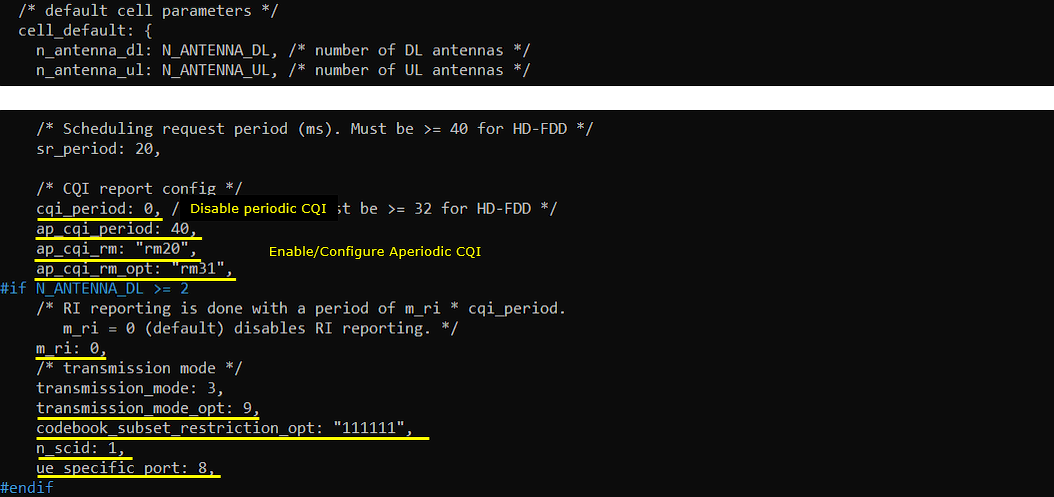
Configure csi_rs_nzp and csi_rs_zp in the same way as the previous TM9 periodic CSI report test.
In this example, csi_rs_nzp is configured as the non-zero-power CSI-RS resource. The period is set to 5 and the offset is set to 4. This defines when the CSI-RS is transmitted. The n_antenna value is set to 2, which matches the 2x2 MIMO target of this test. The resource_config is set to 8, and p_c is set to 0.
The csi_rs_zp section configures the zero-power CSI-RS resource. The period is also set to 5 and the offset is set to 4. The resource_config_list is set to 0x2000. This defines the muted CSI-RS resource pattern.
Even though this test uses aperiodic CQI reporting, CSI-RS configuration is still important. The UE needs CSI-RS to measure the downlink channel and generate the CSI information when the eNB triggers the aperiodic report.
So the main point of this section is that the CSI-RS measurement resources are configured for TM9 operation. csi_rs_nzp provides the actual CSI-RS signal for measurement, and csi_rs_zp defines the zero-power CSI-RS resource. Later, these values should be confirmed in RRC Connection Reconfiguration under csi-RS-Config-r10.
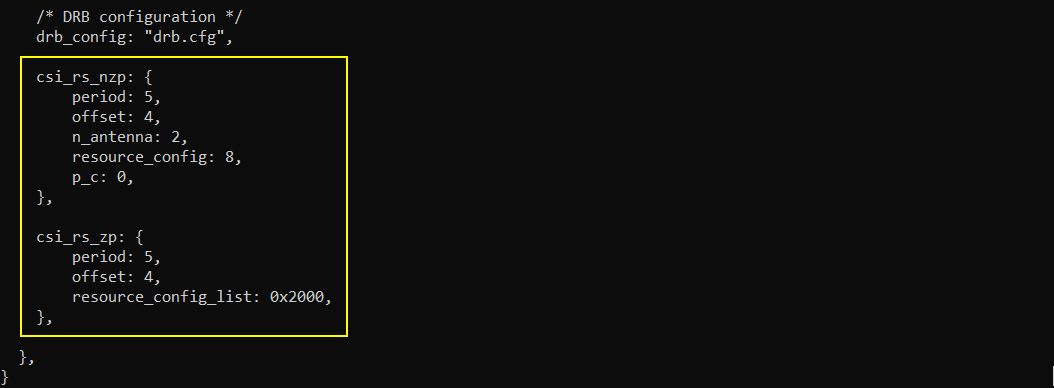
Run and Check
Now run the eNB and check the physical cell configuration.
In this example, the cell phy command is used from the eNB console. This command confirms the actual PHY configuration currently applied to the LTE cell.
The output shows cell 0x001 with RAT set to LTE. The LTE band is 41 and the bandwidth is 5 MHz. This matches the TDD configuration used for this TM9 aperiodic CQI report test.
In the downlink section, the EARFCN is 40620. The downlink antenna number is shown as 2. This confirms that the eNB is running with two downlink transmit antennas, which matches the 2x2 MIMO target of this test. The downlink SCS is 15 kHz and the downlink QAM value is 256.
In the uplink section, the EARFCN is also 40620. This is expected because this is a TDD cell, so downlink and uplink share the same carrier frequency. The uplink antenna number is 1, the uplink SCS is 15 kHz, and the uplink QAM value is 64.
So this result confirms that the basic PHY configuration is correct. The cell is running as a 5 MHz LTE TDD cell on Band 41 with two downlink antennas. The TM9-specific settings, CSI-RS configuration, and aperiodic CQI report configuration are not shown in this command output. They should be confirmed later from the RRC Connection Reconfiguration and lower layer logs.
After running the t command, power on the UE and check that the UE completes attach.
In this example, the PRACH line first shows cell=01, seq=3, ta=1, and snr=29.0 dB. This means the eNB successfully detected the UE random access preamble. After this, the trace shows UE_ID 1 with RNTI 003d, so the UE is connected to the LTE TDD cell.
The CQI value is around 7, and RI is shown as 1 in the first UE trace. This means the UE is reporting downlink channel quality and rank information, but this portion does not show rank 2 operation yet.
Later, another PRACH is detected with cell=01, seq=25, ta=1, and snr=28.3 dB. After this, the trace shows UE_ID 2 with RNTI 003e. In this second UE trace, RI is shown as 2. This is important for the TM9 2x2 MIMO test because RI 2 indicates that the UE is reporting two-layer reception capability.
The downlink MCS and bitrate values are relatively low in this trace. For example, the bitrate values include 7.35k, 1.05k, 8.58k, and 5.50k. This is acceptable at this step because the main purpose is not throughput measurement. The main purpose is to confirm attach and check that CQI/RI feedback is visible.
The uplink side also shows PUCCH SNR and uplink bitrate values. Since this test is for aperiodic CQI reporting, the next important check is not only the normal trace output, but also the RRC and PHY logs. In the next step, we need to confirm that periodic CQI is disabled, TM9 is configured, CSI-RS is configured, and the aperiodic CQI report is triggered and received as expected.
So this trace confirms that the UE completed attach and started reporting CQI and RI. The appearance of RI 2 confirms that the 2x2 MIMO condition is reflected at runtime.
Log Analysis
In this log analysis step, check the physicalConfigDedicated IE inside the RRC Connection Reconfiguration message.
For this TM9 aperiodic CQI report test, this message is used to confirm that the UE is configured with TM9, codebook restriction, aperiodic CQI reporting, and CSI-RS resources.
In this example, physicalConfigDedicated includes antennaInfo with explicitValue-r10. Inside antennaInfo, transmissionMode is set to tm9-v1020. This confirms that the UE is configured for LTE Transmission Mode 9.
The same antennaInfo section also shows codebookSubsetRestriction-r10 set to 111111. This matches the codebook_subset_restriction_opt value configured earlier. ue-TransmitAntennaSelection is set to release.
Next, check cqi-ReportConfig. In this example, cqi-ReportPeriodic is set to release. This is important because periodic CQI reporting was disabled by setting cqi_period to 0 in the configuration file.
Instead of periodic reporting, cqi-ReportModeAperiodic is configured as rm31. This confirms that aperiodic CQI reporting is enabled. This matches the configured ap_cqi_rm_opt value.
The csi-RS-Config-r10 section is also present. csi-RS-r10 is set to setup. The antennaPortsCount is set to an2, which matches the 2x2 MIMO target. resourceConfig is set to 8, subframeConfig is set to 4, and p-C is set to 0. These values match the csi_rs_nzp configuration.
The zero-power CSI-RS configuration is also shown. zeroTxPowerCSI-RS-r10 is set to setup, zeroTxPowerResourceConfigList-r10 is set to 2000H, and zeroTxPowerSubframeConfig-r10 is set to 4. This matches the csi_rs_zp configuration.
So this log confirms that the intended TM9 aperiodic CQI configuration is delivered to the UE. The key checkpoints are transmissionMode tm9-v1020, cqi-ReportPeriodic release, cqi-ReportModeAperiodic rm31, and csi-RS-Config-r10 with antennaPortsCount an2, resourceConfig 8, subframeConfig 4, and zero-power CSI-RS configuration.
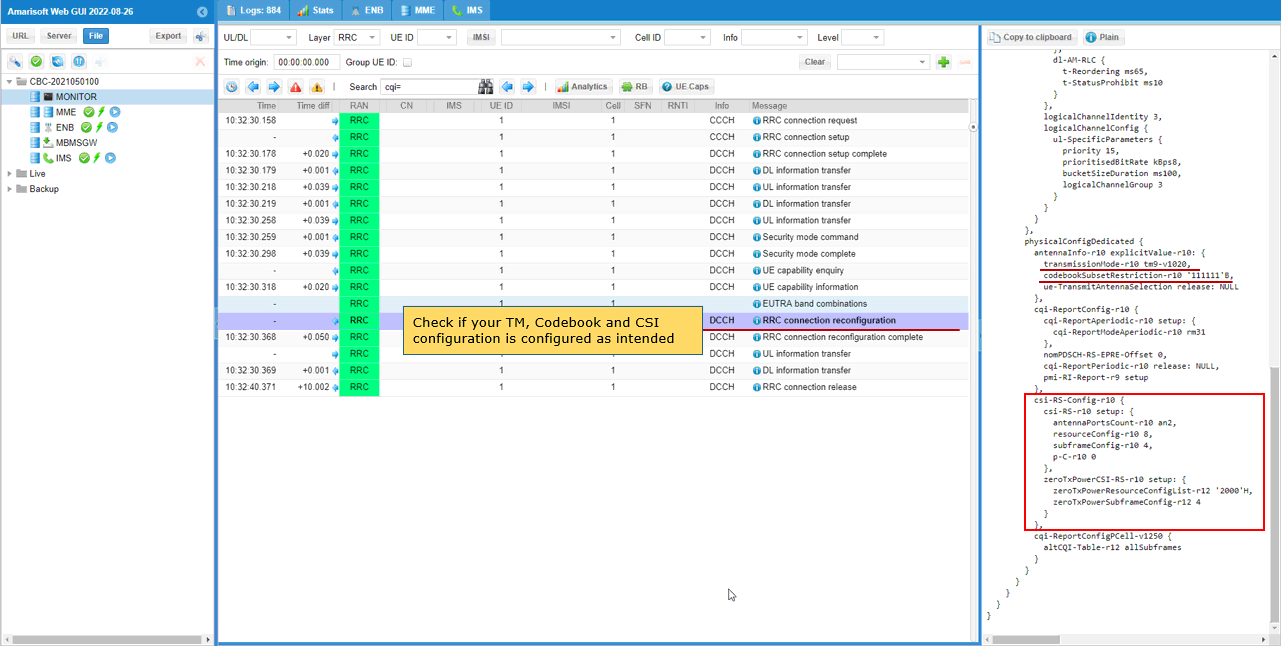
In this PHY log check, verify both TM9 downlink scheduling and aperiodic CSI report triggering.
For TM9, the downlink scheduling should use DCI Format 2C. In this example, the PDCCH message shows dci=2c. This confirms that the eNB is using the expected TM9 scheduling format. DCI 2C is one of the important PHY-level indicators that TM9 is working.
For the aperiodic CSI report case, you should also check the uplink grant. In this example, the selected DCI message is an uplink grant with dci=0. On the right side, the decoded DCI shows csi_request=1. This is the key checkpoint for aperiodic CSI reporting.
csi_request=1 means the eNB is explicitly requesting the UE to send a CSI report. This is different from the periodic CSI report case, where the UE sends CSI at configured periodic occasions. In the aperiodic case, the UE sends the report only when it is triggered by the eNB through the uplink grant.
After this trigger, you should check the following uplink transmission. In the log, PUSCH appears after the DCI 0 trigger. This indicates that the UE sends the requested uplink information on PUSCH. For this test, this is where the aperiodic CSI/CQI report is carried.
So this log confirms the two main PHY-level behaviors for TM9 aperiodic CQI reporting. First, TM9 downlink scheduling is active because DCI Format 2C is used. Second, aperiodic CSI reporting is triggered because the uplink DCI 0 contains csi_request=1. This matches the RRC configuration where periodic CQI was released and aperiodic reporting mode rm31 was configured.
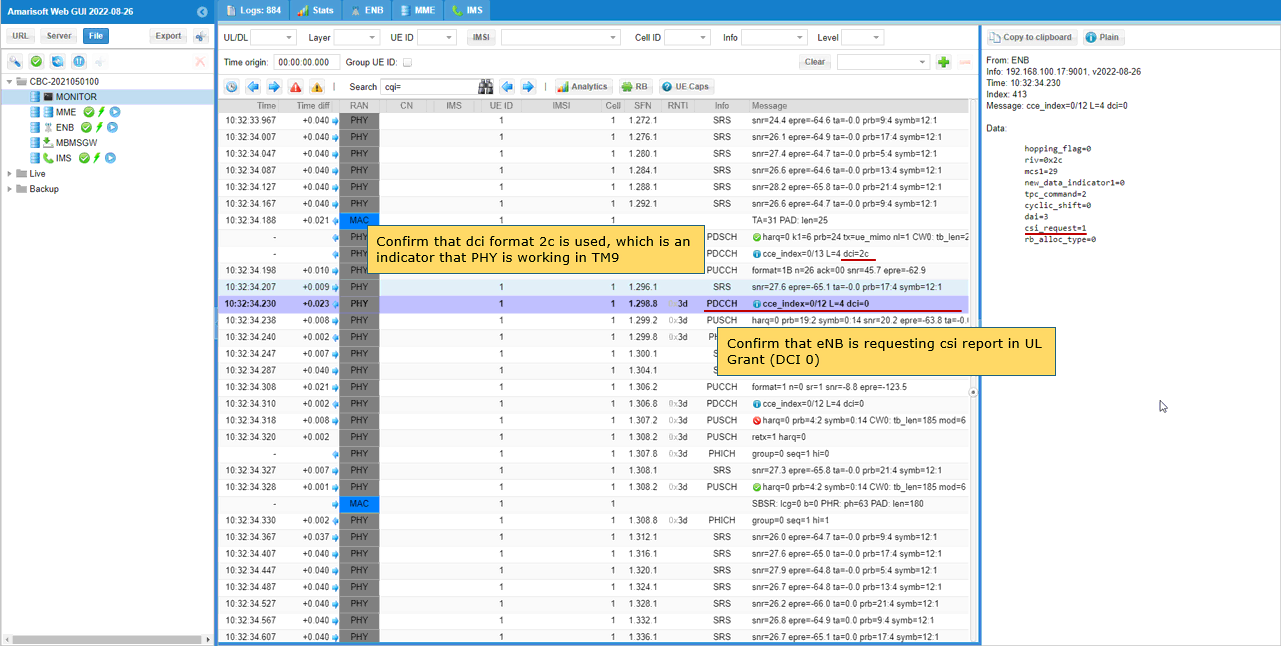
For aperiodic CQI reporting, the UE reports CQI through PUSCH, not PUCCH.
This is an important difference from the periodic CSI report case. In the periodic case, the UE sends CSI feedback at configured reporting occasions, usually through PUCCH format 2. In the aperiodic case, the eNB first triggers the report using an uplink grant, and then the UE sends the requested CQI/CSI information on PUSCH.
In this example, after the uplink DCI 0 includes csi_request=1, the following PUSCH log shows the UE response. The decoded PUSCH information includes cqi=1000000000000001. This confirms that the UE is carrying the aperiodic CQI report on PUSCH.
So the full flow is as follows. The eNB sends DCI 0 with csi_request=1. This tells the UE to report CSI. Then the UE sends the requested CQI/CSI information on PUSCH. This confirms that the aperiodic CQI reporting mechanism is working as expected.
For this test, the key point is not to look for periodic CQI on PUCCH. Since periodic CQI was disabled and aperiodic CQI was enabled, the expected report path is PUSCH.
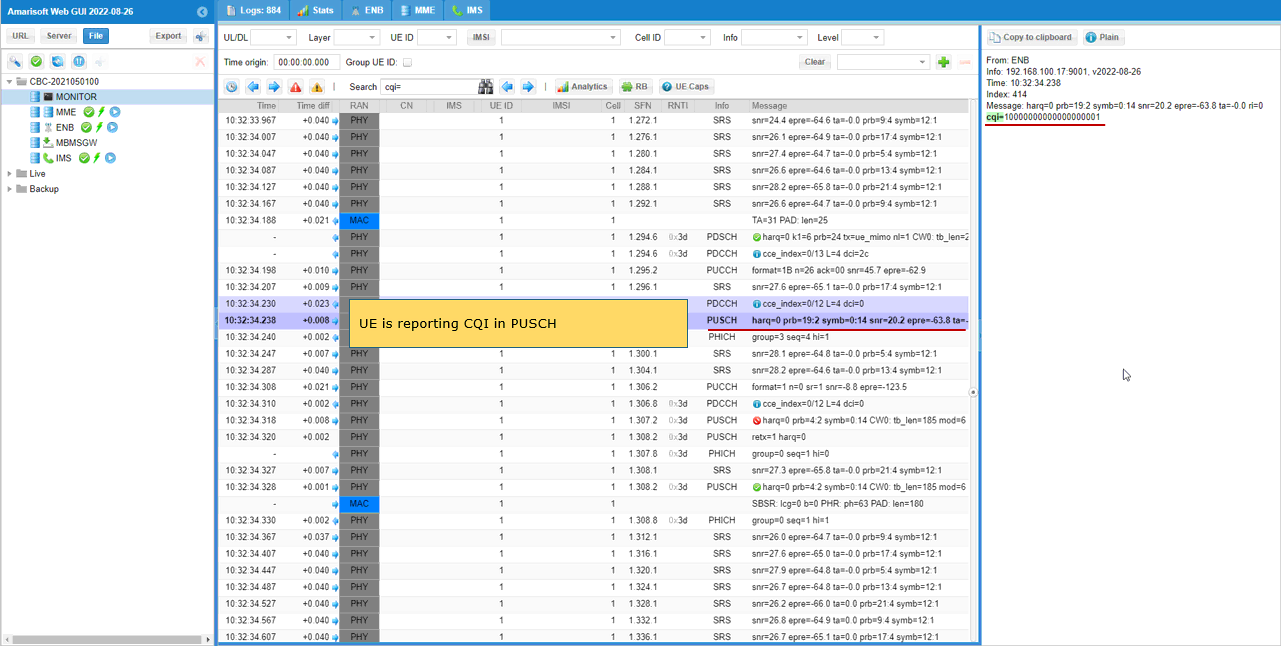
Test 8 : TM10 - 2x2 MIMO, Periodic CSI Report
This test is to show how to configure TM10 (Transmission Mode 10) with 2x2 MIMO and Periodic CSI Report and test it.
Configuration
I used the eNB configuration enb-tm10-2x2.cfg which is copied from enb.default.cfg and modified for this tutorial.

I used the mme configuration mme-ims.cfg and ims configuration ims.default.cfg
In enb-tm10-2x2.cfg , the configurations are set as follows.
This test is for TM10 with 2x2 MIMO and periodic CSI reporting. The basic configuration is similar to the previous TM9 test because TM10 also depends on CSI-RS and CSI reporting.
TDD is set to 1. This means the LTE cell is configured as TDD. So later, when you check the running cell with cell phy, the downlink and uplink EARFCN should be the same.
N_RB_DL is set to 25, so the LTE bandwidth is 5 MHz. N_ANTENNA_DL is set to 2, so the eNB is configured with two downlink transmit antennas. This matches the 2x2 MIMO target of this test. N_ANTENNA_UL is set to 1, so the uplink uses one antenna.
CHANNEL_SIM is set to 0, so the channel simulator is disabled. NG_ENB is set to 0, so this is configured as a normal LTE eNB.
So this first configuration block prepares the basic LTE TDD 2x2 MIMO cell. The TM10-specific part is not fully shown in this block yet. It should be configured in the following sections, especially the transmission mode optional setting, CSI-RS configuration, and periodic CSI report configuration.
In this part, configure the TM10 related transmission mode parameters inside the cell_default section.
The antenna configuration is based on the predefined constants. n_antenna_dl is set to N_ANTENNA_DL, and n_antenna_ul is set to N_ANTENNA_UL. Since N_ANTENNA_DL is defined as 2, the cell is configured for 2x2 MIMO.
RI reporting is enabled because N_ANTENNA_DL is greater than or equal to 2. In this example, m_ri is set to 4. This means RI reporting is configured with a period based on m_ri and cqi_period. This allows the UE to report the preferred transmission rank for MIMO operation.
The transmission mode configuration is similar to the previous TM9 example. transmission_mode is hardcoded to 3, but transmission_mode_opt is set to 10. This is the key point for this test. It means the optional transmission mode is configured as TM10.
The codebook_subset_restriction_opt parameter is set to 111111. This defines the codebook subset restriction used with the optional transmission mode configuration.
The n_scid parameter is set to 1. This is related to the scrambling identity used for UE-specific reference signal based transmission.
The ue_specific_port parameter is set to 8. This means UE-specific antenna port 8 is used. This is important because TM10 also relies on UE-specific reference signal and CSI-RS based operation.
So the main point of this section is that TM10 is enabled by setting transmission_mode_opt to 10. The other related parameters, such as codebook_subset_restriction_opt, n_scid, and ue_specific_port, define the supporting configuration for TM10 operation.
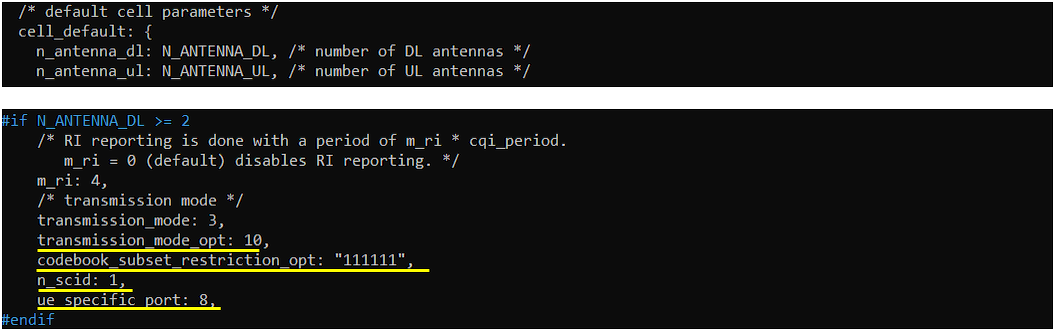
Configure the CSI-RS related resources for the TM10 periodic CSI report test.
In this example, three CSI-related sections are configured: csi_rs_nzp, csi_rs_zp, and csi_im.
First, csi_rs_nzp configures the non-zero-power CSI-RS resource. The period is set to 20 and the offset is set to 4. The n_antenna value is set to 2, which matches the 2x2 MIMO target of this test. resource_config is set to 8, and p_c is set to 0. This NZP CSI-RS is used by the UE to measure the downlink channel and generate CSI feedback.
Next, csi_rs_zp configures the zero-power CSI-RS resource. The period is also set to 20 and the offset is set to 4. The resource_config_list is set to 0x2000. This defines the muted CSI-RS resource pattern.
The additional section for this TM10 test is csi_im. This configures the CSI interference measurement resource. The period is set to 20, the offset is set to 4, and resource_config is set to 2. This is important for TM10 because TM10 can use CSI process based configuration, where the UE may measure both channel and interference resources to generate CSI feedback.
So the key difference from the previous TM9 example is the addition of csi_im. For TM10, you should check not only NZP CSI-RS and ZP CSI-RS, but also CSI-IM configuration. Later in the RRC log, these values should appear in the CSI-RS and CSI process related configuration.
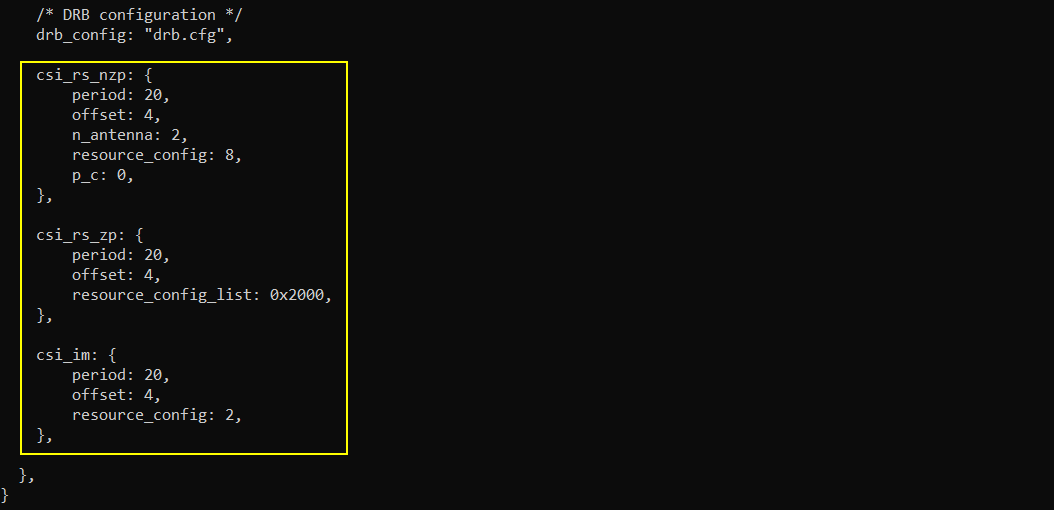
Run and Check
Now run the eNB and check the physical cell configuration.
In this example, the cell phy command is used from the eNB console. This command confirms the actual PHY configuration currently applied to the LTE cell.
The output shows cell 0x001 with RAT set to LTE. The LTE band is 41 and the bandwidth is 5 MHz. This matches the TDD configuration used for this TM10 periodic CSI report test.
In the downlink section, the EARFCN is 40620. The downlink antenna number is shown as 2. This confirms that the eNB is running with two downlink transmit antennas, which matches the 2x2 MIMO target of this test. The downlink SCS is 15 kHz and the downlink QAM value is 256.
In the uplink section, the EARFCN is also 40620. This is expected for LTE TDD because uplink and downlink use the same carrier frequency. The uplink antenna number is 1, the uplink SCS is 15 kHz, and the uplink QAM value is 64.
So this result confirms that the basic PHY configuration is correct. The cell is running as a 5 MHz LTE TDD cell on Band 41 with two downlink antennas. The TM10-specific configuration, CSI-RS, CSI-IM, and periodic CSI report configuration are not shown in this command output. They should be confirmed later from RRC Connection Reconfiguration and lower layer logs.
After running the t command, power on the UE and check that the UE completes attach.
In this example, the PRACH line shows cell=01, seq=3, ta=1, and snr=29.0 dB. This means the eNB successfully detected the UE random access preamble. After this, the trace shows UE_ID 1 with RNTI 003d, so the UE is connected to the LTE TDD cell.
The CQI value is around 7 or 8 in the first UE trace, and RI is shown as 1. This means the UE is reporting downlink channel quality and rank information. Later, another PRACH is detected with seq=25, ta=1, and snr=28.3 dB, and the trace shows UE_ID 2 with RNTI 003e. In this second UE trace, RI is shown as 2. This is important for the TM10 2x2 MIMO test because RI 2 means the UE is reporting two-layer reception capability.
The downlink MCS and bitrate values are relatively low in this trace, such as 1.75k, 1.05k, and 8.58k. This is acceptable at this stage because the purpose of this step is not to measure maximum throughput. The purpose is to confirm that the UE attaches successfully and starts reporting CQI and RI.
The uplink side also shows PUCCH SNR and uplink bitrate values. Since this test uses periodic CSI reporting, the next important step is to check the RRC and PHY logs. In RRC, we need to confirm TM10, CSI-RS, CSI-IM, and CSI report configuration. In PHY logs, we need to confirm that periodic CSI feedback is received as expected.
So this trace confirms that the UE completed attach and started normal radio operation. The appearance of RI 2 confirms that the 2x2 MIMO condition is reflected at runtime.
Log Analysis
In this log analysis step, check the physicalConfigDedicated IE inside the RRC Connection Reconfiguration message.
For TM10, this message is important because it confirms the TM10 transmission mode, the CQI report configuration, and the CSI-RS related configuration delivered to the UE.
In this example, physicalConfigDedicated includes antennaInfo with explicitValue-r10. Inside antennaInfo, transmissionMode is set to tm10-v1130. This confirms that the UE is configured for LTE Transmission Mode 10.
The same antennaInfo section also shows codebookSubsetRestriction-r10 set to 111111. This matches the codebook_subset_restriction_opt value configured earlier. ue-TransmitAntennaSelection is set to release.
Next, check cqi-ReportConfig. The cqi-ReportPeriodic field is configured as setup. cqi-PUCCH-ResourceIndex is set to 0, and cqi-pmi-ConfigIndex is set to 45. The cqi-FormatIndicatorPeriodic is set to widebandCQI-r10. This means the UE is configured to send periodic wideband CQI/PMI feedback. The ri-ConfigIndex is set to 322, so RI reporting is also configured.
The TM10-specific CSI configuration is shown in csi-RS-ConfigNZPToAddModList-r11 and csi-RS-ConfigZPToAddModList-r11. In the NZP CSI-RS configuration, csi-RS-ConfigNZPId-r11 is set to 1, antennaPortsCount-r11 is set to an2, resourceConfig-r11 is set to 8, subframeConfig-r11 is set to 19, and qcl-CRS-Info-r11 is configured. This confirms that the non-zero-power CSI-RS resource for 2 antenna ports is delivered to the UE.
The zero-power CSI-RS configuration is also present. csi-RS-ConfigZPId-r11 is set to 1, resourceConfigList-r11 is set to 2000H, and subframeConfig-r11 is set to 19. This matches the zero-power CSI-RS configuration from the eNB configuration.
So this log confirms that TM10 periodic CSI reporting is configured as intended. The key checkpoints are transmissionMode tm10-v1130, cqi-ReportPeriodic setup, cqi-pmi-ConfigIndex 45, ri-ConfigIndex 322, NZP CSI-RS with antennaPortsCount an2 and resourceConfig 8, and ZP CSI-RS with resourceConfigList 2000H.
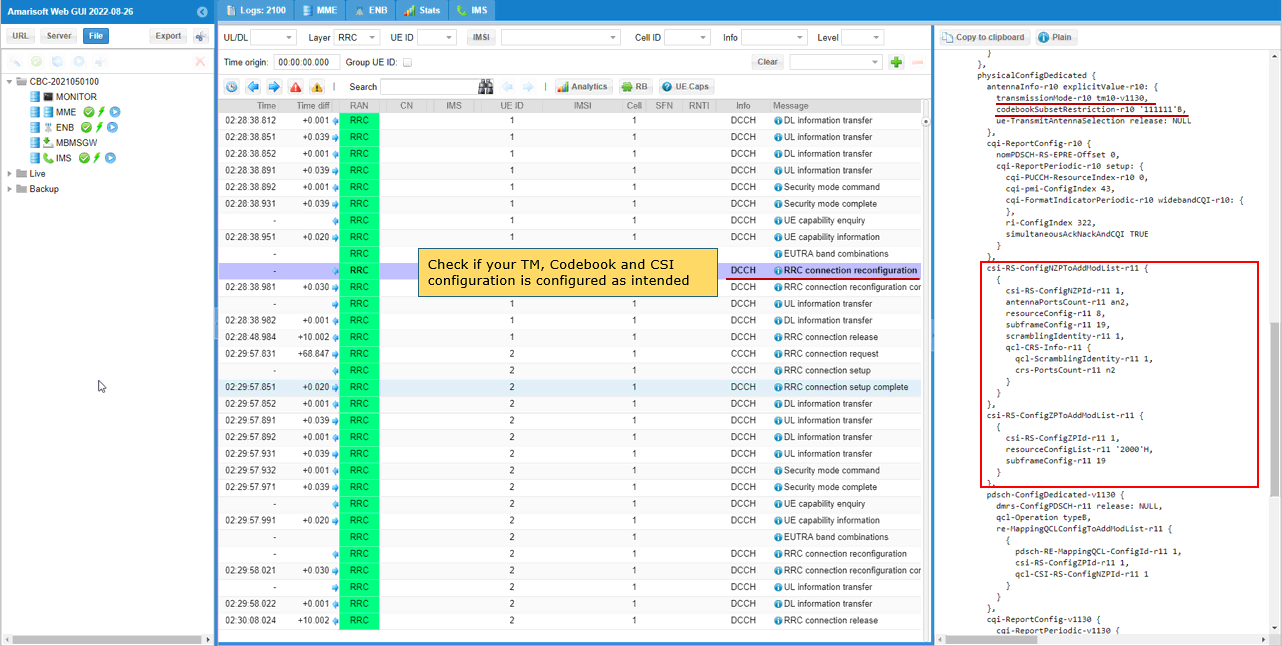
In this additional RRC check, verify the TM10 transmission mode and CSI report configuration in more detail.
In this example, the RRC Connection Reconfiguration message shows physicalConfigDedicated with antennaInfo set to explicitValue-r10. Inside antennaInfo, transmissionMode is set to tm10-v1130. This confirms that the UE is configured for LTE Transmission Mode 10.
The same section also shows codebookSubsetRestriction-r10 set to 111111. This matches the optional codebook subset restriction configured in the eNB configuration file. This means the TM10 codebook restriction is delivered to the UE.
Next, check the CSI report configuration under cqi-ReportConfig-v1130. In this example, cqi-ReportBothProc-r11 is shown. This is important for TM10 because TM10 uses CSI process based reporting. The UE may report CSI based on configured CSI processes rather than only the older single CSI reporting structure.
The csi-IM-ConfigToAddModList-r11 section shows csi-IM-ConfigId-r11 set to 1, resourceConfig-r11 set to 2, and subframeConfig-r11 set to 19. This matches the csi_im configuration in the eNB configuration file. It confirms that the CSI interference measurement resource is delivered to the UE.
The csi-ProcessToAddModList-r11 section shows csi-ProcessId-r11 set to 1. It also links csi-RS-ConfigNZPId-r11 to 1 and csi-IM-ConfigId-r11 to 1. This means the CSI process is built from the configured NZP CSI-RS resource and CSI-IM resource.
Inside p-C-AndCBSRList-r11, p-C-r11 is set to 0 and codebookSubsetRestriction-r11 is set to 111111B. This confirms that the CSI process also carries the intended power and codebook subset restriction information.
Finally, cqi-ReportBothProc-r11 shows nrof-CSI-Processes-r11 set to 1 and pmi-RI-Report-r11 set to setup. This confirms that PMI and RI reporting are enabled for the configured CSI process.
So this log confirms the TM10-specific CSI report structure. The key checkpoints are transmissionMode tm10-v1130, csi-IM-ConfigId 1, resourceConfig 2, subframeConfig 19, csi-ProcessId 1, csi-RS-ConfigNZPId 1, csi-IM-ConfigId 1, codebookSubsetRestriction 111111B, and pmi-RI-Report setup. This confirms that TM10 periodic CSI reporting is configured through the CSI process based structure.
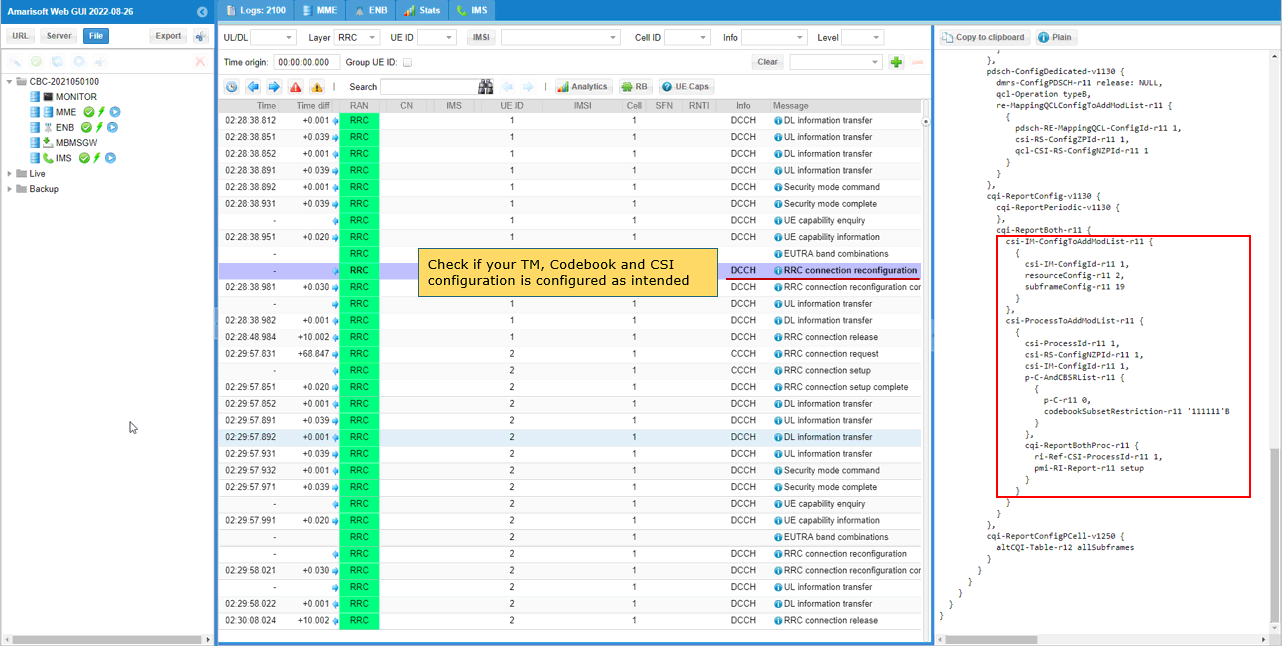
This filtering step is optional, but it is useful for lower layer log analysis.
In this example, the log display filter is used to select only the physical channels that are useful for the TM10 periodic CSI report test. The selected items include DCCH, PDCCH, PDSCH, and PUSCH.
DCCH is useful because it carries the RRC Connection Reconfiguration message. This is where you can check the TM10 configuration, including transmissionMode tm10-v1130, cqi-ReportConfig, CSI-RS configuration, CSI-IM configuration, and CSI process configuration.
PDCCH is useful because it shows the downlink and uplink scheduling commands. For TM10, this helps you check whether the expected DCI format is used and whether the UE is being scheduled correctly.
PDSCH is useful because it shows the actual downlink shared channel transmission. This helps you confirm that downlink data transmission is active after the TM10 configuration is applied.
PUSCH is useful because it shows uplink transmission. Depending on the CSI reporting mode and scheduling behavior, uplink information or CSI-related feedback may be visible through this channel.
So this step is mainly for convenience. Filtering is not mandatory, but it reduces unnecessary messages and makes it easier to focus on the important parts of the test. For TM10 periodic CSI report analysis, the main things to check are the RRC configuration on DCCH, the scheduling on PDCCH, the downlink transmission on PDSCH, and the uplink behavior on PUSCH or PUCCH depending on where the feedback is carried.
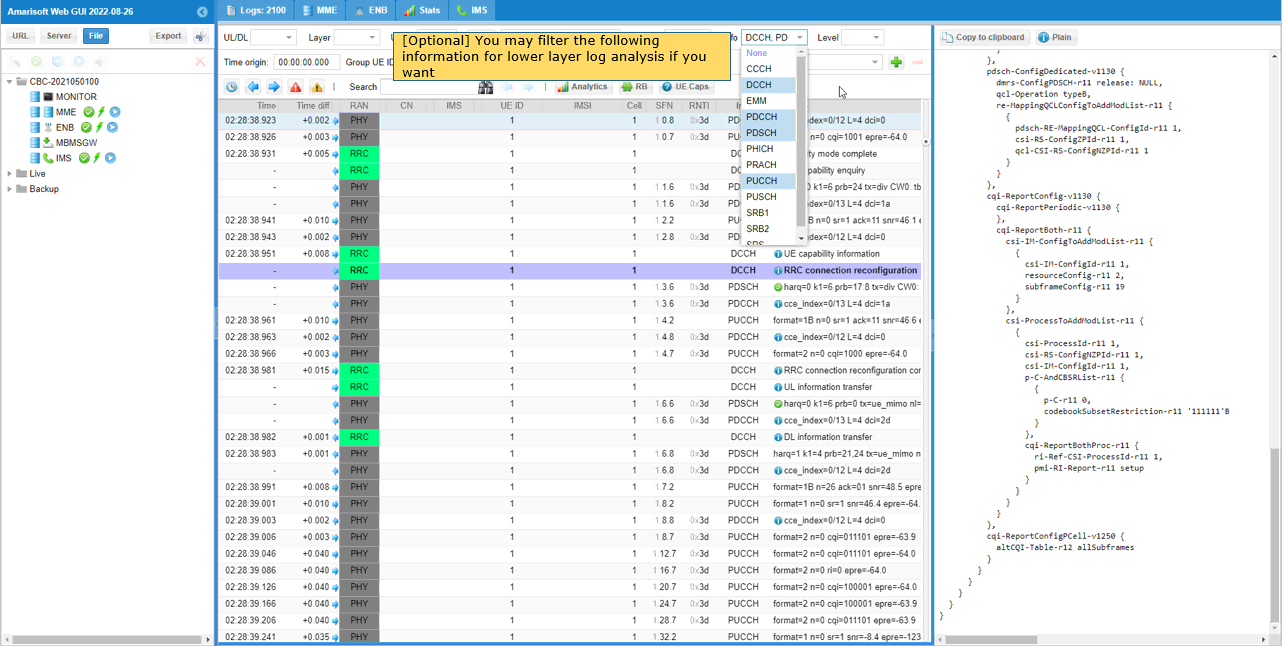
In this PHY log check, verify the DCI and PUCCH feedback for the TM10 2x2 MIMO periodic CSI report test.
For TM10, the downlink scheduling should use DCI Format 2D. In this example, the selected PDCCH message shows dci=2d. This is the key PHY-level checkpoint for TM10. It confirms that the eNB is using the expected downlink scheduling format for TM10 operation.
On the right side, the decoded DCI shows the scheduling information. It includes resource_allocation_header, rb_alloc_bitmap, tpc_command, dai, harq_process, mcs1, new_data_indicator1, rv_idx1, mcs2, new_data_indicator2, and rv_idx2. This means the eNB is scheduling downlink transmission with MIMO-related parameters.
The DCI also shows precoding_info and pdsch_re_mapping_qcl. These are important for TM10 because TM10 is based on CSI-RS and CSI process related configuration. The eNB uses this information together with the configured CSI-RS, CSI-IM, and CSI process settings.
Next, check the PUCCH messages. In this example, repeated PUCCH format2 entries are shown with CQI values such as cqi=111101, cqi=011101, cqi=101101, and cqi=101001. This indicates that the UE is sending periodic CSI feedback and that the eNB is receiving it as expected.
So this log confirms the expected TM10 behavior at the PHY level. The eNB schedules the UE using DCI Format 2D, the DCI includes TM10-related scheduling and precoding information, and the UE sends periodic CSI feedback through PUCCH format2. Together with the RRC confirmation of transmissionMode tm10-v1130, CSI-RS, CSI-IM, and CSI process configuration, this confirms that TM10 2x2 MIMO with periodic CSI reporting is configured and operating as intended.
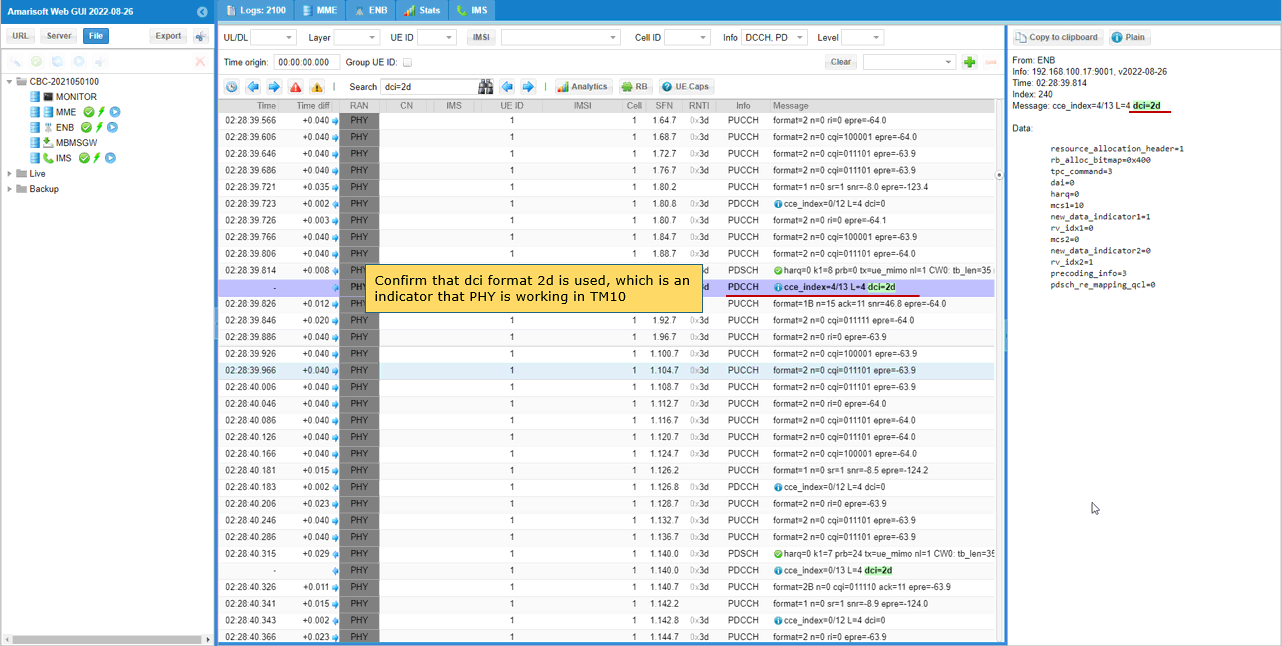
RRC / NAS Signaling
RrcConnectionReconfiguration
: This is the RrcConnectionReconfigurationmessage sent by eNB to configure Transmission Mode. (
{
message c1: rrcConnectionReconfiguration: {
rrc-TransactionIdentifier 0,
criticalExtensions c1: rrcConnectionReconfiguration-r8: {
dedicatedInfoNASList {
'...'H
},
radioResourceConfigDedicated {
srb-ToAddModList {
...
},
physicalConfigDedicated {
antennaInfo-r10 explicitValue-r10: {
transmissionMode-r10 tm4,
codebookSubsetRestriction-r10 '0001AAABFFFFFFFF'H,
ue-TransmitAntennaSelection release: NULL
},
cqi-ReportConfig-r10 {
...
},
cqi-ReportConfigPCell-v1250 {
...
}
},
drb-ToAddModList-r15 {
{
...
}
}
},